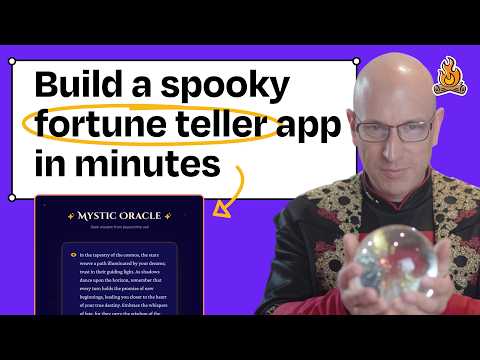
Vibe-coding a kid-friendly AI fortune teller for your Halloween festivities | Marco Casalaina
Claire Vo (host), Marco Casalaina (guest)
In this episode of How I AI, featuring Claire Vo and Marco Casalaina, Vibe-coding a kid-friendly AI fortune teller for your Halloween festivities | Marco Casalaina explores building a kid-friendly AI fortune teller app with GitHub Spark A technical hiccup (“haunted” by expired corporate credit cards) turns the episode into a short, improvised Halloween vibe-coding session.
Building a kid-friendly AI fortune teller app with GitHub Spark
A technical hiccup (“haunted” by expired corporate credit cards) turns the episode into a short, improvised Halloween vibe-coding session.
Marco Casalaina demonstrates GitHub Spark by generating a simple mobile-friendly fortune teller app that creates a new fortune on button tap, starting from a minimal prompt.
They iteratively refine the output via prompting—shortening fortunes, making them kid-friendly, then pushing for more concrete, humorous, simpler-language predictions suitable for toddlers.
Marco also briefly contrasts quick demos with “serious” work, recommending Spec Kit to pressure-test requirements by asking clarifying questions and producing stronger feature specs.
Key Takeaways
Start with the smallest prompt that can work.
Marco begins with a one-line ask (“Make a mobile app… generates a new fortune”), letting the tool scaffold a PRD and UI quickly before refining details.
Get the full analysis with uListen AI
Use iterative prompting to shape tone and audience fit.
They progressively constrain the model: one sentence, kid-friendly, more concrete, more humorous, and simpler vocabulary—showing how small edits steer outputs fast.
Get the full analysis with uListen AI
Abstract “mystic” fortunes are easy; kid-friendly usefulness requires specificity.
The first fortune is poetic but meaningless; the improved versions become actionable and playful (e. ...
Get the full analysis with uListen AI
Watch for repetitive patterns and test outputs like a product.
When multiple fortunes start repeating “shiny rock” variations, Marco calls out the need to “integration test these things,” highlighting quality checks even in lightweight demos.
Get the full analysis with uListen AI
Real projects benefit from structured spec workflows, not just vibe coding.
Marco recommends Spec Kit for complex features because it interrogates ambiguous requirements (length limits, edge cases) and helps produce a robust spec before implementation.
Get the full analysis with uListen AI
Vibe-coded prototypes can be extended into real experiences (voice, ambience).
Claire plans to add a spooky voice layer for a block party, illustrating how quick apps become delightful demos when paired with simple UX enhancements.
Get the full analysis with uListen AI
Notable Quotes
“So why don't we not just talk about it, why don't we actually do it?”
— Marco Casalaina
“Oh, my gosh… it made a PRD.”
— Claire Vo
“‘In the tapestry of the cosmos…’ Now, what I like about this is it is completely ambiguous and means nothing.”
— Claire Vo
“You gotta, like, integration test these things. Are these all rocks?”
— Marco Casalaina
“When I'm doing real… projects… I will 100% use SpecKit.”
— Marco Casalaina
Questions Answered in This Episode
In GitHub Spark, what prompt details most influence whether it generates a PRD first versus jumping straight into code/UI?
A technical hiccup (“haunted” by expired corporate credit cards) turns the episode into a short, improvised Halloween vibe-coding session.
Get the full analysis with uListen AI
What specific prompt patterns help reduce repetition (like the recurring “rock” motif) in short-form generations such as fortunes?
Marco Casalaina demonstrates GitHub Spark by generating a simple mobile-friendly fortune teller app that creates a new fortune on button tap, starting from a minimal prompt.
Get the full analysis with uListen AI
How would you design a “kid-age slider” (toddler to teen) so the app reliably changes vocabulary complexity and humor style?
They iteratively refine the output via prompting—shortening fortunes, making them kid-friendly, then pushing for more concrete, humorous, simpler-language predictions suitable for toddlers.
Get the full analysis with uListen AI
What safety constraints would you add to prevent scary, sensitive, or overly predictive fortunes (e.g., health, family, death) for children?
Marco also briefly contrasts quick demos with “serious” work, recommending Spec Kit to pressure-test requirements by asking clarifying questions and producing stronger feature specs.
Get the full analysis with uListen AI
Can Spec Kit be used to define a test plan for generative outputs—like diversity, readability grade level, and “no repeats” checks—before coding?
Get the full analysis with uListen AI
Transcript Preview
Welcome to a spooky and unplanned Halloween edition of How I AI. I'm Claire Vo, product leader and AI obsessive, here on a mission to help you use LLMs to do spooky stuff for your kids. Today, we had a haunted episode recording that we couldn't get to work, so instead of our regular scheduled programming, we did a quick Halloween vibe code that I think some of you parents out there will be inspired by. If you have other Halloween vibe codes, please share them with us in the comments, and enjoy this very short episode of How I AI: Halloween Edition. [upbeat music] Marco, we may, we may not be able to do our podcast today. We are haunted by-
We are haunted
... expired cr- ex- expired corporate credit cards. But you have a, a Halloween-based AI use case [chuckles] we're gonna talk about instead, just for a few minutes before we reschedule.
I do, I do, and maybe I'll, I'll kind of do it live on the fly here.
Yeah.
And so why don't we, why don't we not just talk about it, why don't we actually do it? So I'm dressed as Captain Picard right now, uh, as I do every year, dressed as Captain Picard. I mean, it naturally fits with my-
fits
... you know-
Brand
- brand and stuff like that. Of course, I am a huge Star Trek fan. I'm in the middle of Strange New Worlds right now, Season 4. But, uh, by night, at least for Halloween, I do something a little bit different. I am the block fortune teller. So this is the Halloween party block that I live on here in Piedmont, California, and so we will block off the street, and all of our neighbors do crazy stuff. And so, you know, my neighbor across the street is gonna have all this projection stuff going on, and they have, like, fire coming out of something and... But what I do, well, I am a fortune teller. So traditionally, uh, what I have done for the past few years is that I have pre-created fortunes. So I set up this table, and on this table, uh, I have a, a, a crystal ball, and the crystal ball glows and stuff like that. It's not a high-tech crystal ball. It has nothing but a couple of LED lights in it, but the kids come up, and there's lots of kids in town, you know, hundreds of them really, come up, and they, they will get their fortunes from this thing. Now, in reality, what I did was I, in the past, have pre-created these fortunes. So I make a list of them with GPT-3 and then GPT-4, and I store them in a note on my phone, and I kind of keep it between my legs under the table, and I'll kind of pick one at random. So when a kid comes up, I'll pick this one, and I make a kind of kid-friendly fortunes. Now, this year, I, I was thinking about doing this, and since we're talking, I'm gonna do this live now.
Install uListen to search the full transcript and get AI-powered insights
Get Full TranscriptGet more from every podcast
AI summaries, searchable transcripts, and fact-checking. Free forever.
Add to Chrome