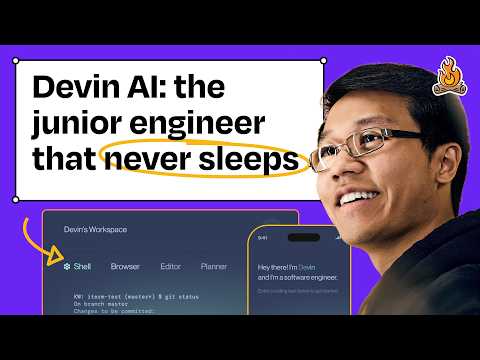
How Devin replaces your junior engineers with infinite AI interns that never sleep | Scott Wu (CEO)
Scott Wu (guest), Claire Vo (host)
In this episode of How I AI, featuring Scott Wu and Claire Vo, How Devin replaces your junior engineers with infinite AI interns that never sleep | Scott Wu (CEO) explores devin as async AI intern: tasks, workflows, and adoption tips Scott Wu (Cognition Labs CEO) explains Devin as an asynchronous “junior engineer” optimized for well-scoped tasks rather than open-ended architectural problems.
Devin as async AI intern: tasks, workflows, and adoption tips
Scott Wu (Cognition Labs CEO) explains Devin as an asynchronous “junior engineer” optimized for well-scoped tasks rather than open-ended architectural problems.
They demo a workflow using DeepWiki to understand a repo, generate a high-context prompt, and launch a Devin session that researches an external MCP server (ChatPRD) and produces a GitHub pull request.
The conversation highlights how Slack/Linear-based, public-by-default “multiplayer” collaboration helps teams both teach the agent and upskill humans through shared prompting patterns.
They close with tactical “top tasks” Devin excels at (frontend fixes, upgrades, docs, incident response, tests) and an additional tip: using ChatGPT voice as an audible meeting participant to reduce friction for quick fact-finding.
Key Takeaways
Devin performs best on clearly scoped tasks, not vague “problems.”
Wu frames Devin as a junior engineer: strong at executing defined work (e. ...
Get the full analysis with uListen AI
Use a sync step (Wiki/Search) to set up the async step (agent execution).
DeepWiki helps you rapidly map the codebase and relevant files; that context is then transformed into a stronger prompt before you “hand off” to Devin asynchronously.
Get the full analysis with uListen AI
Prompt refinement is a leverage point—turn the 5-word ask into a spec-like prompt.
Instead of “add X,” the workflow generates a detailed prompt referencing patterns, types, files, and checks—reducing retries and making the async run more reliable.
Get the full analysis with uListen AI
Asynchronous agents unlock “multithreading” across many workstreams.
Because you don’t babysit execution, you can kick off 2–10 tasks in parallel, then periodically review progress, diffs, screenshots, and PRs when convenient.
Get the full analysis with uListen AI
Institutionalize Devin as first-line response in Slack for reactive engineering.
Cognition tags Devin on issues, crashes, and small requests so it can triage, propose fixes, and open PRs—humans then do targeted review and final polish.
Get the full analysis with uListen AI
Public, multiplayer threads increase both adoption and quality.
Running sessions in shared channels enables teammates to add domain guidance (e. ...
Get the full analysis with uListen AI
When Devin fails, debug the agent’s history and correct the missing input.
Wu suggests treating it like pairing with an intern: inspect what it searched/changed, identify the wrong assumption (e. ...
Get the full analysis with uListen AI
Notable Quotes
“Devin is async. Once you kick off a Devin session, Devin's gonna start working... but you're not expected to be there with it.”
— Scott Wu
“Devin's my favorite intern on my team, and I have infinite of them.”
— Claire Vo
“Tasks, not problems.”
— Scott Wu
“If you had an intern... would you just send them a five-word Slack message?”
— Scott Wu
“I almost think of ChatGPT voice as, like, a better Google.”
— Scott Wu
Questions Answered in This Episode
In your “tasks, not problems” framing, what are the clearest red flags that a task is too ambiguous for Devin to run async without heavy supervision?
Scott Wu (Cognition Labs CEO) explains Devin as an asynchronous “junior engineer” optimized for well-scoped tasks rather than open-ended architectural problems.
Get the full analysis with uListen AI
How does DeepWiki keep its generated documentation accurate as the repo evolves—does it refresh automatically, and how do you handle hallucinated architecture descriptions?
They demo a workflow using DeepWiki to understand a repo, generate a high-context prompt, and launch a Devin session that researches an external MCP server (ChatPRD) and produces a GitHub pull request.
Get the full analysis with uListen AI
What’s your internal rubric for reviewing Devin-generated PRs (tests required, diff size limits, file touch limits, confidence thresholds)?
The conversation highlights how Slack/Linear-based, public-by-default “multiplayer” collaboration helps teams both teach the agent and upskill humans through shared prompting patterns.
Get the full analysis with uListen AI
You mentioned Devin learning the codebase “over time.” What exactly is retained across sessions, and how do you prevent stale or incorrect “institutional memory”?
They close with tactical “top tasks” Devin excels at (frontend fixes, upgrades, docs, incident response, tests) and an additional tip: using ChatGPT voice as an audible meeting participant to reduce friction for quick fact-finding.
Get the full analysis with uListen AI
In the Slack multiplayer workflow, how do you avoid noisy threads or over-tagging Devin—do you have norms for when humans should intervene vs let it run?
Get the full analysis with uListen AI
Transcript Preview
Devin is async. Once you kick off a Devin session, Devin's gonna start working and looking through the code, but you're not expected to be there with it. It's just as if you gave your intern a project, and your intern is going and working on it.
Devin's my favorite intern on my team, and I have infinite of them. Why don't you pick a task that you might bite off for your product and show us how you would work through that end to end?
I'll say, "Please go research the ChatPRD MCP server." So this will produce a pull request for us. Often, you're running a few of these at once, just like a nice way to have multiple tasks going and then check in on each of them.
One of the benefits of this from a How I AI use case is you can multithread a lot with tools like this, and set two, three, four, five, 10 of these going at once on different projects and not feel like you have to sit there and babysit things. [upbeat music] Welcome back to How I AI. I'm Claire Vo, product leader and AI obsessive, here on a mission to help you build better with these new tools. Today is a very special episode for me because we're talking to Scott Wu, CEO and founder of Cognition Labs, and the builder of one of my favorite AI products, Devin. We're gonna hear about how Scott uses DeepWiki and Devin to kick off well-scoped tasks to get things done, uses Devin as his favorite and most tagged employee inside of Slack, and how he's making it not weird to bring ChatGPT voice into your meetings. Let's get to it.
This podcast is supported by Google. Hey, everyone, Shresta here from Google DeepMind. The Gemini 2.5 family of models is now generally available. 2.5 Pro, our most advanced model, is great for reasoning over complex tasks. 2.5 Flash finds the sweet spot between performance and price, and 2.5 Flash Lite is ideal for low-latency, high-volume tasks. Start building in Google AI Studio at ai.dev.
Scott, thanks for joining How I AI. As Devin's number one reply guy on X, I am [chuckles] really excited about this conversation, and for you to show off how your company uses, and you use the product that at least makes me very happy, and I'm sure makes lots of software engineering teams out there very happy. So welcome.
Thank you so much for having me. No, I, I'm, I'm honored to be here, honestly. I'm a big fan of you guys, and, and, and all the work you do, so...
Great! Well, we wanna get into... We have lots of stuff to talk about, but what we really wanna do is get into how you AI, and in particular, how you AI with the products that you've built. And, you know, I think what's really fun as somebody who's building AI products, it's, it's something you get to use every day and get really good at, but also probably show some of our listeners and watchers some tips and tricks about using the tools that you've built that they may not have thought about so far. So we're getting the expert look into how to AI with the Cognition product. So what are you gonna show us first, and what are some of your common workflows when you're doing engineering work or trying to move the product forward?
Install uListen to search the full transcript and get AI-powered insights
Get Full TranscriptGet more from every podcast
AI summaries, searchable transcripts, and fact-checking. Free forever.
Add to Chrome