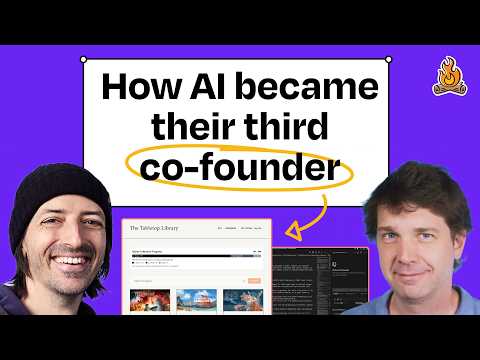
How a VC and tech founder used AI to launch a brick-and-mortar business in their spare time
Andrew Mason (guest), Nabeel Hyatt (guest), Claire Vo (host)
In this episode of How I AI, featuring Andrew Mason and Nabeel Hyatt, How a VC and tech founder used AI to launch a brick-and-mortar business in their spare time explores vC and founder use AI to build board-game club fast Andrew Mason (Descript) and Nabeel Hyatt (Spark Capital) describe turning a board-game hobby into Tabletop Library, a membership-based physical venue in Berkeley built largely as a nights-and-weekends project enabled by AI.
VC and founder use AI to build board-game club fast
Andrew Mason (Descript) and Nabeel Hyatt (Spark Capital) describe turning a board-game hobby into Tabletop Library, a membership-based physical venue in Berkeley built largely as a nights-and-weekends project enabled by AI.
They used Claude Projects as an “AI business partner” to rapidly generate and iterate on documents like business plans, pricing, customer personas, permitting research, landlord materials, and timelines—building institutional memory as they went.
AI also handled “grunt work,” most notably creating a Dewey Decimal–like classification system for hundreds of games and populating operational data into Airtable via AI-assisted workflows.
Finally, they built an AI concierge: an SMS-based agent (Twilio + n8n + Airtable MCP tools) that interprets natural-language requests, books tables, and recruits other members to form game groups—an experience they argue wouldn’t exist without AI.
Key Takeaways
Use AI to make “side-gig” businesses feasible.
They argue the project would not exist without AI because it compresses research, planning, and execution cycles that would otherwise require full-time effort or a larger team.
Get the full analysis with uListen AI
Treat AI as a partner/muse, not a search oracle.
Their habit shift was asking “Have you asked Claude yet? ...
Get the full analysis with uListen AI
Build context through artifacts, not just chats.
They iterated by generating documents (mission, plan, pricing, timelines), then feeding those artifacts back into the Claude Project as canonical context for subsequent decisions.
Get the full analysis with uListen AI
Know the model’s edges—spatial tasks can be weak.
They found floor-planning outputs poor due to lack of spatial memory, while market/framework/persona work was strong because it resembles patterns present in training data.
Get the full analysis with uListen AI
Choose tooling that supports humans and agents together.
Airtable wasn’t just a database; it allowed non-engineer operations via GUIs while still being automatable via integrations and agent tool access.
Get the full analysis with uListen AI
Unstructured text fields become powerful with agents.
They simplified data modeling by storing availability and preferences as free text, relying on the agent to interpret and update—reducing schema complexity for early-stage systems.
Get the full analysis with uListen AI
AI enables entirely new services, not just automation.
Their LFG (looking-for-gamers) flow—texting a request, recruiting a quorum, then revealing/booking—would be impractical for a human to coordinate at scale or speed.
Get the full analysis with uListen AI
Notable Quotes
““There’s just no way this business would have existed without AI, at about 100 different levels.””
— Nabeel Hyatt
““LLMs have no spatial memory, so a lot of the floor plan things it did were pretty poor.””
— Nabeel Hyatt
““It might sound like we’re outsourcing thought… but… your feedback cycle is so fast… you’re just mainlining that.””
— Andrew Mason
““This is the kind of thing that would be literally impossible without AI… a Dewey Decimal System of board games.””
— Nabeel Hyatt
““When you get stuck in a rat hole… revert back and try something different.””
— Andrew Mason
Questions Answered in This Episode
What were the final membership tiers/pricing and what assumptions in Claude’s projections proved most wrong after signing the lease?
Andrew Mason (Descript) and Nabeel Hyatt (Spark Capital) describe turning a board-game hobby into Tabletop Library, a membership-based physical venue in Berkeley built largely as a nights-and-weekends project enabled by AI.
Get the full analysis with uListen AI
How did you validate demand before renting the space—waitlists, surveys, pre-sales, or event pilots—and how much of that was AI-assisted?
They used Claude Projects as an “AI business partner” to rapidly generate and iterate on documents like business plans, pricing, customer personas, permitting research, landlord materials, and timelines—building institutional memory as they went.
Get the full analysis with uListen AI
Can you detail the TLCS (Tabletop Library Classification System): how you chose top-level categories, ensured mutual exclusivity, and handled edge-case games?
AI also handled “grunt work,” most notably creating a Dewey Decimal–like classification system for hundreds of games and populating operational data into Airtable via AI-assisted workflows.
Get the full analysis with uListen AI
What specific Berkeley permitting/ordinance issues were most confusing, and how did you verify AI-generated guidance with experts to avoid compliance risk?
Finally, they built an AI concierge: an SMS-based agent (Twilio + n8n + Airtable MCP tools) that interprets natural-language requests, books tables, and recruits other members to form game groups—an experience they argue wouldn’t exist without AI.
Get the full analysis with uListen AI
For the SMS concierge, what’s the exact quorum logic (number of players, time windows, game length) and how do you prevent spam/over-messaging members?
Get the full analysis with uListen AI
Transcript Preview
there's this kind of renaissance going on with board games that I've just gotten clued into in the last couple of years. Both of us had independently thought, "Wouldn't it be cool if there was, like, a membership-based social club, like a physical space that you could go to and just show up and play board games, either bringing your own friends, like you might do at a board game cafe, if you've ever seen one of those, but also you could play with other members?"
If you're starting your board game navigation, and maybe if you've ever been inside of a board game cafe, you've had this feeling, you walk in, and you've maybe played Catan, and maybe your friends had you play Wingspan, and now there's just, like, a wall of games, and you have absolutely no idea where to start. Well, this has been solved. In libraries, you have a card catalog library system where all of the French history books are next to each other, and so on and so forth. This is the kind of thing that would be, like, literally impossible without AI, but we basically have a bunch of design prompts in Claude, back in those projects, that help to categorize into kind of a Dewey Decimal System of board games.
I've seen how AI can help you code at an extremely proficient level. You can PM, but you are showing me how you can take your slightly nerdy, little bit niche hobby to an extreme level, [chuckles] and even turn it into a business.
It's truly the most ridiculous idea. If he had proposed this and we didn't have AI, I would've gone to the mat, like, "This is such a crazy thing that nobody's gonna want, and it's gonna be such a waste of time." But because we do, we can indulge in this kind of stuff, and it's really fun. And maybe for every five of these, one of them will be the best thing ever.
[upbeat music] Welcome back to How I AI. I'm Claire Vo, product leader and AI obsessive, here on a mission to help you build better with these new tools. Today, I have Andrew Mason, CEO of Descript, and Nabeel Hyatt, VC at Spark Capital. Sure, they're a founder and a VC by day, but by night, they used AI to take their hobby and turn it into an in-person business. Let's get to it. This episode is brought to you by Lovable. If you've ever had an idea for an app but didn't know where to start, Lovable is for you. Lovable lets you build working apps and websites by simply chatting with AI. Then you can customize it, add automations, and deploy it to a live domain. It's perfect for marketers spinning up tools, product managers prototyping new ideas, or founders launching their next business. Unlike no-code tools, Lovable isn't about static pages. It builds full apps with real functionality, and it's fast. What used to take weeks, months, or even years, you can now do over the weekend. So if you've been sitting on an idea, now's the time to bring it to life. Get started for free at lovable.dev. That's lovable.dev. Nabeel and Andrew, thank you for being here. What I love about what we're gonna talk about is I've seen how AI can help you code at an extremely proficient level. You can PM, like, 10 PMs, but you are showing me how you can take your slightly nerdy, little bit niche hobby to an extreme level, [chuckles] and even turn it into a business. So Andrew, can you tell us a little bit about what you built with AI?
Install uListen to search the full transcript and get AI-powered insights
Get Full TranscriptGet more from every podcast
AI summaries, searchable transcripts, and fact-checking. Free forever.
Add to Chrome