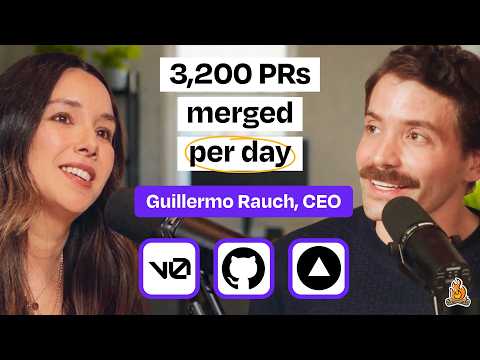
Guillermo Rauch: Vercel CEO on how v0 hit 3,200 PRs merged per day (and lets anyone ship)
Guillermo Rauch (guest), Claire Vo (host)
In this episode of How I AI, featuring Guillermo Rauch and Claire Vo, Guillermo Rauch: Vercel CEO on how v0 hit 3,200 PRs merged per day (and lets anyone ship) explores how Vercel’s v0 turns prompts into production-ready PRs at scale The episode centers on moving beyond “vibe coding” demos into repeatable, production-safe iteration: branching, previews, PRs, and code review baked directly into v0.
How Vercel’s v0 turns prompts into production-ready PRs at scale
The episode centers on moving beyond “vibe coding” demos into repeatable, production-safe iteration: branching, previews, PRs, and code review baked directly into v0.
Rauch showcases skills.sh (a viral hub with ~34k community-submitted skills) as a real example conceived and iterated via prompting, then demonstrates adding a 5-star ratings feature with abuse considerations.
A key theme is workflow design: v0 creates branches, runs a full VS Code-like environment with dependencies, generates PR descriptions, and deploys Vercel preview links quickly—bringing enterprise release discipline to AI-assisted development.
They also discuss internal adoption (rapid growth in PRs merged via v0), cultural implications (marketers shipping changes via PRs instead of “petitioning engineers”), and side projects like an AI-vs-AI 3D chess match built with Vercel’s AI infrastructure.
Key Takeaways
Shipping safely is the real hard part of “vibe coding.”
Rauch argues zero-to-one prompting is easy; the challenge is iterating at scale with safe deployment. ...
Get the full analysis with uListen AI
v0 turns Git workflow into a first-class UI for everyone.
Instead of manual local setup or “Stone Age” branching, v0 adds a “New Branch” flow and naming conventions (contributor/feature) that match real team practices—making collaboration legible to engineers and accessible to others.
Get the full analysis with uListen AI
A browser dev environment removes the biggest adoption barrier: setup.
By providing an in-product VS Code experience with dependencies installed and the app running, v0 eliminates the painful “brew install / local environment” hurdle that blocks designers and marketers from contributing meaningfully.
Get the full analysis with uListen AI
AI changes still need production-minded prompts (abuse, rate limits, UX).
While the prompt looked simple (“add five-star ratings”), Rauch explicitly adds production constraints like preventing abuse and fixing layout shift—modeling how to think like an engineer even when you’re prompting.
Get the full analysis with uListen AI
Preview deployments are a trust-building layer beyond dev mode.
They emphasize dev server parity is good, but Vercel PR previews on production-like infrastructure provide extra assurance. ...
Get the full analysis with uListen AI
Democratized shipping changes org dynamics—if governance stays intact.
Marketers can propose real website changes without “petitioning the government,” but PRs, reviews, and rollbacks keep it responsible. ...
Get the full analysis with uListen AI
When AI gets stuck, use “escape hatches” and meta-debugging.
Rauch recommends switching models for expertise, then feeding the insight back into v0. ...
Get the full analysis with uListen AI
Notable Quotes
“It’s really easy to go from zero to one… what’s harder is to iterate on a project at scale and to deploy changes safely.”
— Guillermo Rauch
“The humiliation ritual of prioritization goes away.”
— Claire Vo
“I didn’t have to go to a terminal or boot up GitHub Desktop… I just press a button, and now I have a branch running.”
— Guillermo Rauch
“Every marketer at Vercel wants to change this page… the old way was… ‘petition to the government.’”
— Guillermo Rauch
“Get busy shipping.”
— Guillermo Rauch
Questions Answered in This Episode
In the skills.sh demo, how exactly is rating data stored in Redis (schema/keys), and what rate-limiting or anti-abuse mechanisms would you add first?
The episode centers on moving beyond “vibe coding” demos into repeatable, production-safe iteration: branching, previews, PRs, and code review baked directly into v0.
Get the full analysis with uListen AI
What does “PRs merged via v0” mean operationally—does it imply code authored by v0, PRs initiated inside v0, or a specific merge workflow?
Rauch showcases skills. ...
Get the full analysis with uListen AI
Where do you draw the line between a marketer safely shipping a page change vs. changes that must remain engineer-owned (security, performance, compliance)?
A key theme is workflow design: v0 creates branches, runs a full VS Code-like environment with dependencies, generates PR descriptions, and deploys Vercel preview links quickly—bringing enterprise release discipline to AI-assisted development.
Get the full analysis with uListen AI
What guardrails should teams adopt to prevent prompt-injection or supply-chain-style risks when “skills” are installed and shared widely?
They also discuss internal adoption (rapid growth in PRs merged via v0), cultural implications (marketers shipping changes via PRs instead of “petitioning engineers”), and side projects like an AI-vs-AI 3D chess match built with Vercel’s AI infrastructure.
Get the full analysis with uListen AI
You mentioned feature flags/experimentation as part of production rigor—how do you envision v0 generating changes that are automatically wrapped in flags and instrumented with metrics?
Get the full analysis with uListen AI
Transcript Preview
I'll say one thing about vibe coding: it's really easy to go from zero to one. I think we've all seen the demos of, "I prompt something," [chuckles] and it's cool. I think what's harder is to iterate on a project at scale and to deploy changes safely. Every marketer at Vercel wants to change this page at some point, and the old way was one of two ways. One is what I call you had to petition to the government. You had to go to engineers and say, "Engineers, can you please add a logo over here?" or whatnot, or pray that the CMS was perfectly wired up for any ambition, or dream, or idea you had. So now they can just open this page in v0 and prompt anything that they want.
It reduces the friction of getting something live really, really low. The humiliation ritual of prioritization goes away, and you can actually focus your time on defending the merits of an idea, on the actual idea, as opposed to the hypothesis of the idea that then has to be implemented. And so I think it changes the speed of companies in a really significant way. [upbeat music] So this is truly a first-time vibe podca- podcast that we're doing together, and I wanted to introduce myself. I'm Claire Vo. I'm a product leader and obsessed with AI, and I have a podcast, How I AI, where I teach people how to build better with all these new tools, including ones that we're gonna see today, and I'm really excited to have you here, Git. First, we're just gonna get to the, the thing that everybody's wondering about: What is your most favorite feature that you released this week on v0?
Well, I'll tell you, the hottest thing in AI today is skills. Everyone is excited about the fact that we can now augment agents, and AI applications, and agentic engineering with skills, like, skills that the model doesn't yet have. And so we launched skills.sh, and the beautiful thing about what we'll show you today is that v0 can seriously go from prototype all the way to production. So we're able to conceive changes to things like skills.sh. I'm gonna show you really quickly. Skills.sh is a new... You can think of it as like npm. It's a hub, an open ecosystem of skills, and it's pretty dramatic what's happening to this site. So you can see that we now have 34,000 skills submitted by the community, and this website has gone viral all over the internet. It's hosted on Vercel, but the most exciting part to me is that it was conceived in v0.
I have a quick question for the audience: How many of you have installed a skill in the last week?
Oh, wow!
Okay, a lot of people.
Skill build.
Um, how many of you have the top three installed?
[chuckles]
Actually, top, top five. [chuckles]
It's very heavy at the top, right?
Install uListen to search the full transcript and get AI-powered insights
Get Full TranscriptGet more from every podcast
AI summaries, searchable transcripts, and fact-checking. Free forever.
Add to Chrome