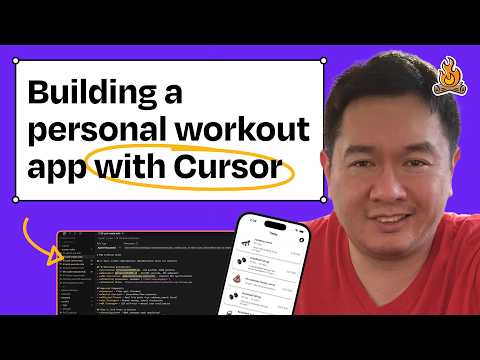
How I built an Apple Watch workout app using Cursor and Xcode (with zero mobile-app experience)
Claire Vo (host), Terry Lin (guest)
In this episode of How I AI, featuring Claire Vo and Terry Lin, How I built an Apple Watch workout app using Cursor and Xcode (with zero mobile-app experience) explores building Apple Watch workout app via Cursor, Xcode, and structured AI workflow Terry Lin built “Cooper’s Corner,” an Apple Watch + iPhone workout tracker that lets users speak exercises, weight, and reps, then converts the transcript into structured workout logs with history and analytics.
Building Apple Watch workout app via Cursor, Xcode, and structured AI workflow
Terry Lin built “Cooper’s Corner,” an Apple Watch + iPhone workout tracker that lets users speak exercises, weight, and reps, then converts the transcript into structured workout logs with history and analytics.
He started with an ultra-simple MVP: recording Voice Memos on Apple Watch, transcribing with GPT, and dumping results into a spreadsheet—then upgraded to a database-backed system and native apps.
Because iOS development requires Xcode for building/debugging, he “dual-wields” Cursor for coding and Xcode for compilation, simulator/device testing, and watch builds.
He developed a repeatable Cursor process—PRD creation, PRD review (rated for executability), PRD execution, plus refactoring and “rubber duck” learning rules—while managing token/context limits with smaller files and frequent Git commits.
Key Takeaways
Start with a “low-effort” MVP before building the full app.
Terry validated the core behavior by narrating workouts into Apple Watch Voice Memos, then using GPT to transcribe/tag and output to a spreadsheet—proving the value before investing in native apps and backend structure.
Get the full analysis with uListen
Voice-to-structured-data is the real product unlock, not just transcription.
The app doesn’t merely convert speech to text; it extracts exercise, weight, reps, timestamp, and other tags into consistent records that power analytics like top exercises and progression charts.
Get the full analysis with uListen
Mobile AI coding still needs platform-native tooling for build/debug.
Cursor can generate and edit Swift/iOS code, but Xcode remains essential for compilation errors, simulator/device behavior, and Watch-specific builds—so he keeps both tools pointed at the same project folder.
Get the full analysis with uListen
Treat the model like a cross-functional team with a real dev process.
His workflow mirrors org structure: write a PRD, have another “role” review it, iterate until it’s executable, then run a phased checklist with pauses—reducing hallucinations and rework.
Get the full analysis with uListen
Use “PRD review scoring” to predict whether execution will succeed.
By asking a model to rate the PRD (0–10) assuming zero context, he finds missing edge cases, unclear file targets, or inconsistent APIs—then iterates until it’s ~9/10 to enable near one-shot implementation.
Get the full analysis with uListen
Optimize code structure for AI collaboration, not just human taste.
Large 900–1500 line files caused Cursor to consume context in chunks and get “tripped up,” so he refactors toward smaller files (≈200–400 lines) to improve model navigation and reliability.
Get the full analysis with uListen
Risk mitigation beats hero debugging when agentic runs go sideways.
Frequent Git commits (before/after phases or every few tasks) provide a clean rollback strategy, making it safer to let the model “run,” then return for QA and device testing.
Get the full analysis with uListen
Notable Quotes
“Two months later, I now have an Apple Watch and an iPhone app.”
— Terry Lin
“They could either work with you or work for you.”
— Terry Lin
“I realized I was just running into a lot of context windows with these same rules.”
— Terry Lin
“I call it vibe refactoring.”
— Terry Lin
“Anything that lets me know what's going on in the mobile.”
— Terry Lin
Questions Answered in This Episode
Can you walk through the exact prompt/schema you use to turn a workout transcript into reliable structured fields (exercise, weight, reps, sets) without the model “making stuff up” over time?
Terry Lin built “Cooper’s Corner,” an Apple Watch + iPhone workout tracker that lets users speak exercises, weight, and reps, then converts the transcript into structured workout logs with history and analytics.
Get the full analysis with uListen AI
What does your backend data model look like (tables, foreign keys, relationships) that enables the 7/30/90-day consistency views and progression charts?
He started with an ultra-simple MVP: recording Voice Memos on Apple Watch, transcribing with GPT, and dumping results into a spreadsheet—then upgraded to a database-backed system and native apps.
Get the full analysis with uListen AI
In your Xcode+Cursor “dual-wielding” setup, what are the most common build/runtime errors that AI introduces, and what debugging steps consistently resolve them?
Because iOS development requires Xcode for building/debugging, he “dual-wields” Cursor for coding and Xcode for compilation, simulator/device testing, and watch builds.
Get the full analysis with uListen AI
How did you implement cross-device syncing between Watch and iPhone (e.g., WatchConnectivity, background delivery), and what failure modes did you have to design feedback for (like the “Sent to iPhone” timer)?
He developed a repeatable Cursor process—PRD creation, PRD review (rated for executability), PRD execution, plus refactoring and “rubber duck” learning rules—while managing token/context limits with smaller files and frequent Git commits.
Get the full analysis with uListen AI
What are examples of PRD-review score deductions you see most often (e.g., missing edge cases, ambiguous file touchpoints), and what template changes improved scores fastest?
Get the full analysis with uListen AI
Transcript Preview
you used AI to make getting swole at the gym easier. I am so excited about this. Let's see how you built this!
I started using the GPT mobile app as, like, speech-to-text, and I was like, "Well, if the model can understand when I'm talking to it, like it is right now, why can't a workout app do this, and then tag the data for me? Make it like a structured data set with analytics."
Let's talk about how you built this thing, 'cause I wouldn't even know where to start in terms of the mobile and watch side of things.
I was like, "What if I have a Python script that takes these files, and it takes the GPT-4.0 and it just suits it to me in an Excel?" Two months later, I now have an Apple Watch and an iPhone app. Now, I did jumping jacks, 35 reps. See, it sends it to the phone, so whatever device you have, log your workouts pretty much with no work.
It does simplify this experience of going to the gym, like the gym bros with their notebooks, where they're writing down their reps or in their notes app. This is awesome. [upbeat music] Welcome back to How I AI. I'm Claire Vo, product leader and AI obsessive, here on a mission to help you build better with these new tools. Today, we have Terry Lin, product manager, vibe coder, and AI-powered gym bro. He's [chuckles] gonna show us how he made a mobile and watch app to track his workouts using Cursor, Xcode, and index cards. Let's get to it. This episode is brought to you by Paragon, the fastest way to ship product integrations. Are integrations on your product roadmap? Whether you want to ingest your users' files from apps like Google Drive or OneDrive, sync data with their CRMs, or automate tasks like searching Salesforce records, integrations are mission critical for products and SaaS. But integrations take months to build, and existing solutions aren't good enough. Embedded IPAs are great for automation but break under high volume, and unified APIs are limited by their endpoints and data access. With Paragon, developers can ship new integrations in days, with purpose-built products to support any use case, from high-volume ingestion to real-time actions and automations. That's why engineering teams at you.com, Pipedrive, Cinch, and hundreds of other B2B SaaS and AI companies use Paragon, so they can focus their efforts on core product features, not integrations. Visit useparagon.com/howiai to see how Paragon 2.0 can help you accelerate your product's integration roadmap today, and get $1,000 off. Terry, I'm super excited to have you on the podcast. Welcome.
Thank you, thank you. Uh, long-time listener, first-time caller.
Well, speaking of first time, we have had a lot of web developers, including myself, on this podcast, but we actually haven't spoken to very many people building for mobile, and I know mobile apps have special challenges, technically, you know, just building them. And then I'm super curious to see how folks like you are approaching using AI to build mobile apps. So before we get into the how, let's see the what. What did you build with AI?
Install uListen to search the full transcript and get AI-powered insights
Get Full TranscriptGet more from every podcast
AI summaries, searchable transcripts, and fact-checking. Free forever.
Add to Chrome