How to create your own AI performance coach: Optimizing your nutrition, recovery & injury management
Lucas Werthein (guest), Claire Vo (host)
In this episode of How I AI, featuring Lucas Werthein and Claire Vo, How to create your own AI performance coach: Optimizing your nutrition, recovery & injury management explores build a personal AI coach by unifying your health data Lucas shares how repeated sports injuries and the overwhelm of siloed health data (wearables, labs, imaging, PT guidance, nutrition plans) pushed him to build a custom “WellCoach GPT.”
Build a personal AI coach by unifying your health data
Lucas shares how repeated sports injuries and the overwhelm of siloed health data (wearables, labs, imaging, PT guidance, nutrition plans) pushed him to build a custom “WellCoach GPT.”
He shows how he manually feeds diverse inputs—Whoop CSVs, sleep/strain, journals, workouts, InBody scans, bloodwork, plus MRI/X-ray imaging—so the model can produce personalized, high-ROI recommendations.
A major emphasis is prompt design: clear goals (pain-free performance, joint safeguarding), realistic expectations, and strict “anti-prompts” that prevent risky or unproven advice.
The conversation expands into a future vision where AI becomes the missing synthesizer in healthcare—helping patients and doctors communicate better via continuously captured data—while also touching on related workflows like synthetic clients and an AI co-founder for brainstorming.
Key Takeaways
The core problem isn’t missing health data—it’s missing synthesis.
Lucas already had experts and measurements (PT, doctors, labs, Whoop, scans), but struggled to unify them into coherent daily actions. ...
Get the full analysis with uListen AI
Multimodal context (including imaging) changes the quality of coaching.
Beyond workouts and food logs, adding MRI/X-ray files gives “under-the-hood” structural context. ...
Get the full analysis with uListen AI
A high-performing AI coach starts with realistic goals and constraints.
Instead of “make me elite,” Lucas defines outcomes like pain-free movement, joint safeguarding, and sustainable output while running a company. ...
Get the full analysis with uListen AI
Frameworks beat tips: define nutrition, training-load, recovery, and feedback loops.
He encodes principles like stable glucose/low inflammation, load management using readiness/HRV, and sleep-first recovery. ...
Get the full analysis with uListen AI
Hard boundaries (anti-prompts) reduce risk and ‘biohacking drift.’
Lucas explicitly forbids pushing intensity on low-recovery days, novelty therapies, and unproven supplements, and instructs the coach to act on red flags. ...
Get the full analysis with uListen AI
The AI’s ‘always-available’ loop is valuable for compliance and anxiety reduction.
He uses it to plan around events (omakase/sake; parties) and to get quick reinforcement after meals via photos. ...
Get the full analysis with uListen AI
Use AI to validate, reformat, and operationalize medical guidance—not replace it.
Lucas checks alignment between his doctor/PT guidance and the model’s plan, then asks for a day-by-day roadmap to a tournament date. ...
Get the full analysis with uListen AI
Notable Quotes
“The problem isn’t the lack of data, the problem is the lack of synthesis and putting it all together.”
— Lucas Werthein
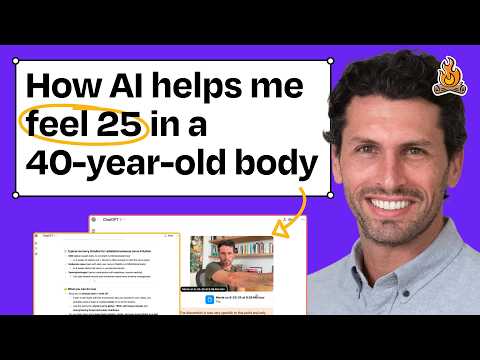
“I’m wanting to demand of my body to feel like twenty-five in a forty-year-old’s body.”
— Lucas Werthein
“Not only is this how I’m performing on an output basis, but this is… the structural setup under the hood.”
— Claire Vo
“No fluff, no hacks, nothing that hasn’t been proven.”
— Lucas Werthein
“In five years or less, everyone will have access to a personal AI health coach… not to replace doctors, but to help us show up more informed.”
— Lucas Werthein
Questions Answered in This Episode
What exact instruction template did Lucas use (role/goals/frameworks/boundaries/response style), and which parts mattered most for improving output quality?
Lucas shares how repeated sports injuries and the overwhelm of siloed health data (wearables, labs, imaging, PT guidance, nutrition plans) pushed him to build a custom “WellCoach GPT.”
Get the full analysis with uListen AI
How did the GPT handle conflicting signals—for example, feeling motivated to train while Whoop shows yellow/red recovery—and what decision rules did Lucas encode?
He shows how he manually feeds diverse inputs—Whoop CSVs, sleep/strain, journals, workouts, InBody scans, bloodwork, plus MRI/X-ray imaging—so the model can produce personalized, high-ROI recommendations.
Get the full analysis with uListen AI
When Lucas says “no supplements like creatine,” how does he decide what counts as ‘proven’ and ‘high ROI,’ and should those boundaries be personalized differently for other users?
A major emphasis is prompt design: clear goals (pain-free performance, joint safeguarding), realistic expectations, and strict “anti-prompts” that prevent risky or unproven advice.
Get the full analysis with uListen AI
What’s the best workflow for feeding imaging (MRI/X-ray) into a GPT responsibly—what can it realistically infer vs. what should be strictly deferred to clinicians?
The conversation expands into a future vision where AI becomes the missing synthesizer in healthcare—helping patients and doctors communicate better via continuously captured data—while also touching on related workflows like synthetic clients and an AI co-founder for brainstorming.
Get the full analysis with uListen AI
In the elbow injury example, what specific prompts helped translate the doctor/PT guidance into a tournament-ready timeline with checkpoints and ‘stop’ criteria?
Get the full analysis with uListen AI
Transcript Preview
I have always been super active into sports, really constantly pushing myself to the limits of what my body can do, and naturally, that means injuries, right? And for me, it became a little bit too much, and so as soon as ChatGPT launched, I started experimenting with aggregating this data so that I can get a more clear synthesis of what I can do to actually optimize the body.
One of the things that I have never seen anybody do yet, I've seen a lot of folks drop in their daily workouts or their food diaries, but I have not seen MRIs and imaging here. And what important context for somebody who's an athlete to say, "Not only is this how I'm performing on an output basis, [chuckles] but this is actually, like, the structural setup under the hood," so it's really interesting, that combination of data into these files.
I'm wanting to demand of my body to feel, like, twenty-five in a forty-year-old's body, and it's interesting to think, what if every person could have a coach that organizes all this action into clarity, right? And part of what we've been talking about is that not everyone is looking for this type of performance. Most people don't need six-packs or match prep, but they could use help with the basics, right? Eating less processed food, sleeping better, moving more, and I think an AI coach could meet people where they are and actually give them the necessary nudges and contextualization of information that they need to be a better version of themselves.
[upbeat music] Welcome back to How I AI. I'm Claire Vo, product leader and AI obsessive, here on a mission to help you build better with these new tools. Today, we have Lucas Werthein, Head of Technology at Cactus, who has done work for basically everybody: Apple, Coca-Cola, MTV, and even Beyoncé herself. But today, we're not going to talk about product development. We're going to talk about how Lucas has built a wellness coach inside ChatGPT to optimize his nutrition, his workouts, and keep him feeling twenty-five, even though he's a little bit older than that. This is a really fun episode with some practical insights for people just trying to make their lives better with AI. Let's get to it. This episode is brought to you by WorkOS. AI has already changed how we work. Tools are helping teams write better code, analyze customer data, and even handle support tickets automatically. But there's a catch: these tools only work well when they have deep access to company systems. Your copilot needs to see your entire code base. Your chat bot needs to search across internal docs, and for enterprise buyers, that raises serious security concerns. That's why these apps face intense IT scrutiny from day one. To pass, they need secure authentication, access controls, audit logs, the whole suite of enterprise features. Building all that from scratch, it's a massive lift. That's where WorkOS comes in. WorkOS gives you drop-in APIs for enterprise features, so your app can become enterprise-ready and scale upmarket faster. Think of it like Stripe for enterprise features. OpenAI, Perplexity, and Cursor are already using WorkOS to move faster and meet enterprise demands. Join them and hundreds of other industry leaders at workos.com. Start building today. Lucas, welcome to How I AI. Thanks for being here.
Install uListen to search the full transcript and get AI-powered insights
Get Full TranscriptGet more from every podcast
AI summaries, searchable transcripts, and fact-checking. Free forever.
Add to Chrome