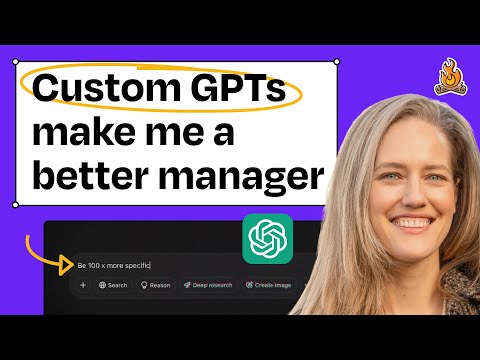
How custom GPTs can make you a better manager | Hilary Gridley (Head of Core Product at Whoop)
Hilary Gridley (guest), Claire Vo (host)
In this episode of How I AI, featuring Hilary Gridley and Claire Vo, How custom GPTs can make you a better manager | Hilary Gridley (Head of Core Product at Whoop) explores custom GPTs help managers scale feedback, taste, and coaching quality Hilary Gridley (Head of Core Product at Whoop) shares practical workflows for creating custom GPTs that act like a manager’s “rubric engine,” especially for evaluating artifacts like slide decks and writing.
Custom GPTs help managers scale feedback, taste, and coaching quality
Hilary Gridley (Head of Core Product at Whoop) shares practical workflows for creating custom GPTs that act like a manager’s “rubric engine,” especially for evaluating artifacts like slide decks and writing.
Her core method is to extract criteria from examples of “good vs. bad” work (often as simple PDFs), then iteratively refine those criteria using prompts like “Be 100 times more specific.”
She demonstrates turning the rubric into a specialized GPT (“Deck Doctor”) that scores outputs, explains why criteria matter, and gives concrete improvement suggestions—saving managers time by handling the first 60–70% of feedback.
Beyond decks, she shows how to use AI to sharpen thinking and writing by having it restate your thesis, surface blind spots, and restructure drafts—while keeping the final voice authentically yours. She also discusses AI adoption gaps (notably among women) and highlights playful, everyday use cases that make AI more accessible.
Key Takeaways
Start by defining what “good” means to you—then encode it.
Hilary’s framing is that great managers articulate “what good looks like. ...
Get the full analysis with uListen AI
Use good/bad pairs to let the model infer your criteria.
Collect “before and after” examples (slides, emails, docs) and have the model extract patterns. ...
Get the full analysis with uListen AI
Begin vague to explore, then get aggressively specific to converge.
She intentionally avoids overly specific initial prompts to reduce bias and discover unexpected patterns. ...
Get the full analysis with uListen AI
Convert criteria into repeatable evaluations with a specialized GPT.
Once criteria are solid, ask the model to write the “GPT instructions” and bake in behaviors like being “ruthlessly helpful. ...
Get the full analysis with uListen AI
Custom GPTs reduce prompting burden for your team.
A GPT lets teammates upload an artifact and press enter, bypassing the steep learning curve of prompting. ...
Get the full analysis with uListen AI
Use GPTs to personalize coaching for specific growth areas.
Beyond a general evaluator, Hilary creates targeted GPTs—e. ...
Get the full analysis with uListen AI
For writing, test clarity by asking for a restated thesis, not a rating.
Because models tend to be overly positive, she asks it to summarize her thesis and supporting points to see if meaning landed. ...
Get the full analysis with uListen AI
Notable Quotes
““My favorite prompt in the world is… ‘Be 100 times more specific.’””
— Hilary Gridley
““I always start with, ‘What does good mean to me?’ And so how can I get this AI to think like me?””
— Hilary Gridley
““Criteria are what we’re trying to get to… you would already be a better manager because you’re able to communicate the criteria that you care about.””
— Hilary Gridley
““The GPT is never gonna replace you… But it can take a lot of time off your plate in terms of going from the 0 to the 60 or the 70%.””
— Hilary Gridley
““I want it to start with me, and I want it to end with me… in between is between me and the robot.””
— Hilary Gridley
Questions Answered in This Episode
What did Hilary’s “good vs. bad PDF” rubric-extraction prompt look like in its exact final form, and what did she change after the first output?
Hilary Gridley (Head of Core Product at Whoop) shares practical workflows for creating custom GPTs that act like a manager’s “rubric engine,” especially for evaluating artifacts like slide decks and writing.
Get the full analysis with uListen AI
When she says “Be 100 times more specific,” what kinds of specificity does she want (examples, thresholds, do/don’t rules, vocabulary), and which ones backfire?
Her core method is to extract criteria from examples of “good vs. ...
Get the full analysis with uListen AI
How does she prevent a deck-evaluator GPT from becoming overly “nice” or giving false confidence—what guardrails or negative examples does she include?
She demonstrates turning the rubric into a specialized GPT (“Deck Doctor”) that scores outputs, explains why criteria matter, and gives concrete improvement suggestions—saving managers time by handling the first 60–70% of feedback.
Get the full analysis with uListen AI
What are the most effective rubric categories for slide decks beyond the ones mentioned (headline clarity, one idea per slide, visual hierarchy), and how does she weight them?
Beyond decks, she shows how to use AI to sharpen thinking and writing by having it restate your thesis, surface blind spots, and restructure drafts—while keeping the final voice authentically yours. ...
Get the full analysis with uListen AI
How does she operationalize GPT usage on a team: where are GPT links stored, how are they introduced in onboarding, and how does she measure whether they’re actually improving work quality?
Get the full analysis with uListen AI
Transcript Preview
My favorite prompt in the world is, I will say, "Be 100 times more specific."
It's really interesting that some of the ways that we work as managers, where we're evaluating work, really have natural translations into using some of these AI tools as well.
The GPT is never gonna replace you. It's never gonna be as good as having a really good manager, at least not in the next six months. Maybe beyond that, I can't predict. But it can get you far. It can take a lot of time off your plate in terms of going from the zero to the 60 or the 70%. And if you can get all of that work off your plate as a manager, the amount of leverage you gain by being able to invest that time back into other things, whether that's more strategic work or more hands-on coaching, is really remarkable, and it's why I get so excited about this. [upbeat music]
Welcome back to How I AI. I'm Claire, product leader and AI obsessive, here on a mission to help you build better with these new tools. We've spoken a lot about how AI is going to transform how the individual contributor gets work done, but not so much what AI means for the manager. That's why you're gonna love this conversation with Hilary Gridley, Head of Core Product at Whoop. Hilary has some really creative techniques for scaling yourself as a manager and giving your team access to your expertise, all using GPTs. Let's get to it. This episode is brought to you by Orkes, the company behind open source Conductor, the platform powering complex workflows and process orchestration for modern enterprise apps and agentic workflows. Legacy business process automation tools are breaking down. Siloed low-code platforms, outdated process management systems, and disconnected API management tools weren't built for today's event-driven, AI-powered, cloud-native world. Orkes changes that. With Orkes Conductor, you get a modern orchestration layer that scales with high reliability, supports both visual and code-first development, and brings human, AI, and systems together in real time. It's not just about tasks, it's about orchestrating everything: APIs, microservices, data pipelines, human-in-the-loop actions, and even autonomous agents. So build, test, and debug complex workflows with ease. Add human approvals, automate back-end processes, and orchestrate agentic workflows at enterprise scale, all while maintaining enterprise-grade security, compliance, and observability. Whether you're modernizing legacy systems or scaling next-gen AI-driven apps, Orkes helps you go from idea to production fast. Orkes, orchestrate the future of work. Learn more and start building at orkes.io. That's O-R-K-E-S dot I-O. Hilary, I'm so excited about our conversation because you have told me you've created, and I quote, "a billion GPTs." So what's the real truth? How many do you think you've actually created? [chuckles]
W- what is a billion minus one, is probably right. I've probably made 100, but I only use a few dozen of them. I feel like there is a learning curve of having to make a bunch, and then I got it really tuned in, and now I can... I have a pretty good hit rate on when I make them. Uh, but I would say I have dozens that I'm, I'm regularly using with my team.
Install uListen to search the full transcript and get AI-powered insights
Get Full TranscriptGet more from every podcast
AI summaries, searchable transcripts, and fact-checking. Free forever.
Add to Chrome