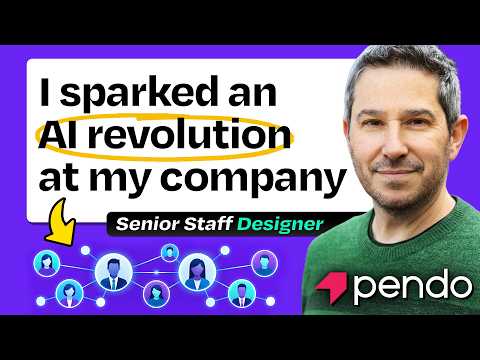
How one designer led an AI revolution at Pendo: The paternity leave epiphany | Brian Greenbaum
Brian Greenbaum (guest), Claire Vo (host)
In this episode of How I AI, featuring Brian Greenbaum and Claire Vo, How one designer led an AI revolution at Pendo: The paternity leave epiphany | Brian Greenbaum explores a designer’s playbook for scaling AI adoption across product teams While on paternity leave, Brian tried Cursor, rapidly built a prototype, and sent a decisive Slack message to leaders proposing an AI upskilling initiative across product (design + PM + others).
A designer’s playbook for scaling AI adoption across product teams
While on paternity leave, Brian tried Cursor, rapidly built a prototype, and sent a decisive Slack message to leaders proposing an AI upskilling initiative across product (design + PM + others).
He then drove adoption with a two-pronged model: recurring synchronous learning sessions with live exercises, plus an asynchronous Slack channel for “radical many-to-many sharing.”
To make AI usage safe and scalable, the team measured sentiment and awareness, then built a centralized AI Knowledge Center that clarified approved tools, data rules, and procurement pathways.
Brian also demonstrates how individual experimentation can influence company roadmap—e.g., building a prototype MCP server to show how agents could query Pendo data and generate dashboards.
Key Takeaways
A single concrete “I built this” moment can ignite organizational change.
Brian’s fast Cursor-built prototype created undeniable proof, making his leadership outreach compelling and actionable rather than hypothetical.
Get the full analysis with uListen AI
Position AI adoption as both productivity and market leadership.
He framed the initiative around internal leverage (do more, better decisions) and external credibility (Pendo as a thought leader for customers undergoing the same shift).
Get the full analysis with uListen AI
Adoption requires both calendar time and a sharing surface.
Bi-weekly sessions create protected time for hands-on practice, while a public Slack channel sustains momentum through continuous peer examples and experimentation.
Get the full analysis with uListen AI
Make sessions interactive to reveal how AI really behaves.
Having everyone run the same Bolt. ...
Get the full analysis with uListen AI
Use playful experimentation to break “MVP-only” thinking.
Encouraging wild iterations (themes, gamification, media) helps PMs/designers rebuild the muscle of imagining “magic” experiences now feasible with AI.
Get the full analysis with uListen AI
Measure sentiment and policy/tool awareness—not just usage.
The sentiment survey captured fear vs. ...
Get the full analysis with uListen AI
A documented ‘golden path’ reduces shadow AI and accelerates safe experimentation.
The AI Knowledge Center clarified approved tools, permissible data, and how to get access—turning legal/security/procurement from bottlenecks into an enablement flywheel.
Get the full analysis with uListen AI
Prototype to show value; production-grade code is optional at first.
Brian’s MCP server wasn’t about perfect implementation—it was a tangible demo that helped others “touch” the concept, influencing roadmap and sparking executive engagement.
Get the full analysis with uListen AI
Non-technical roles need technical literacy to design real AI solutions.
He argues PMs/designers should understand LLMs, agents, and basics like HTML/CSS to better connect capabilities to customer problems without becoming ML engineers.
Get the full analysis with uListen AI
Notable Quotes
““I think we really need to uplevel the skill of our entire product organization, not just designers, but also PMs.””
— Brian Greenbaum
““There’s no playbook for how to learn this stuff… the technology’s evolving so fast.””
— Brian Greenbaum
““If you don’t make the time for it, you’re never gonna learn it, and at some point you’re gonna get behind.””
— Brian Greenbaum
““We’ve lost our muscle for asking for the magic thing… now our bar can just be so much higher.””
— Claire Vo
““One of my most popular sessions… was called ‘WTF is MCP?’””
— Brian Greenbaum
Questions Answered in This Episode
What did Brian include in his original paternity-leave Slack message that made leadership immediately pay attention—and how would you adapt that template for your org?
While on paternity leave, Brian tried Cursor, rapidly built a prototype, and sent a decisive Slack message to leaders proposing an AI upskilling initiative across product (design + PM + others).
Get the full analysis with uListen AI
In the live Bolt.new exercise, why did identical prompts produce different results (and failures) across participants, and how should teams plan for that variability in real work?
He then drove adoption with a two-pronged model: recurring synchronous learning sessions with live exercises, plus an asynchronous Slack channel for “radical many-to-many sharing.”
Get the full analysis with uListen AI
How would you structure a bi-weekly AI session agenda to balance education, hands-on practice, and show-and-tell without turning it into a lecture series?
To make AI usage safe and scalable, the team measured sentiment and awareness, then built a centralized AI Knowledge Center that clarified approved tools, data rules, and procurement pathways.
Get the full analysis with uListen AI
What specific anti-“information hoarding” norms or incentives can you implement to encourage ‘radical many-to-many sharing’ without penalizing high performers?
Brian also demonstrates how individual experimentation can influence company roadmap—e. ...
Get the full analysis with uListen AI
What were the five sentiment survey questions, and what additional question would you add to distinguish ‘fear’ from ‘skepticism’ vs. ‘lack of time’ as adoption blockers?
Get the full analysis with uListen AI
Transcript Preview
I had tried Cursor for the first time, and what I was able to create just blew me away. I sent a message to my manager, my manager's manager, the CPO, and then a few other folks that I knew were really interested in AI, and I was like: "Listen, I had this really profound experience, and I think we really need to uplevel the skill of our entire product organization, not just designers, but also PMs. We need to become more familiar with this technology. We need to understand how we can use it." This is actually the message that I sent while I was on paternity leave that definitely got my leaders really fired up. I didn't know exactly how this was gonna go. All I knew was that I needed to get more folks paying attention to this AI stuff.
If you are the first to [chuckles] raise your hand that says, "You know what? I wanna figure out how our team can use AI. I'm gonna lead this organization," it's such a unique leadership opportunity to show cross-functional, broad impact on teams. [upbeat music] Welcome back to How I AI. I'm Claire Vo, product leader and AI obsessive, here on a mission to help you build better with these new tools. Today, I have Brian Greenbaum at Pendo, and he's gonna show us not only how he uses AI in his own product work, but his step-by-step plan for getting your product and design teams adopting AI as well. Let's get to it.
This podcast is supported by Google. Hey, everyone, Shresta here from Google DeepMind. The Gemini 2.5 family of models is now generally available. 2.5 Pro, our most advanced model, is great for reasoning over complex tasks. 2.5 Flash finds the sweet spot between performance and price, and 2.5 Flash Lite is ideal for low-latency, high-volume tasks. Start building in Google AI Studio at ai.dev.
Brian, thanks for joining us on How I AI. Happy to have you.
Yeah, so excited to be here.
Well, what I am excited about in our conversation is in a lot of our How I AI episodes, we've shown specific ways that you can s- use specific tools to build or do things with AI. And you're gonna help us take a step back and say, you know, let's say you have all these tools, and you want to start using them. How do you get a full team or a full organization, a full company, actually adopting AI? And so this is a how I get everybody else to [chuckles] use AI episode. So I would love to start with what I call the inception phase, which we all have gone through or are all in the process of trying to get our team to go through, which is when you get people excited and sort of jumpstart the energy around AI. And I think you approached this in a really interesting way, so I'd love you to walk us through what you did at Pendo.
Install uListen to search the full transcript and get AI-powered insights
Get Full TranscriptGet more from every podcast
AI summaries, searchable transcripts, and fact-checking. Free forever.
Add to Chrome