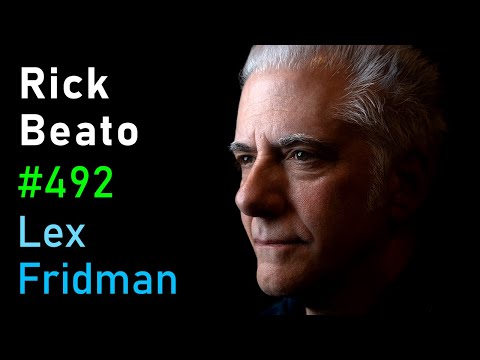
Rick Beato: Greatest Guitarists of All Time, History & Future of Music | Lex Fridman Podcast #492
Lex Fridman (host), Rick Beato (guest), Rick Beato (guest), Rick Beato (guest)
In this episode of Lex Fridman Podcast, featuring Lex Fridman and Rick Beato, Rick Beato: Greatest Guitarists of All Time, History & Future of Music | Lex Fridman Podcast #492 explores rick Beato on guitar legends, creativity, AI, and music industry today Rick Beato traces his musical formation through early rock solos, gypsy jazz, and bebop, arguing that deep early exposure to “high-information music” can profoundly shape musical perception and skill.
Rick Beato on guitar legends, creativity, AI, and music industry today
Rick Beato traces his musical formation through early rock solos, gypsy jazz, and bebop, arguing that deep early exposure to “high-information music” can profoundly shape musical perception and skill.
They contrast perfect pitch with relative pitch, emphasizing that relative pitch and ear training are broadly learnable and often more practical for working musicians.
The discussion celebrates iconic players and performances (Hendrix, Gilmour, Knopfler, Metallica) while highlighting what makes greatness recognizable: phrasing, space, tone, and identity-in-a-note.
They explore songwriting and production as a craft learned through repetition and constraints, using stories from producers and artists like Elton John, The Beatles, and Miles Davis to illustrate creativity under pressure.
Beato and Fridman argue that AI-generated music is improving but tends to feel “boring” and inauthentic, and they critique modern industry incentives (interpolations, many co-writers, copyright claims, streaming economics).
Key Takeaways
Learn songs first to stay motivated; theory can follow.
Beato recommends beginners start with open chords, clean fretting, and simple strumming so they can play real music quickly; deeper theory becomes valuable once momentum and curiosity are established.
Get the full analysis with uListen AI
Relative pitch is the most transferable “superpower” for musicians.
Unlike perfect pitch, relative pitch can be trained through daily interval and chord recognition practice, helping musicians quickly identify progressions, melodies, and harmonies in real musical contexts.
Get the full analysis with uListen AI
Early exposure to complex music may build lifelong musical fluency.
Beato links language acquisition research to pitch perception, suggesting infants exposed socially to harmonically rich music may retain stronger pitch categories and listening discrimination.
Get the full analysis with uListen AI
Great improvisation is a learned language, not a mystery talent.
From Django to bebop, they frame styles as vocabularies built through listening and repetition; “chromatic” notes function as connective tissue rather than random complexity.
Get the full analysis with uListen AI
Iconic guitarists are recognizable by phrasing, space, and tone—sometimes from a single note.
They argue that identity comes from micro-details (vibrato, timing, gear choices, muting technique) and musical “speech-like” phrasing, not just speed or difficulty.
Get the full analysis with uListen AI
AI will reward strong taste more than raw generation ability.
Beato finds most AI outputs mediocre, with occasional gems; the competitive advantage shifts to creators who can quickly judge what’s good, then rework it with human production, performance, and editing.
Get the full analysis with uListen AI
Modern music economics and platform rules shape what rises to the top.
They criticize award-worthy hits built on interpolations/samples and discuss how copyright-claim systems can divert all revenue from long-form educational videos even when use is transformative and fair.
Get the full analysis with uListen AI
Notable Quotes
“Thought is the enemy of flow.”
— Rick Beato
“Dissonance equals emotion.”
— Rick Beato
“I miss the comfort of being sad.”
— Lex Fridman (quoting Kurt Cobain lyric)
“If you ever learn to play guitar like this, you've accomplished something with your life.”
— Rick Beato (quoting his father about Joe Pass)
“Somebody's gotta be successful, so why can't it be you?”
— Rick Beato
Questions Answered in This Episode
On perfect pitch: What specific evidence would convince you that “every child is born with perfect pitch,” and how would you test it experimentally?
Rick Beato traces his musical formation through early rock solos, gypsy jazz, and bebop, arguing that deep early exposure to “high-information music” can profoundly shape musical perception and skill.
Get the full analysis with uListen AI
Ear training: What’s the most efficient 10-minutes-a-day routine you’d prescribe for someone who wants to transcribe songs by ear within 3 months?
They contrast perfect pitch with relative pitch, emphasizing that relative pitch and ear training are broadly learnable and often more practical for working musicians.
Get the full analysis with uListen AI
Greatness debate: If “greatest guitarist” is too simplistic, what multi-dimensional rubric would you use (tone, phrasing, innovation, composition, influence, live consistency)?
The discussion celebrates iconic players and performances (Hendrix, Gilmour, Knopfler, Metallica) while highlighting what makes greatness recognizable: phrasing, space, tone, and identity-in-a-note.
Get the full analysis with uListen AI
AI music: What would a truly compelling human-AI workflow look like that preserves authenticity—where does the human contribution become unmistakable?
They explore songwriting and production as a craft learned through repetition and constraints, using stories from producers and artists like Elton John, The Beatles, and Miles Davis to illustrate creativity under pressure.
Get the full analysis with uListen AI
Pop songwriting credits: When 8–12 writers appear on a track, what’s your best guess for how credit is actually negotiated (creative contribution vs business/risk management)?
Beato and Fridman argue that AI-generated music is improving but tends to feel “boring” and inauthentic, and they critique modern industry incentives (interpolations, many co-writers, copyright claims, streaming economics).
Get the full analysis with uListen AI
Transcript Preview
The following is a conversation with Rick Beato, legendary music educator, interviewer, producer, songwriter, and a true multi-instrument musician, playing guitar, bass, cello, and piano. Rick, with his incredible YouTube channel, celebrates great musicians and musical ideas and helps millions of people, including me, fall in love with great music all over again. This is the Lex Fridman Podcast. To support it, please check out our sponsors in the description, where you can also find links to contact me, ask questions, give feedback, and so on. And now, dear friends, here's Rick Beato. You had, I think, an incredibly fun and diverse beginning to your music journey. I heard somewhere that one of the things that made you fall in love with music was, uh, listening to guitar solos, some epic guitar solos. Uh, what's an early guitar solo that you remember you connected to spiritually, [laughs] uh, musically, where you're like, "Wow, there's magic in this"?
Well, the first solo that I learned was Hey Joe. It was actually a good beginner song, you know, when I first started playing the guitar, because it has pretty simple chords, right? So it's like E, C, G, D, A.
Mm-hmm.
And I learned the solo, and I figured out this, like, oh, see, it's this pentatonic scale, E minor pentatonic scale. I didn't know that's what it was called, but I learned this thing, and it's like, whoa, he's just in this one shape here. Now, there was no... You couldn't go look anything up. You just... If you could figure out the notes, you noticed that there was a little pattern to it. And then I, I got so obsessed with it, and I showed my younger brother, John, who started playing guitar right at the same time I did. So I was 14, he was 11. And I would play rhythm for him for five minutes while he would solo over Hey Joe. And then as soon as I'd start soloing, he'd throw the guitar down, then we'd get in a fight.
Mm-hmm.
And so my mom eventually was like, "What is going on here?" And I was like, "John won't play rhythm." [laughs]
[laughs]
"John won't play rhythm for me." She's like, "Okay, I'll play rhythm for you. What, what are the chords?" And J-
That's awesome
... and I was like, "Okay, it's like E, the C, G, D, A."
Yeah.
And so my mom would literally play rhythm for 20 minutes while I'd play.
#parenting. [laughs]
That's amazing. I, when I, when I look back on it now, my mom's been gone for 10 years now. When I look back on it, it's like, my God, my parents were so cool.
We should mention that Hey Joe, and Hendrix in general, is kind of known for the rhythm not being simple rhythm, just the chords that you mentioned.
Right.
It's what you do with those chords. It's almost improvisation on the rhythm side.
He did all this really cool chord fragments, uh, riffs, and things like that, that's just part of his... that's the Hendrix style.
Install uListen to search the full transcript and get AI-powered insights
Get Full TranscriptGet more from every podcast
AI summaries, searchable transcripts, and fact-checking. Free forever.
Add to Chrome