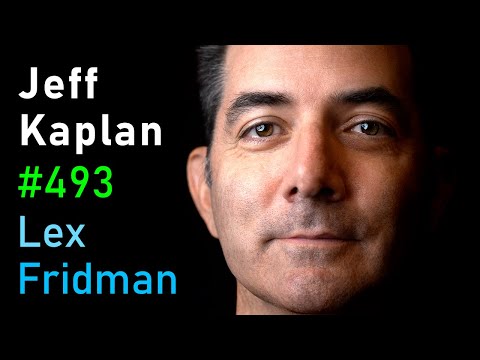
Jeff Kaplan: World of Warcraft, Overwatch, Blizzard, and Future of Gaming | Lex Fridman Podcast #493
Jeff Kaplan (guest), Lex Fridman (host), Lex Fridman (host), Lex Fridman (host)
In this episode of Lex Fridman Podcast, featuring Jeff Kaplan and Lex Fridman, Jeff Kaplan: World of Warcraft, Overwatch, Blizzard, and Future of Gaming | Lex Fridman Podcast #493 explores jeff Kaplan on gaming craft, Blizzard legacy, and new studio. Jeff Kaplan traces his early love of games (arcades, Zork, Quake) and a detour through creative writing marked by intense rejection, depression, and ultimately recovery.
Jeff Kaplan on gaming craft, Blizzard legacy, and new studio.
Jeff Kaplan traces his early love of games (arcades, Zork, Quake) and a detour through creative writing marked by intense rejection, depression, and ultimately recovery.
EverQuest became both an escape and a proving ground for leadership—leading to real-life friendships, meeting his wife, and a surprising pipeline into Blizzard and World of Warcraft.
He details Blizzard’s early culture, the design breakthroughs behind WoW’s quest-driven leveling and polish, and the organizational failures that doomed Titan but seeded Overwatch’s success.
Kaplan discusses toxicity, matchmaking, esports and monetization pressures, his painful departure from Blizzard, and his new independent studio building The Legend of California.
Key Takeaways
Design the ‘path of least resistance’ toward the experience you want.
WoW succeeded by making questing the fastest/most rewarding leveling route, naturally moving players through story and zones instead of stationary grinding.
Get the full analysis with uListen AI
Small teams preserve trust, shared context, and creative velocity.
Kaplan argues small teams give everyone a “loud voice,” reduce discipline stereotyping, and keep decisions holistic rather than compartmentalized.
Get the full analysis with uListen AI
Polish is culture plus architecture, not a last-minute phase.
Blizzard’s quality came from passionate QA integrated with devs, systematic testing, and engineering built for rapid hotfixes without client downtime.
Get the full analysis with uListen AI
Titan failed from a lack of executable vision, not a lack of ideas.
The project over-hired before defining cohesive art/design/tech constraints, suffered nonfunctional tools, and tried to ‘run’ before it could ‘crawl.’
Get the full analysis with uListen AI
Overwatch emerged by distilling complexity into character-driven clarity.
A suggestion to create many ‘micro-classes’ led to hero kits with 1–2 defining mechanics and strong personality, built from Titan’s best remnants (e. ...
Get the full analysis with uListen AI
Team-centric competitive design can unintentionally fuel blame and toxicity.
With limited individual feedback (no scoreboard; medals that can be weaponized), players default to self-focused narratives and lash out at teammates.
Get the full analysis with uListen AI
Business pressure can break creative systems when it becomes coercive.
Kaplan describes a tipping point where revenue targets and implied layoffs made the work feel extractive, catalyzing his decision to leave Blizzard.
Get the full analysis with uListen AI
Resetting worlds can create long-term engagement—if the reset feels exciting.
Rust’s monthly wipes keep the ‘fresh start’ fantasy alive and enable new players to begin on equal footing, a concept he’s adapting carefully.
Get the full analysis with uListen AI
AI is useful for tedious tasks, but current tooling is unreliable and ethically fraught.
He sees value in automation (e. ...
Get the full analysis with uListen AI
Indie studios are positioned to drive innovation—if creators retain control.
Kaplan’s advice is to “own the craft,” avoid surrendering value to corporate layers, and optimize for creative control over maximal funding.
Get the full analysis with uListen AI
Notable Quotes
““There’s three types of fun: fun for the player, fun for the designer, and fun for the computer.””
— Jeff Kaplan
““Focus on what you wanna do, not what you wanna be.””
— Jeff Kaplan
““My whole career and my family are thanks to EverQuest, so I think I won the game.””
— Jeff Kaplan
““The best feature we can add for the player is shipping.””
— Jeff Kaplan
““Rust is the most PvP thing in all of PvP.””
— Jeff Kaplan
Questions Answered in This Episode
WoW quests: How exactly did you rebalance XP so quests became the ‘path of least resistance’ without making mob-killing feel pointless?
Jeff Kaplan traces his early love of games (arcades, Zork, Quake) and a detour through creative writing marked by intense rejection, depression, and ultimately recovery.
Get the full analysis with uListen AI
Horde vs Alliance: Looking back, what concrete player behaviors proved Allen Adham right about faction identity—and where did it create long-term design debt?
EverQuest became both an escape and a proving ground for leadership—leading to real-life friendships, meeting his wife, and a surprising pipeline into Blizzard and World of Warcraft.
Get the full analysis with uListen AI
Blizzard polish: What were the most important engineering decisions that made hotfixing possible, and what tradeoffs did that impose on content/tools?
He details Blizzard’s early culture, the design breakthroughs behind WoW’s quest-driven leveling and polish, and the organizational failures that doomed Titan but seeded Overwatch’s success.
Get the full analysis with uListen AI
Green Hills of Stranglethorn: If you could redesign that quest today while keeping the ‘social trading’ intention, what would the modern version look like?
Kaplan discusses toxicity, matchmaking, esports and monetization pressures, his painful departure from Blizzard, and his new independent studio building The Legend of California.
Get the full analysis with uListen AI
Titan: What were the earliest objective signals (metrics, playtest outcomes, tool uptime) that leadership should have used to kill or reboot the project sooner?
Get the full analysis with uListen AI
Transcript Preview
There's three types of fun: fun for the player, fun for the designer, and fun for the computer.
Is it PvP?
It's all PvP. In fact, Rust is the most PvP thing in all of PvP.
[laughs] Well, I don't know what that means, but [laughs] I-
Rust players know what that means. My whole career and my family are thanks to EverQuest, so I think I won the game.
[laughs]
And we're, we're idiots. We're reading the forums, and the forums are just flaming us all the time. Like, "There's lag on this server," and, "Can't log into that server." And that's, that was our perspective of what was happening. And when I showed up at that show, it... One of the most emotional things in my li- it was nothing but an outpouring of love. I had believed I would never work anyplace but Blizzard. I loved it. It was a part of who I was. Um, and I felt I was a part of it, and I literally thought I would retire from the place. I never thought the day would come, and, uh, that was it.
How painful was it to say goodbye?
It broke me.
Now, meanwhile, as far as the outside world is concerned, you've disappeared off the face of the earth, but you were actually working on a game. The following is a conversation with Jeff Kaplan, a legendary game designer of World of Warcraft and Overwatch, which are two of the biggest, most influential games ever made. He is genuinely one of the most amazing human beings I've ever met. In the many conversations I was fortunate enough to have with him, including while playing video games, he was always kind, thoughtful, hilarious, and still and forever a legit gamer through and through. Of course, he's always quick to celebrate the incredible teams of creative minds he has gotten a chance to work with over the years, and they are truly incredible. Blizzard has created some of the greatest games ever made, games that, to me personally, have brought me thousands of hours of fun, meaning, and happiness, from Warcraft to StarCraft to Diablo, WoW, Overwatch, and more. So for that, a big thank you to Jeff, to the entire Blizzard team, and to every creative mind in the video game industry giving their heart and soul to build video game worlds that we fans get a chance to enjoy. This was a super fun, inspiring, whirlwind conversation, pun intended, with one of the most beloved gamers and game designers ever. Full of memes, lols, wisdom, emotional rollercoaster moments and, of course, Blizzard video game lore. Jeff left Blizzard in 2021 and has been secretly working on a new video game called The Legend of California that I got a chance to play with Jeff. It is incredibly beautiful. Set in the 1800s gold rush era of California, it's an open world online multiplayer game, part adventure and action, part survival, sometimes creating a feeling of loneliness and desperation, and sometimes just awe, watching the sun rise over a beautiful landscape. It's unlike any game that Jeff has ever worked on, and it's a game that I genuinely can't wait to play with all of you. You can wishlist it on Steam, join the alpha later in March, I think, and early access is on the way. This is the Lex Fridman Podcast. To support it, please check out our sponsors in the description, where you can also find links to contact me, ask questions, give feedback, and so on. And now, dear friends, here's Jeff Kaplan. You were first a legendary video game player, in particular in EverQuest, before you ever became a legendary video game designer on, uh, World of Warcraft and on Overwatch, which I think is a wild journey to go through from gamer to designer. But first, let's go way back. When did you first fall in love with video games?
Install uListen to search the full transcript and get AI-powered insights
Get Full TranscriptGet more from every podcast
AI summaries, searchable transcripts, and fact-checking. Free forever.
Add to Chrome