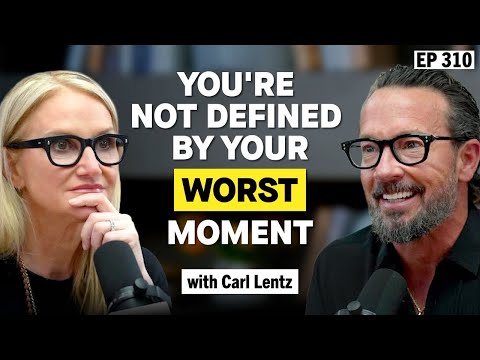
How to Move On, Let Go of Past Mistakes, and Reinvent Yourself
Carl Lentz (guest), Mel Robbins (host)
In this episode of The Mel Robbins Podcast, featuring Carl Lentz and Mel Robbins, How to Move On, Let Go of Past Mistakes, and Reinvent Yourself explores from Shame To Grace: Rewriting Your Worst Chapter Into Power Mel Robbins interviews former Hillsong NYC pastor Carl Lentz about blowing up his life through infidelity, addiction, and secrecy, and how he rebuilt from total public and personal collapse.
From Shame To Grace: Rewriting Your Worst Chapter Into Power
Mel Robbins interviews former Hillsong NYC pastor Carl Lentz about blowing up his life through infidelity, addiction, and secrecy, and how he rebuilt from total public and personal collapse.
Carl explains the difference between shame and remorse, arguing that shame is a self-focused prison while remorse is an engine for change, and details the inner fractures that led to his implosion.
He shares the brutal aftermath—losing his job, home, reputation, friends, and nearly his sanity—and the slow, unglamorous work of healing, rebuilding his marriage, and redefining his identity.
Throughout, they outline a practical emotional roadmap for anyone stuck in regret or self-hatred: confront the fracture, stop digging, forgive yourself, invest in the new you, and choose to author the next chapter.
Key Takeaways
Shame keeps you self-absorbed; remorse propels real change.
Shame says, “I am bad” and locks your focus on yourself, draining energy from healing and others. ...
Get the full analysis with uListen
Your hidden “fractures” will eventually break if you don’t face them.
Carl likens unaddressed issues to a bone fracture an athlete plays on: you can function for a while, but overcompensation and neglect guarantee a worse break later. ...
Get the full analysis with uListen
If you’re in a hole, stop digging and tell someone the truth.
Carl emphasizes that when you’re spiraling—whether in addiction, infidelity, or denial—the first step is to stop compounding the damage with more lies or avoidance and then reach out to someone safe and be fully honest.
Get the full analysis with uListen
Self-forgiveness shows up as investment in your new self, not words.
Saying “I forgive myself” isn’t enough; you demonstrate it by consistently investing time, energy, and habits into the healthier version of you instead of mentally living in your worst chapter.
Get the full analysis with uListen
Forgiveness of others is a decision; the follow-through is daily work.
You won’t instantly feel healed after deciding to forgive; old anger and hurt will resurface. ...
Get the full analysis with uListen
Don’t expect a lifetime of damage to be undone in weeks.
Carl urges people to “give your best self at least as much time as you gave your worst self,” reminding us that rebuilding identity, trust, and wiring (especially after trauma) takes consistent work over years, not quick fixes.
Get the full analysis with uListen
You are the only one who can pick up the pen and rewrite your story.
Regardless of what others did or what you’ve done, you control the narrative from this chapter forward; choosing to author it intentionally—rather than letting shame, other people, or your past dictate it—is where your power lies.
Get the full analysis with uListen
Notable Quotes
“Your worst chapter is not your last chapter.”
— Carl Lentz
“It is easy to lie. It’s not easy to live with lies.”
— Carl Lentz
“Whatever you’re hiding is taking the place of what could be power.”
— Carl Lentz
“At least give your best self the same amount of time to build your life that you gave your worst self to destroy it.”
— Carl Lentz
“You control your story, nobody else… You’ve got to pick up the pen of ownership and say, ‘This is my life. This is who I want to be.’”
— Carl Lentz
Questions Answered in This Episode
Where in my life am I still choosing shame over remorse, and how is that keeping me stuck?
Mel Robbins interviews former Hillsong NYC pastor Carl Lentz about blowing up his life through infidelity, addiction, and secrecy, and how he rebuilt from total public and personal collapse.
Get the full analysis with uListen AI
What “fracture” am I most afraid to bring into the open, and who could I safely tell first?
Carl explains the difference between shame and remorse, arguing that shame is a self-focused prison while remorse is an engine for change, and details the inner fractures that led to his implosion.
Get the full analysis with uListen AI
If I truly forgave myself, what would I start investing in today that I’m currently avoiding?
He shares the brutal aftermath—losing his job, home, reputation, friends, and nearly his sanity—and the slow, unglamorous work of healing, rebuilding his marriage, and redefining his identity.
Get the full analysis with uListen AI
Who am I still mentally carrying because I haven’t forgiven them, and what would it look like to begin releasing them?
Throughout, they outline a practical emotional roadmap for anyone stuck in regret or self-hatred: confront the fracture, stop digging, forgive yourself, invest in the new you, and choose to author the next chapter.
Get the full analysis with uListen AI
If I picked up the pen and authored my next chapter on purpose, what would the first sentence be?
Get the full analysis with uListen AI
Transcript Preview
You should be ashamed of yourself. So, you want me to take my eyes now and go back and look at the horrible things I've done so I can feel shame about them? That's what you want me to do? Now everybody loses. There's a better way. We say a prayer after every single session, which is, "As I lift my eyes from shame to grace." It's called healing. Regret is very different than remorse. Remorse is an engine. Turn that thing on and it'll change you. Your worst chapter is not your last chapter. The thing that's causing you the most pain today, what if I told you that's gonna turn around at some point and it's gonna give you the most power?
Oh, hold on. Say it a little louder for the person in the back, please. (time clock ticking) Hey, it's your friend Mel, and welcome to the Mel Robbins Podcast. I'm absolutely thrilled that you're here, and it is always such an honor to spend time with you and to be together. And if you're a new listener, I also wanted to take a moment and personally welcome you to the Mel Robbins Podcast family. Because you made time to listen to this particular episode, I know you're the kind of person who truly values real, deep conversations that make you think differently about yourself, about your life, and the conversation we're about to have today, oh my gosh, it is going to be incredible because we're gonna be talking about, what do you do after you truly, royally screw things up? Is forgiveness even possible? See, in our Boston studios today, I have the perfect person to help you and me think about forgiveness and how you rebuild after making so many mistakes, and the reason why he's the perfect person is because he's had to do this himself. I'm gonna introduce you to a very good friend of mine, and when you hear who this person is, it may even surprise you. Wait, Mel Robbins is good friends with this guy? I am. And by the time you're done listening to the conversation today, you'll understand why. It takes a lot of courage to be the kind of person who can admit to what you've done wrong and take accountability for making it right, to face yourself in the mirror, to go out in public or show up at school or work or with your friends or your family when you've done something really wrong or you've ruined your reputation or you hurt the people that you care about most, and that's exactly what my friend Carl Lentz has had to do after destroying the life he had built just five years ago. Now, I didn't know him back then. I only met him a few years ago, but let me tell you a little bit about who he was then. Carl was one of the most recognizable mega-church pastors in the world. He co-founded the church Hillsong in New York City, and then he built it from scratch to be almost 150,000 members strong. I mean, in 2017, 2018, 2019, Carl was a cultural icon. He was in the news all the time because he was disrupting what everybody thought a Christian church should be like. I mean, there he was up in front of the pews dressed in leather and skinny jeans and he's all tatted up and rock and roll music is blaring, and from the outside, boy did it look like he was on top of the world. I mean, he couldn't be more blessed. And then, in 2020, it all fell apart in a spectacular train wreck of his own making. He was publicly fired from the church he built, and according to the press release, it was due to, quote, "leadership issues and breaches of trust." It was all over the tabloids. This married mega-church pastor and father of three, beloved by so many, had been having an affair with someone in the church. He lost his job, his reputation, almost every single friend he had, his family lost their housing, and he lost the life he had built because of the choices he had made. And he couldn't outrun this. I mean, there were docuseries made about this thing. He was trending all over the news. Carl owns the mistakes he made. He takes full accountability for what he's done wrong. And today he'll tell you what it feels like to feel like you're driving a locomotive and it's about to hit the wall and you can't stop it. The dread, the weight of it, the anxiety, the secrecy, the arrogance, the lies that you tell yourself and everyone around you. But the reason that I invited him to be here today with you and me is because of what he did after the wreckage. I love that he owns what he did and that he's leaned into the worst things that he's done to extract some of the biggest lessons anyone could learn about life. I love the way that he and his wife and his three children lean toward each other because it's so easy, isn't it, to lean away from people when things get hard? And I also love what they've taken from it as a family and how the entire experience and the past five years have changed him for the better. If you've ever screwed up and gotten fired or lied or cheated on somebody or had a relationship end or done something that you regret, I'm gonna tell you something: It's not the mistake that you made that defines you, it's what you do next. And today, we're gonna flip the way that you think about it on its head. We're gonna teach you how to look at it all differently and forgive yourself, and you're gonna learn how to turn the page, take accountability for what went wrong, learn what you need to learn, forgive yourself, and move on. So please help me welcome my friend Carl to the Mel Robbins Podcast. Carl Lentz, I am so excited that you are here. Thank you for jumping on a plane. Thank you for being here in Boston. I am just... I know that this is going to be a transformational conversation.
Install uListen to search the full transcript and get AI-powered insights
Get Full TranscriptGet more from every podcast
AI summaries, searchable transcripts, and fact-checking. Free forever.
Add to Chrome