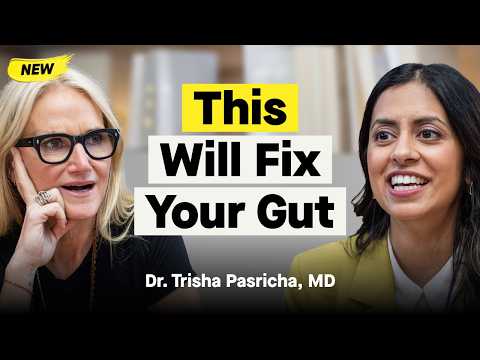
The Gut Health Episode: Harvard Doctor Reveals What’s Normal (and What’s Not)
Dr. Trisha Pasricha (guest), Mel Robbins (host)
In this episode of The Mel Robbins Podcast, featuring Dr. Trisha Pasricha and Mel Robbins, The Gut Health Episode: Harvard Doctor Reveals What’s Normal (and What’s Not) explores harvard GI expert demystifies poop, gut-brain link, and red flags Dr. Trisha Pasricha reframes the gut as a complex organ system—immune, hormonal, and neurological—sending most vagus-nerve signals from gut to brain and influencing mood and stress responses.
Harvard GI expert demystifies poop, gut-brain link, and red flags
Dr. Trisha Pasricha reframes the gut as a complex organ system—immune, hormonal, and neurological—sending most vagus-nerve signals from gut to brain and influencing mood and stress responses.
The episode breaks down digestion anatomy and transit time, then translates common experiences (butterflies, urgency before speaking) into specific stress-hormone physiology and practical decision-making about “gut feelings.”
A large portion of Americans normalize disruptive GI symptoms; the conversation focuses on constipation mechanics, pelvic floor dysfunction, and simple fixes like posture (knees above waist) and biofeedback therapy.
Viewers get a “poop report card” framework: frequency range, ideal time-to-go, stool shape/consistency clues, and color guidance including urgent warning colors and when to document with photos.
The doctor debunks social-media gut trends (especially “leaky gut” as a catch-all diagnosis and routine probiotic use) and emphasizes fiber/prebiotics, limiting ultra-processed foods, and reducing alcohol to protect long-term brain and gut health.
Key Takeaways
Think of the gut as a brain, not just plumbing.
The enteric nervous system contains extensive neural circuitry and produces neurotransmitters; about 80% of vagus-nerve signals travel from gut to brain, reshaping how clinicians view anxiety, mood, and systemic disease links.
Get the full analysis with uListen AI
“Gut feelings” are physiological alarms, not prophecies.
Stress/emotion activates the amygdala → CRH release, slowing the stomach and speeding the colon; Pasricha suggests using the sensation as a cue to pause and ask what the body is detecting (novelty, risk, safety) rather than labeling it good/bad.
Get the full analysis with uListen AI
Normal bowel habits are defined by ease and timing, not “once daily.”
A normal BM should be effortless and socially manageable; frequency can range from 3x/day to once every 3 days, especially shifting with higher fiber intake.
Get the full analysis with uListen AI
Time-on-toilet is a health variable—cap it at five minutes.
Her lab found smartphone bathroom use strongly correlates with sitting >5 minutes and a 46% higher hemorrhoid risk, likely due to prolonged unsupported pelvic-floor pressure and venous engorgement.
Get the full analysis with uListen AI
Constipation is often a coordination/mechanics problem, not just fiber.
A significant subset has pelvic floor dysfunction; evidence-backed biofeedback PT over ~8–12 weeks improves 80–90%, and a simple immediate tweak—raising knees above the waist—can help by straightening the anorectal angle.
Get the full analysis with uListen AI
Stool appearance is a free ‘daily report card’—look at shape and color.
Hard “rabbit pellets” suggest prolonged colon transit or ignoring the urge; color cues matter: pale/clay can indicate blocked bile flow (urgent), maroon/bright red suggests bleeding (needs medical evaluation), and black/tarry can indicate upper GI bleeding (though iron pills can darken stool).
Get the full analysis with uListen AI
Be cautious with trendy diagnoses and supplements; prioritize prebiotics.
“Leaky gut” (intestinal permeability) is real but rarely the proven root cause of vague symptoms; probiotics aren’t recommended for most conditions by AGA, while fiber-rich “fertilizer” (prebiotics) more reliably shifts the microbiome environment.
Get the full analysis with uListen AI
Notable Quotes
“Your gut is a brain.”
— Dr. Trisha Pasricha
“80% of those signals… they’re not going from the brain… down to the gut. They’re going from the gut to the brain.”
— Dr. Trisha Pasricha
“A gut feeling is neither good or bad… it’s simply a message… the stakes of the situation are higher than you realize.”
— Dr. Trisha Pasricha
“Less than five. Ideally, less than one minute. It should be an in-and-out job.”
— Dr. Trisha Pasricha
“If you see [pale clay stool]… you should run and not walk. This is actually an emergency.”
— Dr. Trisha Pasricha
Questions Answered in This Episode
You mention 40% of Americans say bowel issues disrupt daily life—what are the top 2–3 drivers you see clinically (diet, stress, pelvic floor dysfunction, meds), and how should someone triage them?
Dr. ...
Get the full analysis with uListen AI
For the ‘change in bowel habits’ colon-cancer warning sign: what counts as a meaningful change (frequency vs caliber vs urgency), and what at-home tracking is most useful before seeing a clinician?
The episode breaks down digestion anatomy and transit time, then translates common experiences (butterflies, urgency before speaking) into specific stress-hormone physiology and practical decision-making about “gut feelings.”
Get the full analysis with uListen AI
You cite biofeedback for pelvic floor dysfunction with 80–90% improvement—what exactly happens in those sessions, and how can patients find qualified providers?
A large portion of Americans normalize disruptive GI symptoms; the conversation focuses on constipation mechanics, pelvic floor dysfunction, and simple fixes like posture (knees above waist) and biofeedback therapy.
Get the full analysis with uListen AI
Your smartphone/hemorrhoid finding is striking—does the risk come mainly from time sitting, straining, or posture, and what’s the best ‘bathroom setup’ to reduce hemorrhoids?
Viewers get a “poop report card” framework: frequency range, ideal time-to-go, stool shape/consistency clues, and color guidance including urgent warning colors and when to document with photos.
Get the full analysis with uListen AI
On stool color: how do you distinguish beet-related redness from blood in real life (timing, associated symptoms, appearance in the bowl or on paper)?
The doctor debunks social-media gut trends (especially “leaky gut” as a catch-all diagnosis and routine probiotic use) and emphasizes fiber/prebiotics, limiting ultra-processed foods, and reducing alcohol to protect long-term brain and gut health.
Get the full analysis with uListen AI
Transcript Preview
Here's a number that made me realize that we have a gut health crisis hiding in plain sight. 40% of Americans say that their bowels disrupt their daily lives.
40%?
15% of Americans have irritable bowel syndrome. Three out of four Americans can't poop in a public restroom. One out of three struggle to go to the bathroom on vacation.
I have wanted to do an episode on this topic for years. Gut issues, bloating, constipation, gas, IBS, and yes, you and I, we're gonna talk about poop. Oh, yes, we're going there. Today's guest is one of the world's leading experts on the gut-brain connection and how your body influences your mental health, stress, and decision-making. I'm talking about Dr. Trisha Pasricha. Dr. Pasricha is a board-certified neurogastroenterologist, a physician-scientist, and an assistant professor of medicine at Harvard Medical School. What is the gut specifically?
Your gut is a brain. You will think about the gut just as a digestive organ, and it is so much more than that. What if it is gut dysfunction that's responsible for our anxiety? What if it's gut dysfunction that causes depression? What if it's gut dysfunction that causes neurodegenerative disorders? And that completely changed our field, and it's still shaping medicine today.
Okay, now here's a question.
Yeah.
Oh, God. I can't believe I'm gonna ask you this.
I'm so excited. [laughs]
[laughs] Hey, it's Mel, and before we get into this episode, my team was showing me 57% of you who watch The Mel Robbins Podcast here on YouTube are not subscribed yet. Could you do me a quick favor? Just hit subscribe so that you don't miss any of the episodes that we post here on YouTube. It lets me know you're enjoying the guests and the content that we're bringing you, because I wanna make sure you don't miss a thing, and I'm so glad you're here for this episode, 'cause this is a really good one. All right. Let's dive in. Dr. Trisha Pasricha, I'm so excited that you are here.
Thank you so much for having me, Mel.
Oh, my gosh. All right. We are gonna dig into this. I cannot wait. I, I really can't wait to talk about poop. I, I know that, that we're gonna get into that a little bit later, but, um, I'd like to start by asking you, how would my life be different? If I take everything that you're about to teach us today to heart, I apply it to my life, I share it with my friends, what's gonna change about my life?
Your life is gonna change in two big ways. First, you're gonna stop thinking about your gut as a digestive organ. You're gonna start thinking about your gut as a brain, because that's what it is. Your gut is a brain. It has more nerve cells than the entirety of your spinal cord. It is creating all the same neurotransmitters, like dopamine, like serotonin, and it is constantly sending signals up to the brain in your head through this information superhighway called the vagus nerve. And also, so many of the diseases that we're most afraid of, from certain cancers to Parkinson's disease, these can all start in the gut. Once you realize that, everything changes, because then you can realize you can change your health, not 10 years from now, but today. You can start to take control of your health through your gut, and that gives you real control. The second thing that's gonna change for you is that you're gonna realize this whole time your symptoms were never all in your head. All of those GI symptoms, the bloating, the trouble with digestion, the going to the bathroom, none of that was ever just stress. And I think the reason that so many people for so long haven't been believed is because some people aren't as familiar with all of the data and all of the research that I'm gonna share with you today. And once you have that knowledge and that validation, it's gonna give you power back and agency to get the help that you need.
Install uListen to search the full transcript and get AI-powered insights
Get Full TranscriptGet more from every podcast
AI summaries, searchable transcripts, and fact-checking. Free forever.
Add to Chrome