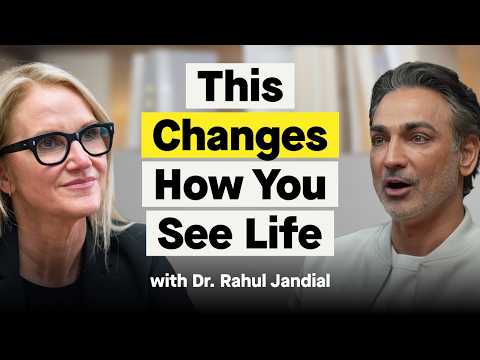
This One Episode Will Change How You Think About the World & Your Life (From #1 Cancer Doctor)
Mel Robbins (host), Dr. Rahul Jandial (guest), Dr. Rahul Jandial (guest)
In this episode of The Mel Robbins Podcast, featuring Mel Robbins and Dr. Rahul Jandial, This One Episode Will Change How You Think About the World & Your Life (From #1 Cancer Doctor) explores a cancer surgeon’s playbook for crisis, change, and meaning now Jandial distinguishes “crisis mode” from “growth mode,” arguing that survival maneuvers (like simplifying and breathing control) are different from self-improvement practices meant for stable seasons.
A cancer surgeon’s playbook for crisis, change, and meaning now
Jandial distinguishes “crisis mode” from “growth mode,” arguing that survival maneuvers (like simplifying and breathing control) are different from self-improvement practices meant for stable seasons.
He explains how end-of-life patients reveal a coping divide between “I wish I had…” regret-focused narratives and “I’m glad I did…” meaning-focused narratives that are actively constructed.
He frames major life pivots as “amputations” that reallocate limited psychological energy toward what matters most, even when the optics look wrong to others.
He teaches “attentional power” as a trainable skill—using paced nasal breathing—to prevent panic, improve decision-making under stress, and build a reliable crisis toolkit.
Using neuroplasticity examples (spinal recovery, hemispherectomy, myelination), he argues real change comes from consistent moderate practice, not one-time heroic effort or outcome-obsession.
Key Takeaways
Match your strategy to your season: crisis maneuvers vs growth practices.
Jandial argues advice fails when it ignores context; in crisis you need stabilizing actions (triage, guardrails, breathing), while in stable periods you build practices (walks, meditation, skill-building) that prepare you for the next storm.
Get the full analysis with uListen AI
When overwhelmed, “amputate” to concentrate limited psychological energy.
He describes dropping out of Berkeley during a period of threat and his mother’s cancer as a deliberate reallocation, not failure; removing one major demand can restore control and capacity to protect what matters most.
Get the full analysis with uListen AI
Use “I’m glad I did…” to rewrite your life story toward meaning.
From cancer patients, he observes coping improves when people stop looping on “I wish I had…” and instead actively build a coherent narrative of lessons, values, relationships, and growth—even when the event was painful.
Get the full analysis with uListen AI
Don’t make irreversible decisions in the peak of crisis.
His guidance for people in acute distress: slow the physiology first, set guardrails, and delay life-altering choices until you can plan with support the next day.
Get the full analysis with uListen AI
Paced nasal breathing is a portable anti-panic tool you must rehearse.
He recommends inhaling for ~3–4 seconds, holding briefly, exhaling slowly, repeating 10–20 cycles in everyday moments (car, line, desk) so it’s automatic when “things go sideways.”
Get the full analysis with uListen AI
Train attention the way you train muscles—small reps create big capacity.
“Attentional power” improves by repeatedly pulling focus back to breath; that same attention capacity then supports CBT-style reframing, nonjudgmental monitoring, and better choices under pressure.
Get the full analysis with uListen AI
Change is built by repetition that myelinates new “grooves,” not intensity.
He explains the brain conserves energy by insulating repeated circuits (myelination), so 15 minutes daily for months can beat occasional marathons; the effort is front-loaded until the new pattern becomes easier.
Get the full analysis with uListen AI
Notable Quotes
“If they start talking and they say, 'I wish I had...' then they're not coping well.”
— Dr. Rahul Jandial
“They never say, 'Oof, I'm glad I was practical and conservative.'”
— Dr. Rahul Jandial
“Don't count the wins, count the shots.”
— Dr. Rahul Jandial
“There is no final moment of arrival.”
— Dr. Rahul Jandial
“Life is beautiful because it's difficult.”
— Dr. Rahul Jandial
Questions Answered in This Episode
How do you practically decide whether you’re in “crisis mode” versus “springtime,” and what are the first three actions you recommend in each?
Jandial distinguishes “crisis mode” from “growth mode,” arguing that survival maneuvers (like simplifying and breathing control) are different from self-improvement practices meant for stable seasons.
Get the full analysis with uListen AI
In an “amputation” moment, how can someone tell the difference between strategic triage and avoidance/escape?
He explains how end-of-life patients reveal a coping divide between “I wish I had…” regret-focused narratives and “I’m glad I did…” meaning-focused narratives that are actively constructed.
Get the full analysis with uListen AI
Can you give a concrete example of turning an “I wish I had…” loop into an “I’m glad I did…” narrative without becoming inauthentically positive?
He frames major life pivots as “amputations” that reallocate limited psychological energy toward what matters most, even when the optics look wrong to others.
Get the full analysis with uListen AI
You mention “moral injury” as a key constraint—what are common forms of moral injury in careers/relationships, and how do you spot it early?
He teaches “attentional power” as a trainable skill—using paced nasal breathing—to prevent panic, improve decision-making under stress, and build a reliable crisis toolkit.
Get the full analysis with uListen AI
What’s your simplest paced-breathing protocol for someone who gets panic symptoms (dizziness, tingling) when trying breathwork?
Using neuroplasticity examples (spinal recovery, hemispherectomy, myelination), he argues real change comes from consistent moderate practice, not one-time heroic effort or outcome-obsession.
Get the full analysis with uListen AI
Transcript Preview
This is one of the most impactful conversations that I've ever had. Dr. Rahul Jandial, a world-renowned cancer surgeon and neuroscientist who treats stage four cancer patients every day. I'm talking adults, children. He is here to give you the life lessons most people learn too late. What has your patients who are near the end of their life, who come to you as a cancer surgeon, taught you about living life now?
If they start talking and they say, "I wish I had..." Then they're not coping well. But some of my others, they say, "I'm glad I did," they're coping well. They never say, "Oof, I'm glad I was practical and conservative." It's a perspective on your life. It's a, it's your own, the story you write for yourself.
So is there a mindset that the person who's listening right now could start to build or practice that could help them go after more or shift things in their lives?
You have to know, "Am I in a storm? Am I in a crisis right now?" You gotta know where you're at. There was a time where I was just like, felt like I was drowning, and it, it's a crisis. Now I'm in crisis management mode.
Could you speak directly to the person who's with us right now who's going through an extraordinarily difficult moment, so they're in the crisis mode? Dr. Jandial, what do you want them to know?
The best thing you can do is-
Hey, it's Mel, and before we get into this episode, my team was showing me 57% of you who watch The Mel Robbins Podcast here on YouTube are not subscribed yet. Could you do me a quick favor? Just hit subscribe so that you don't miss any of the episodes that we post here on YouTube. It lets me know you're enjoying the guests and the content that we're bringing you, because I wanna make sure you don't miss a thing, and I'm so glad you're here for this episode, 'cause this is a really good one. All right, let's dive in. Dr. Jandial, welcome to The Mel Robbins Podcast.
Pleasure to be here.
I am so excited you're here, and I know that some of the things that we are gonna talk about today, you have never talked about in an interview.
Written about them, but, uh, not had a conversation about.
Well, that makes me even more excited for what you're about to teach us today from your extraordinary life. You know, if you think about some of the major life lessons that you've learned both through your work and your own personal experiences, what could change about my life if I take to heart everything that you've witnessed, the wisdom you're about to share, and I apply it to my life? What could change?
Well, for me personally, what I wanna share are rules for survival that have served me well, uh, throughout my life, as well as lessons from my cancer patients that have given me a greater sense of meaning and purpose, because I've had the fortune and privilege to share in their lives, um-
Install uListen to search the full transcript and get AI-powered insights
Get Full TranscriptGet more from every podcast
AI summaries, searchable transcripts, and fact-checking. Free forever.
Add to Chrome