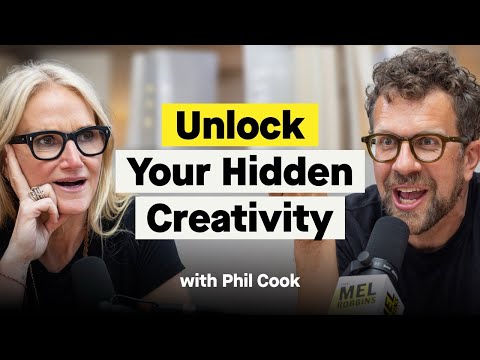
4 Steps to Unlock Your Creativity & Feel More Inspired Every Day
Mel Robbins (host), Phil Cook (guest)
In this episode of The Mel Robbins Podcast, featuring Mel Robbins and Phil Cook, 4 Steps to Unlock Your Creativity & Feel More Inspired Every Day explores four creativity principles to reconnect with intuition and everyday aliveness The conversation argues that most people haven’t “lost” creativity—they’ve buried it under speed, comparison, and expectations, confusing creativity with polished output or public approval.
Four creativity principles to reconnect with intuition and everyday aliveness
The conversation argues that most people haven’t “lost” creativity—they’ve buried it under speed, comparison, and expectations, confusing creativity with polished output or public approval.
Phil Cook links creativity to intuition, describing it as an “exhale” that helps you know yourself, make decisions, and feel more alive in daily life.
They offer four practical principles for unlocking creativity: shed the weight of expectations, lower the stakes, bring yourself to the work through small consistent acts, and find a sanctuary where the world falls away.
Examples range from playful self-expression (fun socks) to private meaning-making (collecting rocks, whittling a “worry stick”), emphasizing creativity as healing, personal, and accessible.
Key Takeaways
Creativity isn’t a talent category; it’s a human capacity.
They challenge the “I’m not creative” identity by expanding creativity beyond art products to everyday choices, preferences, and noticing—anything that expresses the “language of you.”
Get the full analysis with uListen
Your preferences are clues to your intuition.
What music you crank, colors you pick, foods you love, or objects you’re drawn to are treated as guideposts—signals worth naming and following to tune your inner voice like a guitar string.
Get the full analysis with uListen
Shed expectations by separating self-expression from external approval.
They argue creativity gets shut down when it’s judged by outcomes, comparison, or what others think; dropping “who you’re supposed to be” restores access to what’s already alive in you.
Get the full analysis with uListen
Lower the stakes: make it personal, small, and private if needed.
Instead of aiming for “big” (often tied to commerce/consumption), start with low-pressure experiments—yellow nail polish, a joke, a tiny project—so the act of expression becomes the reward.
Get the full analysis with uListen
Vulnerability near the finish line is a sign you’re onto something meaningful.
Phil describes the “last 5%” moment when people abort sharing or completing a creative act; pushing through that vulnerability is framed as the exhale that builds trust in yourself and your intuition.
Get the full analysis with uListen
Bring yourself to the work by showing up with your real limitations.
Creativity is depicted as a practice: time at the instrument, the page, the walk, the shelf—while embracing constraints (even clumsiness) as the very thing that shapes your unique style.
Get the full analysis with uListen
Find (or carry) a sanctuary where the world falls away.
Sanctuary can be a place, routine, song, walk, garden moment, car ride, or object in your pocket; it’s the safe container that helps you regroup, reconnect, and keep creating—often in just minutes.
Get the full analysis with uListen
Notable Quotes
“Creativity allows us to exhale.”
— Phil Cook
“You can speak the language of you. You just have to pay attention to what it is that you notice about life coming in.”
— Phil Cook
“In that realm, you assign the values. You have to assign your own value to what it is, nobody else’s value.”
— Phil Cook
“The indicator is that how vulnerable you feel is an indicator of how personal of something that you made.”
— Phil Cook
“Know that you belong to you.”
— Phil Cook
Questions Answered in This Episode
Phil, how can someone distinguish “intuition” from anxiety or self-criticism when they’re trying to listen inward?
The conversation argues that most people haven’t “lost” creativity—they’ve buried it under speed, comparison, and expectations, confusing creativity with polished output or public approval.
Get the full analysis with uListen AI
What are 3–5 concrete ways to “name your guideposts” (preferences/patterns) so they become actionable rather than just passing feelings?
Phil Cook links creativity to intuition, describing it as an “exhale” that helps you know yourself, make decisions, and feel more alive in daily life.
Get the full analysis with uListen AI
You criticize parents projecting unmet creative goals onto kids—what does a healthier model look like if you still want to expose children to music/art?
They offer four practical principles for unlocking creativity: shed the weight of expectations, lower the stakes, bring yourself to the work through small consistent acts, and find a sanctuary where the world falls away.
Get the full analysis with uListen AI
Can you share a step-by-step way to get through the “last 5%” vulnerability moment (e.g., before sharing an idea in a meeting or finishing a project)?
Examples range from playful self-expression (fun socks) to private meaning-making (collecting rocks, whittling a “worry stick”), emphasizing creativity as healing, personal, and accessible.
Get the full analysis with uListen AI
What would “lowering the stakes” look like for someone whose creativity is tied to performance reviews, clients, or public metrics?
Get the full analysis with uListen AI
Transcript Preview
When was the last time you felt creative? Not productive, not busy, creative. Well, if you haven't felt like that in a while, you're not alone. You and I live in a world that just moves way too fast. We're always scrolling and comparing and reacting. There's always something more important than making space for your own ideas, for your own feelings. No wonder you feel so disconnected. But you wanna know something? That creative part of you, it's not gone. It's been in there since you were born. It's connected to your intuition. Creativity is a way to tap into something deeper and more meaningful in your daily life, and today, we are gonna unleash it. And to help me do that, I'm joined by one of the most grounded, and fun, and inspiring, and creatively awake people I know, Phil Cook. Phil is a musician and a songwriter. He's played with Grammy Award-winning artists like Bonnie Raitt, he's produced award-winning gospel records, and he's released his own deeply personal albums. Phil is a walking reminder that creativity is human.
Your creativity hones your intuition, so you start to listen to your inner voice more. Most people, I think, want to know what that inner voice is when they feel lost. "Guide me." When we tap into our intuition, what we're really tapping into is a chance to know ourselves in a deeper way.
If some part of you knows there's more to life, there's more to you, there's more than what you're currently experiencing, well, this conversation today is for you. Phil and I are gonna help you tap back into it. [upbeat music] Phil Cook-
[laughing]
... I am so excited to welcome you to The Mel Robbins Podcast.
Thanks, Mel.
I already feel more creative and alive.
Hey, I feel very seen. Thank you.
You do?
Yeah, yeah.
You know, Phil, I want- I really wanted to talk to you about creativity because you are living it. You have a very creative life. Something about you and the way that you move through life awakens something in me, and I wanted to introduce you to the person who is here s- with us right now. They may be watching on YouTube, you might be taking a walk, or you're driving a car, and Phil and I are now sitting with you. And Phil, I'd love to have you tell the person who's with us right now, what could they experience in their life that might be different about how life feels? If they really take to heart everything that you're about to share with us today about creativity, about the lessons that you've learned by living a creative life, what could be different?
Life is hard, and painful, and beautiful, and we are all living in these human bodies, born into this world, and who knows how much time we have. So much is happening around us every single day, so much distraction, so much noise. Life gets, uh, fa- it's like fast-forwarding, right? And sometimes I feel like it's like our senses are this one big inhale of all this information year after year. And creativity allows us to exhale. Works hand in hand with intuition. Intuition is tied to our soul. Our soul, and our intuition, and our creativity all working together at the same time. The thing I wanna talk about today really is your intuition is a voice that's inside of you, that you can come to know this voice inside of you, and come to help you make decisions in your life, like tuning a guitar string to exactly the right pitch of you, you know? And your intuition and your creativity feed each other. Your intuition will, um, inform your creativity, and your creativity hones your intuition, so you start to listen to your inner voice more. Most people, I think, want to know what that inner voice is when they feel lost. "Guide me. Help guide me." So when we tap into our intuition, what we're really tapping into is a chance to know ourselves in a deeper way.
Install uListen to search the full transcript and get AI-powered insights
Get Full TranscriptGet more from every podcast
AI summaries, searchable transcripts, and fact-checking. Free forever.
Add to Chrome