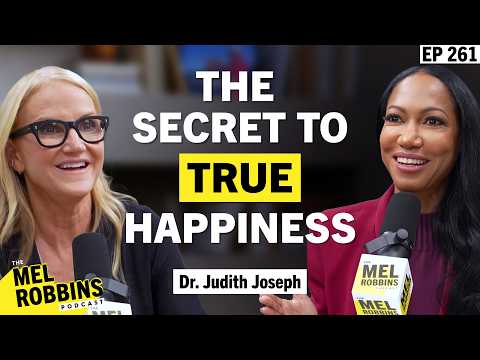
How to Create the Life You Want: Lessons From the #1 Happiness Researcher
Dr. Judith Joseph (guest), Narrator, Mel Robbins (host)
In this episode of The Mel Robbins Podcast, featuring Dr. Judith Joseph and Narrator, How to Create the Life You Want: Lessons From the #1 Happiness Researcher explores scientist Reveals Five Research-Backed Paths To Sustainable Everyday Happiness Psychiatrist and happiness researcher Dr. Judith Joseph joins Mel Robbins to explain why external achievements—houses, cars, careers—don’t deliver lasting happiness, and how deeper biopsychosocial factors do. Drawing on clinical practice and research, she describes five ‘V’s’—Validation, Venting, Values, Vitals, and Vision—as core pathways anyone can use to reduce hidden barriers to joy. Instead of chasing quick fixes, she reframes happiness as accumulating daily ‘points of joy’ across emotions, body, relationships, and future plans. The conversation especially highlights women’s unique vulnerabilities to depression and anxiety, and offers concrete, accessible tools to personalize a happiness “blueprint.”
Scientist Reveals Five Research-Backed Paths To Sustainable Everyday Happiness
Psychiatrist and happiness researcher Dr. Judith Joseph joins Mel Robbins to explain why external achievements—houses, cars, careers—don’t deliver lasting happiness, and how deeper biopsychosocial factors do. Drawing on clinical practice and research, she describes five ‘V’s’—Validation, Venting, Values, Vitals, and Vision—as core pathways anyone can use to reduce hidden barriers to joy. Instead of chasing quick fixes, she reframes happiness as accumulating daily ‘points of joy’ across emotions, body, relationships, and future plans. The conversation especially highlights women’s unique vulnerabilities to depression and anxiety, and offers concrete, accessible tools to personalize a happiness “blueprint.”
Key Takeaways
Start by validating your emotions instead of dismissing them.
Simply asking yourself, “How do I really feel? ...
Get the full analysis with uListen
Venting feelings constructively releases emotional pressure.
Once you’ve named an emotion, you need a safe outlet—talking with a trusted person, praying, therapy, creative expression, or even talking aloud to yourself—while avoiding impulsive, heat-of-the-moment “trauma dumping” on the wrong people.
Get the full analysis with uListen
Reclaim your core values by revisiting what once made you feel alive.
Looking back to childhood joys, meaningful memories, or admired role models can reveal lost values (like nature, music, helping others) that you can reintroduce in small steps, such as a class, a short outing, or a simple creative practice.
Get the full analysis with uListen
Protect your ‘vitals’: body care and relationship quality are non-negotiable.
Nutrition, movement, sleep, limited screen time, and especially supportive relationships all strongly influence mood and longevity; even small upgrades—like adding omega-3-rich foods, a short walk, or tending one healthy relationship—can boost brain health and happiness.
Get the full analysis with uListen
Create a concrete vision of future joy so you’re not stuck in the past.
Tools like a “happiness time capsule” (physical reminders of future experiences you want) or literally scheduling and color-coding joy in your calendar help you plan positive experiences, celebrate small wins, and give yourself something to look forward to.
Get the full analysis with uListen
Tackle one ‘V’ at a time to avoid overwhelm and build momentum.
Trying to overhaul all five areas at once usually backfires; focusing on a single, manageable lever—such as daily emotional check-ins or adding one joyful activity per week—creates early “points of joy” that naturally compound over time.
Get the full analysis with uListen
Redefine happiness as accumulating daily “points of joy,” not a permanent state.
In research, happiness shows up as improvements in sleep, energy, connection, and reduced anxiety or rumination; tracking small shifts in these areas is more realistic and encouraging than waiting to suddenly “feel happy” all the time.
Get the full analysis with uListen
Notable Quotes
“If you don't acknowledge how you feel, you can't do anything about it.”
— Dr. Judith Joseph
“We all have mental health. You may not have a diagnosis, but you have a brain—take care of it.”
— Dr. Judith Joseph
“Real happiness is the sensation of many things: feeling connected when you were lonely, fed when you were hungry, rested when you were tired.”
— Dr. Judith Joseph
“Many people think, ‘Once I have the house, car, partner, perfect job, I’ll feel complete.’ The science shows that once you get those things, you’re still not happy.”
— Dr. Judith Joseph
“Instead of thinking, ‘I don’t feel happy yet,’ think about how many points of joy you got today.”
— Dr. Judith Joseph
Questions Answered in This Episode
Which of the Five V’s—Validation, Venting, Values, Vitals, Vision—do I most neglect, and what is one small experiment I can try with it this week?
Psychiatrist and happiness researcher Dr. ...
Get the full analysis with uListen AI
If I reframed happiness as ‘points of joy,’ what specific sensations or moments would I start counting in my day?
Get the full analysis with uListen AI
How might my own biopsychosocial profile (biology, psychology, and social environment) be quietly shaping my current mood and behavior?
Get the full analysis with uListen AI
In what ways have I been chasing external markers of success instead of reconnecting with values that once made me feel genuinely alive?
Get the full analysis with uListen AI
How could I better support a loved one who seems unhappy—not by giving them tasks, but by helping them validate and safely vent what they’re feeling?
Get the full analysis with uListen AI
Transcript Preview
Everyone has a different idea about happiness.
Mm-hmm.
But many people, when they think of happiness, they're thinking about, "I have this house, I have this car, I have this partner, I have this perfect job. I feel complete." Once you get those things, the science shows that you're still not happy, you're still looking for more things. There are five pathways to happiness. The first, validation. We invalidate how we feel all of the time, we don't acknowledge our stress. We say, "I'm fine, I'm okay." The second V is venting. We need to let out our pressure, we need to let off steam, literally, right? The third is values. Having that self-reflection and thinking about what you truly value, what brings you purpose and meaning. The fourth is vitals. How many bodies did God give you? One. And what do we have to do with it? Take care of it. The fifth is ...
(clock ticking) Hey, it's your friend Mel. I am so happy that you're here, because I love the topic and I love who we're gonna get to spend time with together. And you know who else I love spending time with together? You. It's always an honor to be able to spend this time and learn with you and laugh with you. And if you're brand new, I just wanna welcome you to the Mel Robbins Podcast family. You have picked one heck of a winner of a conversation to listen to, because what's more important than your happiness? Not a whole lot else. And the fact that you hit play, you know what that tells me about you? It tells me that you're interested in learning more about ways that you can improve your life and be happier and you also love research. I love that, because I love that too. And today, I'm bringing you a conversation that's not just inspiring, it's transformational. Today, in our Boston studios, you're gonna get to meet and spend time with the incredible Doctor Judith Joseph. Now, Doctor Judith is a double board certified psychiatrist. She earned her medical degree and MBA, and completed her residency at Columbia University, where she now serves as the chairwoman of the Women in Medicine Board, and she also went to do her fellowship at NYU, where she's been a professor for over a decade. Her cutting-edge research has earned her national recognition, including a US Congress and House of Representatives Proclamation Award for her advocacy in mental health and her innovative research. She is also at the cutting edge of medical research. She's the founder and principal investigator at Manhattan Behavioral Medicine, where she and her team have conducted over 60 clinical research trials, including leading the trial for the first ever FDA approved drug for post-partum depression. Isn't that amazing? Well, that's just the beginning. Doctor Judith's mission aligns perfectly with the mission of the Mel Robbins Podcast, which is to make life-changing information accessible to everyone, in your life, in my life. That's what we're doing here, and why I'm so excited is because through her latest brand new Happy Lab research, she's been working to uncover what she says are the five things based on research that are gonna make you thrive, and today she is revealing them to you, so let's dive in. Please help me welcome the extraordinary Doctor Judith Joseph to the Mel Robbins Podcast.
Install uListen to search the full transcript and get AI-powered insights
Get Full TranscriptGet more from every podcast
AI summaries, searchable transcripts, and fact-checking. Free forever.
Add to Chrome