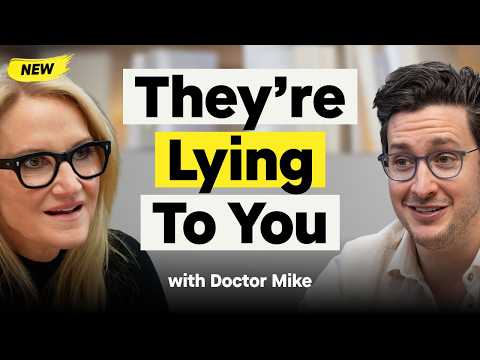
The Top 5 Health Lies & The Truth You Need to Feel Better Today | Doctor Mike
Mel Robbins (host), Dr. Mike Varshavski (guest)
In this episode of The Mel Robbins Podcast, featuring Mel Robbins and Dr. Mike Varshavski, The Top 5 Health Lies & The Truth You Need to Feel Better Today | Doctor Mike explores doctor Mike busts health myths, prioritizes basics, and trust today They argue the biggest health threat isn’t a single supplement or ingredient, but an attention economy that amplifies fear, overconfidence, and profit-driven misinformation while the healthcare system limits time and trust.
Doctor Mike busts health myths, prioritizes basics, and trust today
They argue the biggest health threat isn’t a single supplement or ingredient, but an attention economy that amplifies fear, overconfidence, and profit-driven misinformation while the healthcare system limits time and trust.
Dr. Mike reframes good medicine as informed consent: doctors should present clear data and options, and patients choose based on their goals and risk tolerance.
They highlight structural healthcare problems—billing opacity, PBMs, productivity metrics (RVUs), and lack of primary care access—that disproportionately harm busy, under-resourced families and fuel distrust.
They provide concrete scripts and tactics for disputing medical bills, spotting wellness grifters, and talking to loved ones stuck in misinformation rabbit holes using validation and patience.
They emphasize foundational health behaviors (sleep, movement, nutrition, and human connection) over hyper-optimization, and address high-impact topics like vaccines, nicotine/vaping/pouches, grief, and caregiver burnout.
Key Takeaways
Good healthcare is shared decision-making, not obedience.
Dr. ...
Get the full analysis with uListen
Primary care time is a health intervention.
He argues the most important “doctor you might not be seeing” is a primary care clinician who knows your baseline, can detect subtle changes, and can prevent missed serious issues that urgent care/ER clinicians can’t catch without context.
Get the full analysis with uListen
Always dispute medical bills—assume errors and negotiability.
His rule: “Argue everything. ...
Get the full analysis with uListen
Healthcare distrust grows when humility and communication fail.
They connect post-pandemic overconfidence, poor messaging, and limited access/time with a vacuum that influencers fill; people then interpret “I don’t know” as incompetence instead of honesty and appropriate uncertainty.
Get the full analysis with uListen
Overconfidence is a red flag for wellness grifting.
He notes legitimate clinicians hedge because most symptoms have multiple plausible causes; absolute certainty, miracle claims, and one-size-fits-all protocols often signal someone selling certainty (and a product) rather than practicing medicine.
Get the full analysis with uListen
Chemophobia is easy to exploit; “chemical” is not a synonym for “harmful.”
They use H2O/dihydrogen monoxide to show how scary labels manipulate perception; while real environmental harms deserve research, blanket fear of “chemicals” is scientifically incoherent and commercially weaponized.
Get the full analysis with uListen
Nicotine pouches can be a bigger teen problem because they’re frictionless.
Using a barriers model (stigma, smell, cost, visibility), Dr. ...
Get the full analysis with uListen
Notable Quotes
“Opening your phone these days and searching for a diagnosis or a symptom is literally like shaking a Magic 8-Ball.”
— Dr. Mike Varshavski
“Argue everything. Argue every bill.”
— Dr. Mike Varshavski
“When a doctor says, ‘I don’t know,’ … that’s when they’re being honest.”
— Dr. Mike Varshavski
“I have no doubt in my mind that this year children will die unnecessarily from vaccine-preventable illnesses like measles. It’s a guarantee.”
— Dr. Mike Varshavski
“If your cup isn’t being refilled, you’re gonna fail at helping your loved ones.”
— Dr. Mike Varshavski
Questions Answered in This Episode
You argue ‘some healthcare is better than none, but more isn’t always better.’ What are concrete examples of “too much healthcare” causing harm (tests, scans, false positives), and how should patients weigh that?
They argue the biggest health threat isn’t a single supplement or ingredient, but an attention economy that amplifies fear, overconfidence, and profit-driven misinformation while the healthcare system limits time and trust.
Get the full analysis with uListen AI
When disputing a medical bill, what exact phrases should someone use to request itemized bills, coding reviews, and financial assistance—and what should they document during calls?
Dr. ...
Get the full analysis with uListen AI
You say overconfidence is a key grifter tell. What are the top 5 linguistic cues (phrases, guarantees, timelines, “detox” claims) that reliably separate evidence-based advice from marketing?
They highlight structural healthcare problems—billing opacity, PBMs, productivity metrics (RVUs), and lack of primary care access—that disproportionately harm busy, under-resourced families and fuel distrust.
Get the full analysis with uListen AI
For someone who feels ‘gaslit’ after a rushed appointment, what’s the best way to advocate without escalating conflict—what should they prepare, ask, and follow up with?
They provide concrete scripts and tactics for disputing medical bills, spotting wellness grifters, and talking to loved ones stuck in misinformation rabbit holes using validation and patience.
Get the full analysis with uListen AI
On vaccines: what does “we’ve overturned every stone” mean in terms of study types and surveillance—what would you point a skeptical parent to first and why?
They emphasize foundational health behaviors (sleep, movement, nutrition, and human connection) over hyper-optimization, and address high-impact topics like vaccines, nicotine/vaping/pouches, grief, and caregiver burnout.
Get the full analysis with uListen AI
Transcript Preview
Today's extraordinary guest, he is here to tell you the top health lies and the truth you need to hear to feel better today
This is how many almonds you have to eat. This is how many minutes of your life you'll lose if you eat one hot dog. Do you have headaches? You're not consuming enough pink Himalayan sea salt. Chemophobia, where they're scared of all chemicals. Water is dihydrogen monoxide, but that sounds scary. People view aging as a disease.
Is aging a disease? Doctor Mike is the most followed medical doctor online, where every day he debunks medical misinformation, lies, and raises awareness on health issues to more than 30 million followers
Smoking, then you have vapes. Now we get to the [beep] and all of a sudden, you have a very accessible, very easy, frictionless experience to get nicotine for teens. It can be more problematic than vaping.
That's disgusting. What would you say to somebody who is focused on caring for everyone, but not themselves?
This is effort. You've taken care of everyone and everything else except yourself, and if your cup isn't being refilled, you're gonna fail at helping your loved ones.
What is your take on vaccines?
I have no doubt children will die. It's a guarantee.
Before we jump in, and the episode today is unbelievable, but I gotta show you something. My team just showed me 57% of you who watch the Mel Robbins Podcast here on YouTube are not subscribers. My goal is that we get that number to 50%. I know you're the kind of person that loves supporting people that support you, so if that subscribe button is lit up, it just means you're not a subscriber. Just hit subscribe. That is the number one way you can show your support to your friend Mel Robbins and to the team here at the podcast. It's free, and that way you don't miss a thing. It tells me, the team, that you love the guests that we're bringing. You're gonna love the guest today. You'll love the content that we're putting here on YouTube in an attempt to help you and the people that you love create a better life. Thank you for hitting subscribe. I really appreciate it. All right. Are you ready for a mind-blowing episode? I am too. Let's jump in. Dr. Mike, welcome to the Mel Robbins Podcast.
Thank you so much for having me.
Thank you for taking time out of your busy schedule to be here for me and for the person who's with us, and speaking of the person who is here with us, they are probably feeling a little overwhelmed and burnt out and tired, maybe confused about what the best approach to take with their health is. And what I'd love to have you speak directly to is how might my life change if I take everything to heart that you're about to share with us, the lies you're about to dispel, the truth you're about to share, and I apply it to my life? What might change?
Install uListen to search the full transcript and get AI-powered insights
Get Full TranscriptGet more from every podcast
AI summaries, searchable transcripts, and fact-checking. Free forever.
Add to Chrome