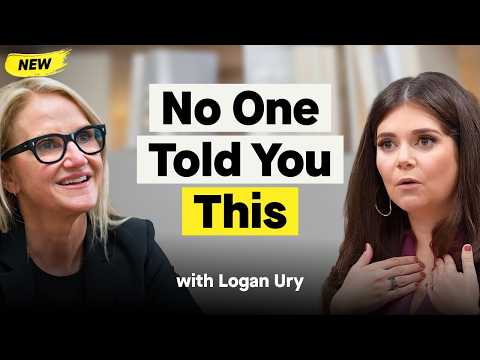
What it Takes to Find & Keep True Love: The Best Advice No One Ever Told You
Mel Robbins (host), Logan Ury (guest)
In this episode of The Mel Robbins Podcast, featuring Mel Robbins and Logan Ury, What it Takes to Find & Keep True Love: The Best Advice No One Ever Told You explores science-backed dating advice: shift mindsets, build skills, find love Logan Ury argues that modern dating feels “toxic” partly because people conflate the inherent difficulty of dating (risk, rejection, ambiguity) with the presence of apps, and she urges listeners to “date like a scientist” by testing assumptions and learning from outcomes.
Science-backed dating advice: shift mindsets, build skills, find love
Logan Ury argues that modern dating feels “toxic” partly because people conflate the inherent difficulty of dating (risk, rejection, ambiguity) with the presence of apps, and she urges listeners to “date like a scientist” by testing assumptions and learning from outcomes.
She explains why common dating heuristics (the “spark,” checklists, the “ick,” texting games) often derail connection, and replaces them with a long-term partner lens and her “Post-Date Eight” reflection questions.
The conversation offers highly actionable guidance: building a clearer profile, limiting simultaneous chats to reduce burnout, moving from texting to dates quickly, handling ghosting with a simple rejection script, and having direct “what are we?” conversations without negotiating.
They also emphasize personal responsibility—developing passions, social courage, and strong friendships—while letting go of what you can’t control (“Let them”).
Key Takeaways
Separate app frustration from the reality that dating is hard.
Ury notes dating inherently involves risk and rejection; blaming technology can hide the real skill gaps (communication, follow-through, resilience) that need practice.
Get the full analysis with uListen
“Date like a scientist” by testing your assumptions.
Treat preferences (e. ...
Get the full analysis with uListen
Your profile should accurately represent your full, real life.
Profiles often over-index on one identity marker (e. ...
Get the full analysis with uListen
Shift from “prom-date mentality” to “life-partner mentality.”
Looks, money, shared hobbies, and similar personalities tend to be overvalued; long-term success is more linked to emotional stability, kindness, loyalty, growth mindset, and conflict skills.
Get the full analysis with uListen
Use the “Post-Date Eight” to evaluate fit, not fantasy.
The questions train you to notice embodied signals (ease/tension), emotional impact (energized vs. ...
Get the full analysis with uListen
Stop over-prioritizing the spark; invest in slow-burn connection.
Only ~11% of couples report love at first sight; the “mere exposure effect” means attraction often grows with familiarity, so writing people off too fast can sabotage good matches.
Get the full analysis with uListen
Know your attachment pattern so you don’t mistake anxiety for chemistry.
Ury describes the anxious-avoidant loop where “chase” feels like love; choosing (and becoming) more secure may feel “boring” initially but supports stable partnership.
Get the full analysis with uListen
Treat situationships as a clarity problem, not a fate.
Situationships aren’t inherently bad if both agree; harm comes when needs are unspoken—ask directly (“What are we? ...
Get the full analysis with uListen
Don’t date potential—date reality.
Both hosts argue “projects” create resentment and aren’t fair; if you wouldn’t choose them as-is, don’t bet your future on a change you can’t control.
Get the full analysis with uListen
Reduce burnout by limiting concurrent chats and moving to dates faster.
Too many conversations increases ghosting and ambiguity; Hinge data suggests fewer ongoing chats (≈5 or fewer) improves progression to dates/relationships, and the “sweet spot” is meeting after ~3 days of texting.
Get the full analysis with uListen
End ambiguity ethically: send a short rejection text instead of ghosting.
Since many ghost because they don’t know what to say, Ury recommends a reusable script (“It was great meeting you, but I don’t think we’re a romantic match”) and avoiding detailed feedback.
Get the full analysis with uListen
Build real-life “approachability” and conversation bridges.
Practical tactics—stand in lines, enter the flow of traffic, ask for recommendations, wear a conversation-starter (“peacock”)—lower the activation energy for meeting strangers in person.
Get the full analysis with uListen
Notable Quotes
““Take that checklist of what you think you should be looking for, tear it up.””
— Logan Ury
““Only 11% of couples experience love at first sight.””
— Logan Ury
““You’re confusing anxiety for chemistry.””
— Logan Ury
““This is a conversation. This is not a negotiation.””
— Logan Ury
““Well, I don’t think you’re dating potential, I think you’re dating a project.””
— Mel Robbins
Questions Answered in This Episode
Post-Date Eight: Which of the eight questions best predicts long-term compatibility in your data, and which do people most ignore?
Logan Ury argues that modern dating feels “toxic” partly because people conflate the inherent difficulty of dating (risk, rejection, ambiguity) with the presence of apps, and she urges listeners to “date like a scientist” by testing assumptions and learning from outcomes.
Get the full analysis with uListen AI
Slow burn vs. spark: How many dates should someone give a “slow-burn” connection before deciding it’s not there?
She explains why common dating heuristics (the “spark,” checklists, the “ick,” texting games) often derail connection, and replaces them with a long-term partner lens and her “Post-Date Eight” reflection questions.
Get the full analysis with uListen AI
Attachment loop: What concrete behaviors help an anxious dater stop pursuing avoidant partners (and vice versa) in the first 30 days?
The conversation offers highly actionable guidance: building a clearer profile, limiting simultaneous chats to reduce burnout, moving from texting to dates quickly, handling ghosting with a simple rejection script, and having direct “what are we? ...
Get the full analysis with uListen AI
Profile audit: What are the top 3 photo mistakes and top 3 prompt mistakes that most reduce quality matches (not just match volume)?
They also emphasize personal responsibility—developing passions, social courage, and strong friendships—while letting go of what you can’t control (“Let them”).
Get the full analysis with uListen AI
Texting sweet spot: Why is “three days to a date” optimal—what goes wrong statistically when it becomes 10–14 days of texting?
Get the full analysis with uListen AI
Transcript Preview
Could you speak to the person listening? They're super discouraged about how toxic dating is, about how they can't find anybody. What do you wish you knew when you were in that place?
Dating is relatively new in the span of human history, and if it feels hard for you, it really feels hard for everyone.
We've got an incredible guest in the studio today, Logan Ury. She's a Harvard-trained behavioral scientist who knows the ins and outs of modern dating. She ran Google's behavioral science team. She is the director of relationship science at Hinge. Logan has the data, the science, and the research-backed advice that you've probably never heard before.
Take that checklist of what you think you should be looking for, tear it up, and instead, these are eight things to ask yourself after every date to look for the things that matter.
What's the research on the spark and love at first sight versus slow burn, it builds over time?
A lot of people think that they need to have the spark, but the research shows us that only 11% of couples experience love at first sight, and the idea of a slow burn is somebody who may not be initially as charming as that other sparky person, but they would make a great long-term partner.
I think one of the huge mistakes that so many people make in relationships is they chase the potential of it, and you excuse away behavior that isn't acceptable. Ghosting has become so common.
One of the biggest causes of dating burnout is not hearing back from someone, and so my advice for people, write a very simple rejection text that you can copy and paste every time.
Give it to us.
"Hey, so-and-so..."
Before we jump in, my team was showing me something. Fifty-seven percent of you who watch The Mel Robbins Podcast here on YouTube are not subscribers, so it's my goal that we get that number to 50%, and I know you're the kind of person that loves supporting people who support you. So if that subscribe button is lit up, it means you're not a subscriber. Do me a favor, just hit Subscribe. That's how you can show your friend Mel Robbins and my team here that you are supporting us, and you love that we support you. By the way, it's free to hit Subscribe, and that way, you don't miss a thing, and it tells me and the team, "Oh, my gosh, I love these experts, Mel," and we will keep bringing them to you here. Thank you, thank you, thank you. All righty, you ready? Let's jump in. [screen whooshes] Logan Ury, welcome to The Mel Robbins Podcast.
So happy to be here!
Okay, I have been so fired up for you to be here in the studio to have this conversation about dating in your 20s and your 30s, and one of the reasons why is because I have two daughters in their 20s. Half of the team here at 143 Studios is early 30s and under, and I am hearing nothing but people complaining in that age group about how toxic dating is, about how they can't find anybody, how they're getting off the apps, how they're super discouraged. And I'm so grateful that you hopped on a plane and flew all the way across country to share your amazing wisdom and this mix of data science and the wisdom that you have from working with people who are single and coaching them. And so I just want to start by saying thank you and then asking you, could you speak to the person listening? What can the person listening expect to be different about their life if they take everything that you're about to teach us about the online dating platforms and how to use them to your advantage, and also what you need to know about dating in real life? How is their life gonna change?
Install uListen to search the full transcript and get AI-powered insights
Get Full TranscriptGet more from every podcast
AI summaries, searchable transcripts, and fact-checking. Free forever.
Add to Chrome