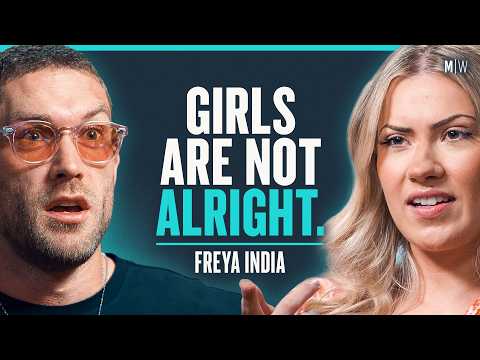
The Extreme Crisis of Young Women - Freya India
Chris Williamson (host), Freya India (guest)
In this episode of Modern Wisdom, featuring Chris Williamson and Freya India, The Extreme Crisis of Young Women - Freya India explores why young women are increasingly miserable, anxious, and politically radicalised online Freya argues her book is being targeted with one-star reviews largely because readers expected a standard progressive critique but encountered skepticism about trans politics, the mental health industry, porn, and family breakdown.
Why young women are increasingly miserable, anxious, and politically radicalised online
Freya argues her book is being targeted with one-star reviews largely because readers expected a standard progressive critique but encountered skepticism about trans politics, the mental health industry, porn, and family breakdown.
She claims many young women have “everything they want but nothing they need,” meaning consumer choice and career opportunity coexist with eroded community, religion, family stability, and real-world belonging.
The conversation frames social media as a substitution machine that turns identity, vulnerability, beauty, and even morality into performance—pushing girls toward rumination, self-diagnosis, and extreme “arms races” in politics and appearance.
They discuss why young women appear more averse than young men to marriage and children, attributing it to risk aversion, fear of vulnerability, unstable relationship models, and learning about sex/relationships through hostile online gender discourse and porn exposure.
They explore a widening political gender gap, suggesting young women are being algorithmically pulled leftward via “safetyism” and reputational pressure, while online ecosystems teach both sexes to generalize the worst stories about the other side.
Key Takeaways
A ‘progressive’ diagnosis can be rejected if it comes from the ‘wrong’ person.
Freya says similar claims are praised when published by mainstream outlets but treated as “far-right dog whistles” when voiced by a right-leaning or heterodox woman, making topic ownership and identity politics central to the backlash.
Get the full analysis with uListen
The core claim is not ‘women are broken’ but ‘women are reacting normally to an abnormal environment.’
Freya distinguishes genuine distress from the added harm of industries that encourage inward focus, labeling, and identity formation around diagnoses rather than addressing upstream cultural conditions.
Get the full analysis with uListen
Social media doesn’t just reflect insecurity—it industrializes it.
They describe an escalating attention economy where beauty, mental health, and politics are pushed toward extremes (Botox-at-17 thumbnails, live-streamed panic attacks, cancellation pile-ons) because extremity outcompetes nuance.
Get the full analysis with uListen
Turning the self into a brand changes what feels ‘rational’ to want.
Freya’s “product vs person” frame suggests motherhood and long-term commitment look like high-risk, low-display investments when status is optimized for visibility, control, and quick feedback loops.
Get the full analysis with uListen
Fear and risk aversion may be the hidden engine of ‘girlboss’ choices.
Rather than reading careerism as simple ambition, they interpret it as a control strategy—insurance against relationship instability, dependence, and the vulnerability of childbearing.
Get the full analysis with uListen
Sex messaging can be simultaneously hypersexual and anti-intimacy.
Freya argues some popular “empowering” sex media communicates contempt, disposability, and dread (“men don’t care about you,” “you’re just a hole”), potentially contributing to lower real-world sexual engagement despite sexualized culture.
Get the full analysis with uListen
Online politics can become a reputational game that rewards moral display over local empathy.
They suggest 2020 accelerated a shift where ‘goodness’ is measured by posts, making participation compulsory and raising the social cost of nuance—while empathy is sometimes performed for distant causes but not practiced interpersonally.
Get the full analysis with uListen
Notable Quotes
“They have everything they want and basically nothing they need.”
— Freya India
“Women are becoming something more like products rather than people.”
— Freya India
“Everything is done in anticipation of an audience.”
— Freya India
“Morality became measurable and instantly judged by your Instagram profile.”
— Freya India
“What you’re praised for in public, you pay for in private.”
— Chris Williamson
Questions Answered in This Episode
What specific evidence in your book most strongly supports the claim that liberal-raised girls are doing worse than conservative/religious-raised girls, and what confounders worry you most?
Freya argues her book is being targeted with one-star reviews largely because readers expected a standard progressive critique but encountered skepticism about trans politics, the mental health industry, porn, and family breakdown.
Get the full analysis with uListen AI
When you say women are being shaped into ‘products,’ what are the clearest everyday behaviors that distinguish a ‘product mindset’ from a ‘person mindset’ in dating, work, and friendship?
She claims many young women have “everything they want but nothing they need,” meaning consumer choice and career opportunity coexist with eroded community, religion, family stability, and real-world belonging.
Get the full analysis with uListen AI
If social media is a key driver, which design features (feeds, filters, stories, DMs, metrics) are most causally harmful—and what would a safer alternative product look like?
The conversation frames social media as a substitution machine that turns identity, vulnerability, beauty, and even morality into performance—pushing girls toward rumination, self-diagnosis, and extreme “arms races” in politics and appearance.
Get the full analysis with uListen AI
How do you separate ‘helpful mental health literacy’ from ‘pathologizing normal feelings’ without discouraging girls who truly need clinical care?
They discuss why young women appear more averse than young men to marriage and children, attributing it to risk aversion, fear of vulnerability, unstable relationship models, and learning about sex/relationships through hostile online gender discourse and porn exposure.
Get the full analysis with uListen AI
You argue pressure is to stay single and self-actualize, not to settle down—what social signals or institutions are producing that pressure, and how has it changed since 2010?
They explore a widening political gender gap, suggesting young women are being algorithmically pulled leftward via “safetyism” and reputational pressure, while online ecosystems teach both sexes to generalize the worst stories about the other side.
Get the full analysis with uListen AI
Transcript Preview
Why has your book got one star-
[laughs]
... on Goodreads?
Because I'm being attacked, um, by [laughs] normie liberal women, I think. Um, so we sent out some galleys, some free copies to just avid Goodreads readers and women who are not in our sort of sphere thinking about things that we are. And I think also because the book looks like an anti-capitalist Marxist book [laughs] , there's no indication that I would sort of be skeptical of the mental health industry or, um, talk about cultural trends like family breakdown. And so a lot of the reviews are women warning each other that this is not what you expect, and you might be hit with a viewpoint you disagree with. Um, and so it's a lot of girls who've got through the first chapter, and then I've said something, like, about trans, and they've just given up and warned each other not to carry on.
You're horrendous.
Yeah, basically.
When did you start writing about women and girls?
I started, um, 2021, so it's been a long time. Um, and it was mostly because I felt anxious, and I wanted to figure out what was going on, and so I was trying to map it all out, and it's taken me sort of five, six years to finally finish the book. So it's, it's not only research that I've done, but it's basically years of my life. I've carried it through different phases and seasons of my life, and this is where I've ended up.
I was talking to William Costelloe. You and him wrote, uh, an article together in Quillette.
Yeah.
And I think you were in still, you were still in sixth form college.
It was so long ago. Yeah, yeah. Um, so I've been writing for a really long time, but part of the criticism against me is that I just picked a topic, and I'm using it to sort of funnel in my right-wing agenda.
Mm-hmm.
So it will be, "Freya just noticed that the mental health crisis was happening, and she's using that to spread her sort of fascist [laughs] -"
Okay
... ideas."
Yeah, yeah, yeah.
Um-
Well, you're in good company here-
Yeah
... 'cause I'm a fascist as well, apparently.
Oh, nice. [laughs]
Uh, we often hear about a lost generation of young men-
Mm-hmm
... but research shows that young women are more pessimistic across the board. They are less likely to say they feel happy, ambitious, excited, or fulfilled and are more pessimistic about the prospect of being happy for their life generally.
Yes.
The fuck's going on?
So is this the New Statesman piece? Yeah. So there was this huge New Statesman piece, Angry Young Women, which made me an angry young woman when I read it. [laughs]
[laughs] Why did you get pissy about the New Statesman piece?
Because they reached a lot of conclusions that a lot of conservative women, conservative people have just been saying for a very long time. So as you said, they were saying that young women feel pessimistic, that they have more negative views that, of men than men have of them, and all we've heard about for the last few years is the manosphere and how men are getting radicalized. And ultimately, the, the argument in their piece was that women are getting radicalized by social media, and particularly by femisphere influencers, so women warning them off other men and getting radical-
Install uListen to search the full transcript and get AI-powered insights
Get Full TranscriptGet more from every podcast
AI summaries, searchable transcripts, and fact-checking. Free forever.
Add to Chrome