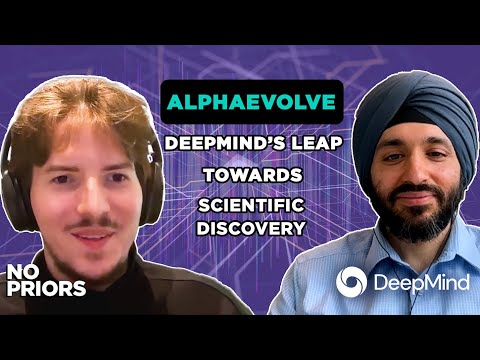
No Priors Ep. 120 | With Google DeepMind’s Pushmeet Kohli and Matej Balog
Sarah Guo (host), Matej Balog (guest), Pushmeet Kohli (guest)
In this episode of No Priors, featuring Sarah Guo and Matej Balog, No Priors Ep. 120 | With Google DeepMind’s Pushmeet Kohli and Matej Balog explores alphaEvolve: Google DeepMind’s AI Agent That Discovers New Algorithms The episode explores AlphaEvolve, a Google DeepMind autonomous coding agent that uses Gemini models plus evolutionary search to invent new algorithms for hard scientific and engineering problems.
AlphaEvolve: Google DeepMind’s AI Agent That Discovers New Algorithms
The episode explores AlphaEvolve, a Google DeepMind autonomous coding agent that uses Gemini models plus evolutionary search to invent new algorithms for hard scientific and engineering problems.
Pushmeet Kohli and Matej Balog explain how AlphaEvolve builds on AlphaTensor and FunSearch, moving from single-problem systems to a general agent that searches directly in program space.
They detail how users define evaluation functions, how evolutionary loops refine candidate programs, and how AlphaEvolve has already produced deployable improvements across Google’s infrastructure and on long‑standing math/computer science problems.
The conversation touches on technical creativity, the importance and limits of automated evaluators, early signs of self‑improving AI, and how such agents could transform scientific discovery while remaining collaborative tools for human experts.
Key Takeaways
Define precise evaluation functions to unlock AI-driven discovery.
AlphaEvolve only needs a clear way to score candidate solutions; once a simulator or evaluator is in place, it can search the space of programs and uncover algorithms that surpass long-standing human-designed methods.
Get the full analysis with uListen AI
Treat LLM “hallucinations” as fuel for structured search, not just errors.
Within AlphaEvolve, the model’s creative, sometimes wrong ideas are aggressively filtered by evaluators and evolutionary selection, turning what is usually a liability into a systematic source of novel algorithmic candidates.
Get the full analysis with uListen AI
Maintain diverse candidate solutions to avoid premature convergence.
The evolutionary loop is explicitly designed to preserve a population of different approaches, recombining and refining them over many generations so the system doesn’t lock into a suboptimal early idea.
Get the full analysis with uListen AI
Use AI agents where search spaces are huge and intuition fails.
Problems like matrix multiplication or data center scheduling involve astronomically large, non-intuitive search spaces; AlphaEvolve excels here by systematically exploring regions humans are unlikely to stumble upon.
Get the full analysis with uListen AI
Prioritize interpretable code outputs for safe deployment.
Unlike opaque neural policies, AlphaEvolve outputs human-readable code, allowing engineers and mathematicians to inspect, understand, and gatekeep solutions before integrating them into critical systems.
Get the full analysis with uListen AI
Invest in better evaluators, including AI-based critics, to broaden domains.
The team sees evaluator quality as the main bottleneck; combining imperfect simulators, auxiliary metrics, and LLM-based critiques (as in AI CoScientist) can extend this approach to fields where exact scoring is hard.
Get the full analysis with uListen AI
View AlphaEvolve as a collaborator that enhances, not replaces, experts.
In practice, mathematicians and engineers use AlphaEvolve interactively—probing, interpreting, and constraining its outputs—gaining both better solutions and new conceptual insights from the generated algorithms.
Get the full analysis with uListen AI
Notable Quotes
“AlphaEvolve is an AI coding agent that is able to discover new algorithms that are able to make new discoveries on open scientific problems.”
— Matej Balog
“We are able to leverage the hallucinations for a beneficial purpose.”
— Pushmeet Kohli
“It is a tool that is already available inside Google and it is being used for many, many problems.”
— Matej Balog
“We are maybe seeing the first sign of self-improvement, but one also needs to be very specific about what we have shown so far.”
— Matej Balog
“You can just sort of see this as a tool that will give scientists a superpower in their ability to search over very complex and sometimes counterintuitive solution spaces.”
— Pushmeet Kohli
Questions Answered in This Episode
How far can systems like AlphaEvolve go in relaxing the need for precise evaluators—could LLM-based critics eventually replace simulators for many tasks?
The episode explores AlphaEvolve, a Google DeepMind autonomous coding agent that uses Gemini models plus evolutionary search to invent new algorithms for hard scientific and engineering problems.
Get the full analysis with uListen AI
What guardrails are needed if AI systems start optimizing their own training procedures in ways that change their cognitive capabilities, not just their speed?
Pushmeet Kohli and Matej Balog explain how AlphaEvolve builds on AlphaTensor and FunSearch, moving from single-problem systems to a general agent that searches directly in program space.
Get the full analysis with uListen AI
In which scientific domains beyond math and computer science will evaluation functions be good enough, soon enough, to enable impactful AlphaEvolve-style discovery?
They detail how users define evaluation functions, how evolutionary loops refine candidate programs, and how AlphaEvolve has already produced deployable improvements across Google’s infrastructure and on long‑standing math/computer science problems.
Get the full analysis with uListen AI
How should education and training for scientists and engineers change if collaborating with algorithm-discovering agents becomes a core part of their workflow?
The conversation touches on technical creativity, the importance and limits of automated evaluators, early signs of self‑improving AI, and how such agents could transform scientific discovery while remaining collaborative tools for human experts.
Get the full analysis with uListen AI
What happens when AlphaEvolve discovers solutions or algorithmic patterns that are no longer interpretable by humans—do we still deploy them, and on what basis of trust?
Get the full analysis with uListen AI
Transcript Preview
Hi, listeners, and welcome back to No Priors. Today, we're joined by two of the key folks behind one of the most compelling developments in AI this year, AlphaEvolve. Pushmeet Koli and Matei Balag worked on this autonomous coding agent that uses Gemini models and evolutionary search to discover new algorithms. It marks a major leap in AI's ability to contribute to core computer science and math, and perhaps sciences beyond that. It's not just a stochastic parrot or a boilerplate generator, it has shown what you might consider technical creativity in the way that Move 37 did with AlphaGo, something humans hadn't done before, even in thousands of years of play. It might even be a real step on the path to self-improving AI. Pushmeet, Matei, thank you so much for being here.
Thank you for having us.
It's a pleasure.
Congratulations on the success and the launch of AlphaEvolve. Can you give me a brief description of- of what it is, broadly?
Yeah, so in maybe one sentence, AlphaEvolve is an AI coding agent that is able to discover new algorithms that are able to make, uh, new discoveries on open scientific problems, and at the same time, those algorithms can be so practical that they are already deployed in key- key parts of Google's own in- infrastructure.
What is the origin story of working on this particular form of coding agent, or this problem statement?
So we are not new to this space of algorithm discovery. Um, as you might know, the- the mission of, uh, all of DeepMind is to build AI responsibly to benefit humanity, and the way our particular team has been doing it for years now is to look for ways how AI can discover new algorithms. New algorithms are everywhere around us, so this is a very, very important question and can have very high impact when we can discover algorithms that solve important computational problems with, uh, higher efficiency than what we have been able to do so far. And kind of the first breakthrough we had in this space was, um, in 2022, when we released a system called AlphaTensor. And so that was a system that was an AI system using, uh, reinforcement learning that for a very specific but, uh, fundamental computational task, so multiplying matrices, for the first time showed that, uh, AI agents can discover better algorithms that- than what humans had been able to do be- before them. Uh, so this was the- the first system that gave, um, weight to this idea that indeed with AI, we'll be able to go into the superhuman region of algorithms that we as humans have not been able to discover ourselves.
How do you differentiate, um, AlphaEvolve from, like, AlphaTensor and FunSearch and some other, um, projects in the sort of lineage of this?
Uh, one way to also describe, uh, what we have done is if you look back at the history of, uh, DeepMind, and, uh, and see a number of sort of projects that have come even before, uh, we started working on computer science, our earlier sort of work, uh, and if you go back to, uh, the project on AlphaGo, where the AlphaGo agent was able to beat the world Go champion in the game of Go, and what was- the remarkable sort of, uh, thing, uh, in- in that, uh, agent was that it was able to explore this amazingly large search space of all possible sort of Go positions in- in such an efficient manner that it can sort of come up with what is the optimal move at that time, right? And it really surprised people. Um, both, uh, G- Go professionals as well as scientists. Scientists believed that that, uh, event would come much, much later because it was a very hard problem. And so, um, what that gave evidence for is that, is the ability of these large-scale, uh, neural network based systems to be able to reason and do very efficient exploration in these large search spaces, and come up with amazing new insights about, uh, the particular domain. And then in the game of Go, I mean, there is this move called Move 37, uh, which is a very creative new move that, uh, the agent discovered that, uh, was not in the Go literature, right, that, uh, really surprised the, uh, Go professionals. So in some sense, uh, we asked ourselves the question that if you have an agent which can do very efficient search in the domain of Go, why can't you use the same kind of philosophy to search for algorithms in the space of algorithms? And in fact, uh, that sort of was the underlying basis of, uh, the work on our- our first sort of, uh, attempt at this- that problem, which culminated in AlphaTensor. Mm-hmm. So, how we structured, uh, the algorithmic discovery, uh, problem is we looked at first a very important problem, and, uh, that problem was matrix multiplication. It is a problem that is ubiquitous in computer, uh, science. It's, uh, one of the key fundamental operators that underlies not only computer science, but also neural networks and machine learning and neu- uh, and- and AI. We said, "Can we find a way to improve matrix multiplication algorithms?" So there's a history of matrix multiplication, which is very interesting, uh, for people who might be interested in it. Like, uh, it's, uh, even though it's such a fundamental operator, um, people thought that the- the complexity or the time it takes to multiply two matrices is O (cube) .
Install uListen to search the full transcript and get AI-powered insights
Get Full TranscriptGet more from every podcast
AI summaries, searchable transcripts, and fact-checking. Free forever.
Add to Chrome