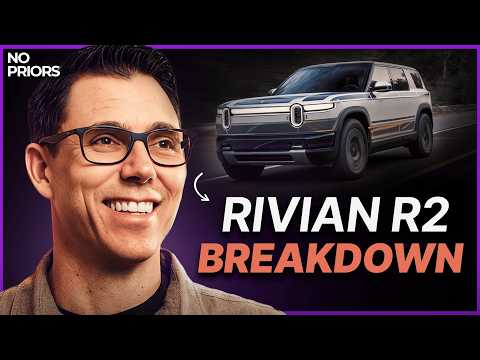
Rivian’s Roadmap to AI Architecture and Autonomy with Founder and CEO RJ Scaringe
RJ Scaringe (guest), Sarah Guo (host)
In this episode of No Priors, featuring RJ Scaringe and Sarah Guo, Rivian’s Roadmap to AI Architecture and Autonomy with Founder and CEO RJ Scaringe explores rivian’s vertically integrated AI stack for autonomy and mass-market EVs Rivian rebooted its autonomy program after launching R1 with a rules-based, third-party camera approach, moving to a clean-sheet, neural-network-centric architecture starting with Gen 2 hardware in 2024.
Rivian’s vertically integrated AI stack for autonomy and mass-market EVs
Rivian rebooted its autonomy program after launching R1 with a rules-based, third-party camera approach, moving to a clean-sheet, neural-network-centric architecture starting with Gen 2 hardware in 2024.
Scaringe argues only a handful of companies have the ingredients to win in autonomy: full sensor/control of data collection, a large vehicle fleet for a data flywheel, and massive onboard and training compute—leading Rivian to build an in-house inference chip.
He claims the auto industry cannot compete at scale without a software-defined, zonal architecture that enables frequent OTA updates, and cites Rivian’s $5.8B VW Group deal as evidence legacy OEMs need a new electronics/software foundation.
R2 is positioned as Rivian’s first true mass-market vehicle (~$45k starting) and a key lever for fleet growth and autonomy training, while EV adoption in the U.S. is framed as primarily a “lack of choice,” not lack of consumer interest.
Key Takeaways
Rivian treated early autonomy as a throwaway and restarted fast.
R1 launched with a “1. ...
Get the full analysis with uListen AI
Modern autonomy progress depends on AI architecture, not rules.
Scaringe describes a step-change driven by transformer-era approaches: older systems were “machine vision plus rules,” while current systems are trained neural networks that improve via data and iteration.
Get the full analysis with uListen AI
Vertical integration is a prerequisite for a serious autonomy flywheel.
Rivian wants raw sensor control (cameras/radar/lidar), onboard event triggering and storage, high-bandwidth uploads (often Wi‑Fi), and internal training pipelines—hard to achieve with arm’s-length suppliers.
Get the full analysis with uListen AI
Onboard inference is the real cost bottleneck, more than sensors.
He argues cameras/radars/lidars have become cheap, but running large models in-car is “an order of magnitude” more expensive than the perception hardware—motivating Rivian’s custom inference chip to put autonomy-capable compute in every vehicle.
Get the full analysis with uListen AI
Autonomy “levels” feel identical until rare corner cases.
For “99. ...
Get the full analysis with uListen AI
Legacy ECU ‘islands’ block rapid feature improvement and AI integration.
Scaringe contrasts domain/function-based architectures (100–150 ECUs with supplier-written software) with zonal architectures (few computers, one OS) that make cross-feature changes and monthly OTAs feasible.
Get the full analysis with uListen AI
R2 is both a market expansion play and an autonomy scaling engine.
R2’s ~$45k entry price targets the U. ...
Get the full analysis with uListen AI
U.S. EV adoption is constrained by product variety, not demand.
He frames ~8% EV penetration as a “shocking lack of choice” under $70k, with many competitors mimicking the Model Y; Rivian’s thesis is that distinctive options pull buyers out of ICE rather than just switching EV brands.
Get the full analysis with uListen AI
Notable Quotes
“By twenty thirty, it'll be inconceivable to buy a car and not expect it to drive itself.”
— RJ Scaringe
“The moment we launched, we knew it was the wrong approach.”
— RJ Scaringe
“Radars are extremely cheap, LiDARs are very cheap, but the really expensive part of the system is actually the onboard inference.”
— RJ Scaringe
“The companies that do this well will exist. The companies that don't do this well... will not exist.”
— RJ Scaringe
“The world doesn't need another Model Y; the world needs another choice.”
— RJ Scaringe
Questions Answered in This Episode
What specifically failed in Rivian’s original “rules-based planner + third-party camera” setup, and what metrics made the reset an obvious call?
Rivian rebooted its autonomy program after launching R1 with a rules-based, third-party camera approach, moving to a clean-sheet, neural-network-centric architecture starting with Gen 2 hardware in 2024.
Get the full analysis with uListen AI
Rivian built an in-house inference chip: what performance targets (TOPS, power, latency) and cost targets drove that decision versus NVIDIA at scale?
Scaringe argues only a handful of companies have the ingredients to win in autonomy: full sensor/control of data collection, a large vehicle fleet for a data flywheel, and massive onboard and training compute—leading Rivian to build an in-house inference chip.
Get the full analysis with uListen AI
How does Rivian decide which “interesting events” get triggered and uploaded—what’s the on-vehicle logic, and how do you avoid biasing the dataset?
He claims the auto industry cannot compete at scale without a software-defined, zonal architecture that enables frequent OTA updates, and cites Rivian’s $5. ...
Get the full analysis with uListen AI
R2 adds lidar: is it primarily for runtime safety, training-time ground truth, or both—and how do you justify the BOM and integration complexity for mass market?
R2 is positioned as Rivian’s first true mass-market vehicle (~$45k starting) and a key lever for fleet growth and autonomy training, while EV adoption in the U. ...
Get the full analysis with uListen AI
You said L2/L3/L4 differ in the “fifth or sixth nine” of corner cases—what are the top corner-case categories you’re prioritizing next, and why?
Get the full analysis with uListen AI
Transcript Preview
By twenty thirty, it'll be inconceivable to buy a car and not expect it to drive itself. Every single one of our cars, we want to have the ability for it to operate at very high levels of autonomy. Radars are extremely cheap, LiDARs are very cheap, but the really expensive part of the system is actually the onboard inference, an order of magnitude more expensive than any of the perception stack. My view is EV adoption in the United States is a reflection of the lack of choice. As consumers, we need lots of choices. We need to have variety. We self-identify with the thing we drive. The world doesn't need another Model Y; the world needs another choice.
[upbeat music] Hi, listeners. Welcome back to No Priors. Today, I'm here with RJ Scaringe, the founder and CEO of Rivian. We're here to talk about their autonomy strategy, proprietary chips, their coming R2 model, whether Americans want EVs, and what our relationship to cars is going to be in the age of AI. Let's get into it. RJ, thanks so much for doing this.
Thank you for having me.
So Rivian's already, uh, an incredibly cool company. How did you decide it was gonna become an autonomy company? When did that happen?
I mean, from the beginning, we thought of it as a transportation and mobility company, and in fact, even before Rivian became Rivian, when I was thinking about what's the first products, it was unclear what kind of car it would be, but or even if it was a car. But it was always clear we wanted to be at the front edge of helping to redefine what does it mean to have access to personal transportation. And so autonomy has always been part of the strategy, but it's now fully coming to life with the technology that we're building.
And when you think about the function of Rivian, there's transportation-
Mm-hmm.
-there's also the experience. Like, wh- when-- how long ago did you guys start investing in the autonomy strategy here?
Yes, we launched R1 in, um, very end of twenty twenty-one.
Mm-hmm.
And we used what I'll broadly characterize, like, a one dato approach to autonomy. So we had a perception platform. We used a, a third party, a front-facing camera that was essentially a third-party solution that then plugged into an overall framework that we built, but it was all rules-based. So the camera was fed a rules-based planner. The planner would then make a bunch of decisions around the feeds from the perception, and it was... You know, the, the moment we launched, we knew it was the wrong approach, but it was the thing we'd started working on, uh, well before the launch. And so at the end of twenty twenty-one, beginning of twenty twenty-two, we made the decision to completely reset the platform. And-
Was that a hard decision?
No, 'cause it was so clear. When we made, we made the-- When you're building something like this, you're, you recognize you're gonna spend many, many billions of dollars creating it. So we knew this, like, at the core of transportation is, is driving, and at the core of that is a shift to having the vehicle be capable of driving itself. And so we made the decision to redo it, like, clean sheet, you know, no legacy of what we had built in the Gen One. And that first launched from a hardware point of view in the middle of twenty twenty-four, uh, so that was with our Gen Two vehicles. You know, not a single line of sha- shared code, not a single piece of common hardware on the perception or on the compute side. And, uh, and then we had to build, like, the actual data flywheel, so we had to grow the car park to build enough of a data flywheel to then start to train the model. And what we showed in our autonomy day late last year, late in twenty twenty-five, was the beginnings of a series of really, like, super exciting steps of how this is gonna grow and expand. I say this all the time, I, I think of not just for Rivian, but I'd say for the auto industry in general, the last three years, compared to the next three years, are gonna look very different. So the rate of progress that we saw in autonomy between, let's say, twenty twenty and twenty twenty-five or twenty twenty-one and twenty twenty-five, and what we're gonna see between today and, let's say, twenty twenty-nine, twenty thirty are-- they're completely different slopes. And that really comes back to, you know, entirely new architectures now being used to develop self-driving, actually, truly AI architectures, whereas before, these were not AI architectures in the, in the true sense. They were, they were, um, u- using machine vision, but really rules-based environments that we defined as, as humans. You know, we codified them, which is very different to how they're now built today.
Install uListen to search the full transcript and get AI-powered insights
Get Full TranscriptGet more from every podcast
AI summaries, searchable transcripts, and fact-checking. Free forever.
Add to Chrome