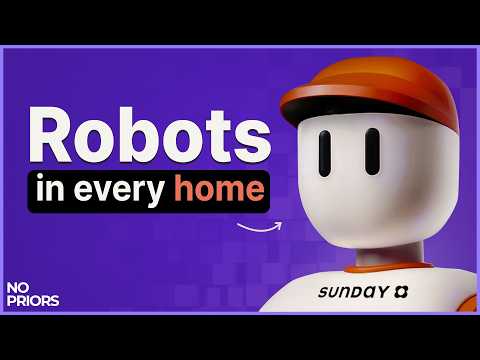
No Priors Ep. 141 | With Sunday Robotics Co-Founders Tony Zhao and Cheng Chi
Tony Zhao (guest), Sarah Guo (host), Cheng Chi (guest)
In this episode of No Priors, featuring Tony Zhao and Sarah Guo, No Priors Ep. 141 | With Sunday Robotics Co-Founders Tony Zhao and Cheng Chi explores sunday Robotics Builds Cheap, Safe Home Robots With Massive Real-World Data Sunday Robotics co-founders Tony Zhao and Cheng Chi describe how recent advances in imitation learning, diffusion policies, and low-cost hardware are finally enabling general-purpose home robots. They explain the shift from brittle, hand-engineered classical robotics to scalable, data-driven systems powered by millions of real-world trajectories collected via custom gloves and tools like Umi. The founders emphasize full-stack integration—hardware, data collection, training pipelines, and product design—to achieve dexterity, generalization, and safety at consumer price points. They outline a 2026 home beta program, discuss realistic timelines and costs, and explain how to critically interpret robotics demos in an industry full of hype.
Sunday Robotics Builds Cheap, Safe Home Robots With Massive Real-World Data
Sunday Robotics co-founders Tony Zhao and Cheng Chi describe how recent advances in imitation learning, diffusion policies, and low-cost hardware are finally enabling general-purpose home robots. They explain the shift from brittle, hand-engineered classical robotics to scalable, data-driven systems powered by millions of real-world trajectories collected via custom gloves and tools like Umi. The founders emphasize full-stack integration—hardware, data collection, training pipelines, and product design—to achieve dexterity, generalization, and safety at consumer price points. They outline a 2026 home beta program, discuss realistic timelines and costs, and explain how to critically interpret robotics demos in an industry full of hype.
Key Takeaways
Data-driven imitation learning is finally making general-purpose home robots viable.
Diffusion policies and transformer-based models trained on paired observation–action data have overcome the brittleness of classical, hand-engineered pipelines, allowing robots to learn complex manipulation from demonstrations at scale.
Get the full analysis with uListen AI
Scalable, high-quality data collection is the core bottleneck in robotics progress.
Sunday’s custom glove and Umi gripper setups let hundreds of non-expert humans collect millions of diverse trajectories in real homes, turning three students’ efforts into one of the largest real-world robotics datasets.
Get the full analysis with uListen AI
Full-stack integration is a competitive advantage in robotics.
Building hardware, data collection tools, cleaning pipelines, and training recipes under one roof lets Sunday iterate rapidly, fix failure modes end-to-end, and avoid research directions that don’t scale to real products.
Get the full analysis with uListen AI
Robot hardware can be cheaper, softer, and less precise when paired with strong perception.
Because modern robots ‘have eyes,’ low-cost, compliant actuators can rely on AI to correct mechanical inaccuracies in real time, enabling safe, home-ready systems without industrial-grade precision motors.
Get the full analysis with uListen AI
Data quality and distribution matching matter as much as data volume.
Failures like a robot trained only on rainy data breaking under direct sunlight show that broad generalization requires careful coverage of real-world conditions plus automated monitoring, calibration, and filtering pipelines.
Get the full analysis with uListen AI
Not all robotics demos indicate real autonomy or generalization.
Sunday urges viewers to question whether demos are teleoperated, whether they show variation in objects and environments, and how long and reliable task sequences are—rather than extrapolating from a single staged clip.
Get the full analysis with uListen AI
Consumer home robots are likely just a few years—not a decade—away.
Sunday plans a 2026 in-home beta with real chores, expects material costs under roughly $10,000 at a few thousand units, and projects a potential consumer launch window around 2027–2028, contingent on reliability and user behavior insights.
Get the full analysis with uListen AI
Notable Quotes
“We’re kind of in between the GPT moment and the ChatGPT moment for robotics.”
— Tony Zhao
“In order for the robot to work in a sunny environment, it must have seen sunny environments in the training data.”
— Cheng Chi
“We really think the robot should have a face. It should have a cute face, and it should be very friendly.”
— Tony Zhao
“Data quality really matters. I always knew it, but once you scale it up, it really matters.”
— Cheng Chi
“When we look at demos, only index on things that are shown, and that’s likely the full scope of that task.”
— Tony Zhao
Questions Answered in This Episode
How will Sunday ensure robots remain safe, trustworthy, and aligned with user expectations once they’re operating autonomously in messy, unpredictable homes?
Sunday Robotics co-founders Tony Zhao and Cheng Chi describe how recent advances in imitation learning, diffusion policies, and low-cost hardware are finally enabling general-purpose home robots. ...
Get the full analysis with uListen AI
What are the most important open research questions in scaling imitation learning from 10 million trajectories to hundreds of millions or billions?
Get the full analysis with uListen AI
How might a large population of home robots change labor markets for domestic work, childcare, and eldercare over the next decade?
Get the full analysis with uListen AI
What standards or benchmarks should the industry adopt to honestly compare generalization and reliability across different robotics approaches and companies?
Get the full analysis with uListen AI
If simulation and world models eventually catch up, how might that change Sunday’s current emphasis on real-world glove-collected data?
Get the full analysis with uListen AI
Transcript Preview
(electronic music) Nobody want to do their dishes. Nobody want to do their laundry. People love to spend more time with their family, with their loved ones. So what we believe in is that if the robot is cheap, safe, and capable, everyone will want our robots. And we see a future where we have more than one billion of these robots in people's homes within the decade. (mechanical whirring)
Thanks, Memo. (mechanical whirring) Hi, listeners. Welcome back to No Priors. Today, we're here with Tony Zao and Cheng Shih, co-founders of Sunday and makers of Memo, the first general home robot. We'll talk about AI and robotics, data collection, building a full-stack robotics company, and a world beyond toil. Welcome. Cheng, Tony, thanks for being here.
Thanks for having us.
Yeah.
Okay. First, I want to ask, like, why are we here? Because classical robotics has not been an area of great optimism over time, or, like, massive velocity of work. And now people are talking about a, a foundation model for robotics or a ChatGPT moment. Um, can you just contextualize, like, the state of AI robotics and why we should be excited?
I would say I think we're kind of in between the GPT moment and the ChatGPT moment. Like, in the context of LMs, what it means is that it seems like we have a recipe that can be scaled, but we haven't scaled it up yet, and we haven't scaled it up so much so that we can have a great consumer product out of it. So this is where I mean, like, GPT, which is like a technology, and ChatGPT, which is a product.
Yeah, um, so we're seeing across academia, there's consensus around what's the method, uh, for manipulation, but everybody's talking about scaling up. It's like we know there's sign of life for the algorithms people are picking, but people don't know if we have more data, like what happened to GPT-2, GPT-3, what will happen. And, but we see a clear trend that, you know, there's no reason to believe that robotics doesn't follow the trajectory of other AI fields, that, you know, scaling up is gonna improve performance.
Maybe even if you took a step back, like, what was the process for deploying a robot into the world, like, 10 years ago? Like, pre-set of generalizable AI algorithms. Like, why, why was it so slow as a field?
Yeah, so previously, um, you know, classical robotics have this sense-plan-act modular approach, where there's a human-designed interface between each of the modules. And those are needed to be designed for each specific task and each specific environment. In academia, that means for every task, that means a paper. So a paper is you design a task, design an environment, and you design interfaces, and then you produce engineered work for that specific task. But once you move on to the next task, you throw away all your code, all your work, and you start over again. And that's also kind of what happened to industry. Uh, and so for each application, people build a very specific software and hardware system around it.
Install uListen to search the full transcript and get AI-powered insights
Get Full TranscriptGet more from every podcast
AI summaries, searchable transcripts, and fact-checking. Free forever.
Add to Chrome