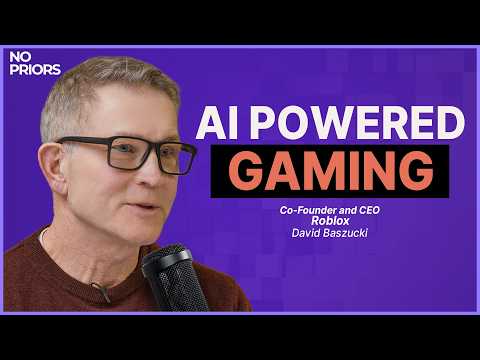
How AI Will Transform Roblox Games into Photorealistic Worlds | CEO David Baszucki
Elad Gil (host), Dave Baszucki (guest), Sarah Guo (host), Elad Gil (host), Dave Baszucki (guest), Sarah Guo (host)
In this episode of No Priors, featuring Elad Gil and Dave Baszucki, How AI Will Transform Roblox Games into Photorealistic Worlds | CEO David Baszucki explores roblox’s AI roadmap: Holodeck realism, NPCs, and creator leverage Baszucki frames Roblox as a 20-year mission to build a high-fidelity, physics-backed “human co-experience” platform—often likened to the Holodeck/metaverse—where AI primarily serves to accelerate realism, scale, and creation.
Roblox’s AI roadmap: Holodeck realism, NPCs, and creator leverage
Baszucki frames Roblox as a 20-year mission to build a high-fidelity, physics-backed “human co-experience” platform—often likened to the Holodeck/metaverse—where AI primarily serves to accelerate realism, scale, and creation.
He contrasts that multiplayer future with an opposite extreme: “real-time dreaming,” where AI generates personalized worlds populated mostly by NPCs, and suggests many hybrid products will emerge between these poles.
A major technical emphasis is synchronization and memory for 10,000-player simulations, plus storing Roblox’s history as replayable vector data (not raster video) for safety, user replay, and training next-gen NPCs.
He anticipates NPCs evolving beyond LLM chat into embodied agents trained on Roblox interaction data, potentially enabling opt-in personal “virtual doppelgängers,” while creators gain leverage via AI-assisted building, testing, and live-ops iteration.
Key Takeaways
Roblox’s north star is stable: physics-backed co-experience at massive scale.
Baszucki describes a long-standing spec—10,000 people, real-time modification, photorealism, NPCs—arguing AI is mainly an accelerator toward that destination rather than a reason to change direction.
Get the full analysis with uListen AI
“4D” is about function and interaction, not just 3D visuals.
He uses 4D to mean simulation with behavior (physics, acoustics, persistence) that enables actions like walking around an office, natural proximity audio, or manipulating objects—capabilities video calls can’t match.
Get the full analysis with uListen AI
The hard problem is multiplayer synchronization and shared memory, not just graphics.
Baszucki highlights the challenge of efficiently synchronizing the state/history of 10,000 participants—where they were, what they did—suggesting future systems may blend native 3D representations with video/latent approaches.
Get the full analysis with uListen AI
Roblox wants to store “everything that happened” as vector history.
He proposes recording Roblox events as vector data to enable playback from any camera angle, support safety investigations, and let users remix meaningful moments—while emphasizing privacy-compliant, judicious use.
Get the full analysis with uListen AI
Next-gen NPCs will be trained from embodied gameplay data, not only text.
Roblox is training NPCs that can navigate and play games using platform interaction data; the roadmap escalates from generally competent NPCs to opt-in personalized models capturing gestures/behavior, and eventually agentic “virtual doppelgängers.”},{
Get the full analysis with uListen AI
Asset generation won’t “cheapify” gaming because expectations rise in parallel.
Baszucki argues that as generative tools reduce asset costs, consumer quality expectations increase at the same speed; the bigger shift is cloud-connected, multi-LOD assets and on-demand procedural/AI generation.
Get the full analysis with uListen AI
The future creator workflow is cloud-native: agents that build, test, and iterate.
He envisions Roblox Studio combining standard AI coding assistants with environment/world generation, plus cloud-based agents that can run automated playtests (NPCs across devices), tune experiences, and support rapid weekly live-ops updates.
Get the full analysis with uListen AI
Notable Quotes
“We do have that business plan slide… it imagined… the Holodeck… the ultimate high-fidelity simulation where people can come together and do stuff.”
— Dave Baszucki
“As the technology for multiplayer 4D simulation gets better and more photorealistic, it’s almost gonna be like video is the downsampling.”
— Dave Baszucki
“Part of the vision for us is to ultimately store the history of everything on Roblox… not raster like video, but… vector… the ability to play back anything that’s ever happened on Roblox.”
— Dave Baszucki
“The data we have, which is 13 billion hours a month, is… very powerful data… around how to create great NPCs that are more than just an LLM.”
— Dave Baszucki
“No matter how cheap it is to create assets, the expectation of quality from consumers goes up at exactly the same velocity.”
— Dave Baszucki
Questions Answered in This Episode
When you say “4D simulation,” what minimum capabilities must be simulated (physics, acoustics, persistence, etc.) for it to feel like a true superset of video?
Baszucki frames Roblox as a 20-year mission to build a high-fidelity, physics-backed “human co-experience” platform—often likened to the Holodeck/metaverse—where AI primarily serves to accelerate realism, scale, and creation.
Get the full analysis with uListen AI
On the 10,000-player goal: what’s the biggest bottleneck today—networking, authoritative simulation, client prediction, or state compression/synchronization?
He contrasts that multiplayer future with an opposite extreme: “real-time dreaming,” where AI generates personalized worlds populated mostly by NPCs, and suggests many hybrid products will emerge between these poles.
Get the full analysis with uListen AI
How would Roblox implement “vector history” in a privacy-compliant way—who can access replays, under what consent model, and how would retention work?
A major technical emphasis is synchronization and memory for 10,000-player simulations, plus storing Roblox’s history as replayable vector data (not raster video) for safety, user replay, and training next-gen NPCs.
Get the full analysis with uListen AI
For NPCs “beyond LLMs,” what training objective matters most: goal completion in games, social believability, safety alignment, or long-horizon memory consistency?
He anticipates NPCs evolving beyond LLM chat into embodied agents trained on Roblox interaction data, potentially enabling opt-in personal “virtual doppelgängers,” while creators gain leverage via AI-assisted building, testing, and live-ops iteration.
Get the full analysis with uListen AI
What product experiences become possible only when NPCs have embodiment and persistent memory (vs. today’s text companions)?
Get the full analysis with uListen AI
Transcript Preview
What proportion of you think your children will have at least one serious relationship with an AI throughout their lifetime?
I think zero right now.
Yeah.
I don't think we're close to crossing the human-AI barrier, but it is worth thinking. Things are changing every day. We have to incorporate and do that. And then there's also some weird universal truths [chuckles] of things that stick around for forty years, and you kind of have to blend them together. We feel if we build Roblox right, it might be the kind of thing that's kicking around in forty years.
[upbeat music] Hi, listeners. Welcome back to No Priors. Today, Elad and I are here with Dave Baszucki, the founder and CEO of Roblox, the 3D immersive world where more than one hundred and fifty million users come every day to hang out. We talk with Dave about the future of AI in gaming, their investments in AI, how NPCs are going to change and really transform game, Roblox's Studio, one of the largest coding platforms out there, and their twenty-year mission to build the Holodeck. Welcome, Dave. Dave, thanks so much for doing this with us.
It is so great to be here, and thank you for doing this in Roblox headquarters.
Yeah, exciting to be here.
Yeah, great to have you guys. Thanks.
So I think we want to start with a big-picture question. I think, um, you all have been really visionary in terms of where all this is heading, and AI is obviously having a big wave and effect on gaming and what's going to happen in the future there, and that's across things like world models. How do you think about NPCs and their evolution? Uh, how you think about assets within games, how you think about world creation. So we'd just love to hear your views of, like, big picture, ten years from now, where are we going? Like, what's coming?
Yeah, so two-step on this one. I would say first, I know you both dabble in investing a little.
Yeah.
So there is, there is a Roblox business plan PowerPoint deck from almost twenty years ago that we pull out sometimes, and we're amazed at the fidelity of it. It, uh, portends a new category. One could call it the category of human co-experience. It's got the sizes of a bunch of companies from twenty years ago, so you can see social networking companies, you can see YouTube video, you can see toys, and you can see all of that. And what this-- what it imagined is really a new category. Some have called it the metaverse, some have called it the, the Holodeck, which is really the ultimate high-fidelity simulation where people can come together and do stuff.
Feels like a Ready Player One, the movie.
The... Exactly.
Yeah.
And so we do have that business plan slide, and, and what we had always imagined is if this high-fidelity space was backed by physics simulation and reality simulation, you'd be able to do stuff. You'd be able to build a car, put wheels on it, drive it around. You'd be able to go to a birthday party and blow out the candles. You'd be able to chop trees down and make a, a house of it. So that, that was literally the genesis of Roblox, and here we are, twenty years later, there's so much more to do. But one vision of AI is how do you superpower the creation of that Holodeck, and how do you get it photorealistic as soon as possible? How do you get ten thousand people in it instead of a hundred? How do you do acoustic simulation that sounds realistic with ten thousand people? So in that sense, AI is super interesting about just trying to get a vision that's been around for twenty years and has arguably been in sci-fi, once again, Snow Crash, Holodeck, forever. Um, there is another interesting vision, and, and I think it's useful comparing these product, um, things. There's much more, "What's the future of just a single person by themselves dreaming what they want to dream?" And, um, we sometimes call that real-time dreaming category. It's a category that, uh, we can see a bit of the trappings of with short-form video. There's a little bit of that in short-form video. You know, someone's two AM in their bed, doom scrolling.
Install uListen to search the full transcript and get AI-powered insights
Get Full TranscriptGet more from every podcast
AI summaries, searchable transcripts, and fact-checking. Free forever.
Add to Chrome