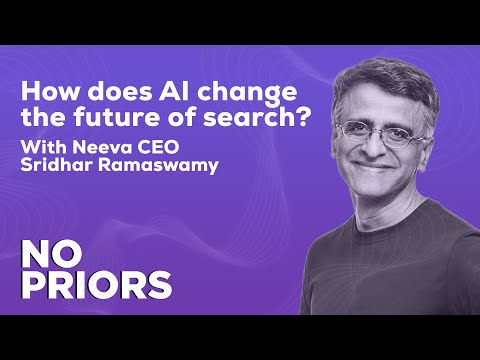
No Priors Ep. 8 | With Neeva’s Sridhar Ramaswamy
Sarah Guo (host), Sridhar Ramaswamy (guest), Elad Gil (host)
In this episode of No Priors, featuring Sarah Guo and Sridhar Ramaswamy, No Priors Ep. 8 | With Neeva’s Sridhar Ramaswamy explores neeva’s Sridhar Ramaswamy on Reinventing Search With AI Answers Sridhar Ramaswamy discusses why he left Google to build Neeva, a privacy-focused, ad-free search engine that later pivoted to AI-powered answer experiences. He explains how large language models (LLMs) unlocked scalable, cited summaries that fundamentally improve search versus traditional lists of links. The conversation dives into the technical and economic challenges of marrying LLMs with information retrieval, from cost and infrastructure to model selection and retrieval-augmented generation. They also explore distribution hurdles, business models, and how AI answers may reshape the relationship between search engines, advertisers, and content publishers.
Neeva’s Sridhar Ramaswamy on Reinventing Search With AI Answers
Sridhar Ramaswamy discusses why he left Google to build Neeva, a privacy-focused, ad-free search engine that later pivoted to AI-powered answer experiences. He explains how large language models (LLMs) unlocked scalable, cited summaries that fundamentally improve search versus traditional lists of links. The conversation dives into the technical and economic challenges of marrying LLMs with information retrieval, from cost and infrastructure to model selection and retrieval-augmented generation. They also explore distribution hurdles, business models, and how AI answers may reshape the relationship between search engines, advertisers, and content publishers.
Key Takeaways
Ad-free, privacy-first search alone isn’t enough to shift consumer habits.
Neeva learned that while people say they care about privacy and fewer ads, especially in the US they rarely switch defaults unless there is a clear, tangible experience upgrade; Europe showed more sensitivity to privacy.
Get the full analysis with uListen AI
AI-generated, cited answers are a step-function improvement over link lists.
LLMs now let search engines synthesize authoritative summaries for the majority of answerable queries, aligning with users’ core preference for minimal effort and direct answers rather than scanning opaque links.
Get the full analysis with uListen AI
LLMs can replace many bespoke, brittle systems in search infrastructure.
Tasks like query rewriting, structured data extraction, and trigger logic for rich results that once required complex regexes and custom code can now be handled by small, fine-tuned models, dramatically simplifying engineering.
Get the full analysis with uListen AI
Cost challenges of LLM search can be mitigated with smaller, specialized models.
Instead of relying on a single massive model for everything, Neeva uses 5–10B parameter models, fine-tuning and human feedback to solve specific problems at much lower serving costs while preserving quality.
Get the full analysis with uListen AI
Distribution and default habits remain the existential challenge for new search engines.
Even with better technology, dislodging entrenched defaults like Google requires creative distribution strategies—apps like Gist, integrations with products like Dashlane or Proton, and embedded conversational search for publishers.
Get the full analysis with uListen AI
AI answers will likely reshape incentives and power dynamics for publishers.
Larger platforms (e. ...
Get the full analysis with uListen AI
The next frontier is LLMs orchestrating tools and actions, not just text.
Sridhar is especially bullish on “action transformers” that combine LLMs with tools like search, calculators, APIs, and code—enabling future AI agents such as AI SREs, code reviewers, and automated workflows.
Get the full analysis with uListen AI
Notable Quotes
“It cannot be that there's one company, one religion, one product for the whole world.”
— Sridhar Ramaswamy
“If you can provide a believable answer to a question, people are always going to prefer that over any number of links.”
— Sridhar Ramaswamy
“Search is one of these things where you need a fair amount of scale before you have any kind of meaningful product.”
— Sridhar Ramaswamy
“Smart people will come up with great explanations for everything that they do as long as it's convenient to them.”
— Sridhar Ramaswamy
“If two years from now three college kids can build a brand new application that uses language models in a fundamental way, that feels very possible—and that is what is really exciting.”
— Sridhar Ramaswamy
Questions Answered in This Episode
How can smaller publishers survive and thrive in a world where AI answers increasingly sit between users and their content?
Sridhar Ramaswamy discusses why he left Google to build Neeva, a privacy-focused, ad-free search engine that later pivoted to AI-powered answer experiences. ...
Get the full analysis with uListen AI
What concrete product experiences will be compelling enough to make mainstream users voluntarily switch their default search engine?
Get the full analysis with uListen AI
Where is the true quality ceiling for small, specialized models versus frontier-scale LLMs in search and summarization?
Get the full analysis with uListen AI
How might regulators eventually respond to the tension between AI-generated answers and the economic viability of the open web?
Get the full analysis with uListen AI
What new categories of AI agents built on action transformers does Sridhar expect to appear first in real-world production use?
Get the full analysis with uListen AI
Transcript Preview
(instrumental music) . Sridhar, I've learned so much from you as an investing partner, founder, and friend. Welcome to the podcast.
Thank you. Very excited to be here saying I've (laughs) learned so much about companies and investing in tech from you.
Let's start with the background. Tell us about the motivation to start Neeva when you were already part of creating the dominant search product.
Yeah. So Neeva was a little bit of back to basics thinking. Uh, when I left Google, I knew I wanted to start a company. Um, I spent a lot of time with Vivek about what we wanted to work on, and we ultimately came to the conclusion that, like, we are (laughs) actually really excited about search. Uh, there's the geek in us that like to help people, uh, find information that they needed. Um, and we were also ambitious enough to think that, you know, 20 years in, uh, we could rethink the search product and create a better one. Our aha moment, uh, is a little bit of an abstract aha moment, which is we said, "If we didn't have to deal with ads, if we didn't have to worry about, like, monetizing, we truly could start from back to basics." As, uh, both of you know, in startups, it's as much about taking advantage of opportunity as it is the original direction that you set." So the first three years of Neeva were really about building a better private search engine. And honestly, it also taught us a lot of pretty harsh lessons about consumers and, uh, you know, whether they were ready for change, um, or not. Um, and really, what we saw happen with AI and large language models last year was that aha moment when we realized, "Wait, we can have the great principles that we started Neeva with and create a much, much better experience." And so that's, that's a little bit of the journey to where we were. But at our core, Neeva was like, "There must be a better search product. It cannot be that there's one company, one religion, one product for the whole world."
So, I think many people, um, who use Google every day would say, like, "It's actually pretty good." And as somebody who was working on this, um, you could see, I think sometimes users are blind when they have a, you know, a default that's this strong. What were the things you thought could be better? And if I could add to that, like, how does that factor into the Neeva mission?
Yeah. So, I mean, an important part, at least early on, was the private and the ads-free. And, you know, we have to say that we underestimated how much people, especially in the US, would care about it. Um, as you know, figuring out consumers is a very tricky thing. People will often not do what they say they, uh, will do or will not even admit to things that... like, they will or will not do. That's just the nature of the game. For us, for example, we were surprised that, um, we did so much better in Europe compared to the United States. And you don't really think of them as being that different, but in practice, in terms of how many people care, it is actually very different. So, a lot of the early Neeva was really about how do we use the power of being, um, privacy-focused and ads-free to create truly a better experience. Um, so we've tried a number of things. Um, they have achieved varying degrees of success. For example, the integration of, uh, things like personal data, personal preferences. Um, but I would say the, the fundamental challenge of Neeva, especially in the United States, has been, how do you get people to take that initial step of caring enough to want to change their search engine? Um, once you actually get people to do that, the job gets considerably easier and they begin to see all of the things that were not really that great about, you know, about that experience. Again, as a startup founder, as a consumer startup founder, I think these are pretty harsh lessons in consumer psychology, but one that, you know, one has to learn.
Install uListen to search the full transcript and get AI-powered insights
Get Full TranscriptGet more from every podcast
AI summaries, searchable transcripts, and fact-checking. Free forever.
Add to Chrome