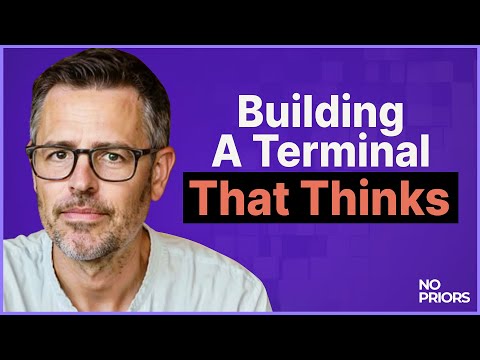
No Priors Ep. 137 | With Warp Co-Founder & CEO Zach Lloyd
Elad Gil (host), Zach Lloyd (guest), Narrator
In this episode of No Priors, featuring Elad Gil and Zach Lloyd, No Priors Ep. 137 | With Warp Co-Founder & CEO Zach Lloyd explores warp CEO Zach Lloyd Explores AI Coding, Consciousness, And Developer Futures Zach Lloyd, co-founder and CEO of Warp, discusses how today’s large language models represent a powerful distillation of intelligence without consciousness, arguing that we’ve effectively passed the Turing test yet still lack any clear way to test for machine awareness.
Warp CEO Zach Lloyd Explores AI Coding, Consciousness, And Developer Futures
Zach Lloyd, co-founder and CEO of Warp, discusses how today’s large language models represent a powerful distillation of intelligence without consciousness, arguing that we’ve effectively passed the Turing test yet still lack any clear way to test for machine awareness.
He explains Warp’s evolution from an “AI terminal” into an “agentic development environment,” where developers can instruct their computers via commands or natural language and let agents handle complex coding and debugging tasks.
Lloyd outlines a shift in software development from “developed by hand” to “developed by prompt,” and eventually toward partial or full automation, while stressing that senior engineering expertise is becoming more—not less—valuable.
They also explore market structure questions around bundling versus fragmentation in dev tools, how model commoditization might play out, and why automation-focused agent workflows could deliver clearer ROI than simple productivity enhancements.
Key Takeaways
Current AI models exhibit impressive intelligence without evidence of consciousness.
Lloyd argues that large language models show functional intelligence through next-token prediction and deep reasoning-like behavior, but lack subjective experience or any convincing basis for attributing true consciousness.
Get the full analysis with uListen AI
The Turing test is effectively passed, but it no longer settles the consciousness debate.
Humans can have rich, seemingly profound conversations with models, yet still intuitively and philosophically resist calling them conscious—showing the Turing test is an outdated benchmark for what really concerns us now.
Get the full analysis with uListen AI
Warp positions the terminal as the primary interface for agentic development.
By sitting as the outer app around the command line, Warp can blend terminal power with richer UX, enabling agents to perform coding, debugging, setup, and other dev tasks initiated by natural language or commands.
Get the full analysis with uListen AI
Software development is moving from manual editing to prompt-driven and partially automated workflows.
Lloyd frames three phases—developed by hand, developed by prompt, and automated development—and expects widespread prompt-based workflows soon, with a growing but incomplete share of tasks fully automated by agents.
Get the full analysis with uListen AI
Senior engineering expertise becomes more critical as agents handle more coding.
Agents behave like powerful junior engineers that can introduce bugs, security issues, or architectural debt, so experienced developers who can design systems, review code, and maintain code quality gain even more importance.
Get the full analysis with uListen AI
Security, verification, and stronger languages gain value in an agent-heavy world.
Tools that automatically detect vulnerabilities or verify correctness, plus safety-oriented languages like Rust, become increasingly important to compensate for the potential risks and volume of agent-generated code.
Get the full analysis with uListen AI
Long-term advantage may shift from models to context, harnesses, and automation.
As model gains for coding appear to slow and potentially commoditize, Lloyd sees more differentiation in how tools wrap models (the “harness”), manage rich context, and enable programmable, outcome-driven automation (e. ...
Get the full analysis with uListen AI
Notable Quotes
“We’ve distilled intelligence into next-token prediction, but there’s no consciousness there.”
— Zach Lloyd
“The Turing test has passed—and what’s crazy is we just passed it and no one seemed to care.”
— Zach Lloyd
“Our target is pro developers building software that’s economically meaningful, not just vibe-coded apps.”
— Zach Lloyd
“You can think of these agents kind of as junior engineers—without senior oversight, they can make your codebase unmaintainable or insecure.”
— Zach Lloyd
“I think the bigger market here is automated development; automation is a better place to be than productivity enhancement.”
— Zach Lloyd
Questions Answered in This Episode
If we can’t rely on behavior alone, what would a convincing, practical test for AI consciousness actually look like?
Zach Lloyd, co-founder and CEO of Warp, discusses how today’s large language models represent a powerful distillation of intelligence without consciousness, arguing that we’ve effectively passed the Turing test yet still lack any clear way to test for machine awareness.
Get the full analysis with uListen AI
How should companies restructure engineering teams and processes to balance human expertise with increasingly capable coding agents?
He explains Warp’s evolution from an “AI terminal” into an “agentic development environment,” where developers can instruct their computers via commands or natural language and let agents handle complex coding and debugging tasks.
Get the full analysis with uListen AI
At what point does the proliferation of agent-generated code create systemic security or maintainability risks that require entirely new safeguards?
Lloyd outlines a shift in software development from “developed by hand” to “developed by prompt,” and eventually toward partial or full automation, while stressing that senior engineering expertise is becoming more—not less—valuable.
Get the full analysis with uListen AI
How might the balance between bundled, all-in-one dev platforms and specialized point tools shift as models commoditize and context becomes the main differentiator?
They also explore market structure questions around bundling versus fragmentation in dev tools, how model commoditization might play out, and why automation-focused agent workflows could deliver clearer ROI than simple productivity enhancements.
Get the full analysis with uListen AI
What metrics or experiments would best demonstrate clear ROI for moving from assistive coding tools toward fully automated development workflows?
Get the full analysis with uListen AI
Transcript Preview
Today on No Priors, I'm joined by Zach Lloyd, the co-founder and CEO of Warp, a terminal product and AI tool for developers that allows you to do different sorts of coding applications. Prior to Warp, Zach was at Google, and he also started another company called Self-Made. We talk about AI dev tooling, but we also end up talking about human consciousness and how can you tell if an AI is actually sentient. Zach, welcome to No Priors.
I'm excited to be here. Thanks for having me.
So, you have a, a master's degree in the philosophy of science.
Yeah.
And if you were to take a very different lens and abstract out of the, you know, coding world and all the things that we tend to think about every day-
Yeah.
... how do you think about it societally in terms of the big wave of AI that's hitting us right now, and wh- wh- where do you think some of these really big societal impacts will be?
The way I think about, like, the advances are it's kinda like we are distilling intelligence.
Mm-hmm.
And so, there are, I think, people who consider what's happening, it's like they're like, "Are we recreating people in some way? Are we recreating consciousness?" But it's not that. It's actually, what's fascinating to me is how much intelligence you can get out of just, like-
Mm-hmm.
... next token prediction. (laughs)
Yeah.
And, like, what does that say about the way that our minds-
Mm-hmm.
... work?
Mm-hmm.
Something I'm always thinking about is, like, is this how our brains are working? Are we-
Yeah.
... are we doing next token prediction? And I don't think so. Like, I think that there's gonna be some further AI unlock.
There's actually a book about this that I think is really interesting called Blindsight.
Okay.
It's like a sci-fi book where they separate consciousness from intelligence.
Yeah.
And basically, humanity meets a space-faring civilization, or civilization is overstating it, a space-faring intelligent being that's not conscious.
Yep.
And what are the implications of that and how do you think about that and how do you communicate with that? Are you basically saying that that's kind of your view of AI right now?
I, I think that's what it is at the moment, is like we've distilled intelligence or something that, like, from, like, an instrumentalist or, like, functional perspective is able to do things that we recognize as intelligence, but it's totally mechanistic, and I don't think anyone who's looking at this thinks that there's any aspect of consciousness-
Mm-hmm.
... to it. I think that's, like, a, a very confusing thing for people.
Yeah.
Um...
'Cause the classical test for this-
Yeah.
... was known as the Turing test, right?
Install uListen to search the full transcript and get AI-powered insights
Get Full TranscriptGet more from every podcast
AI summaries, searchable transcripts, and fact-checking. Free forever.
Add to Chrome