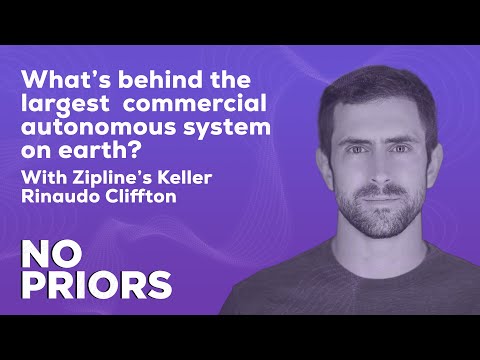
No Priors Ep. 4 | With Zipline’s Keller Rinaudo Cliffton
Sarah Guo (host), Keller Rinaudo Cliffton (guest)
In this episode of No Priors, featuring Sarah Guo and Keller Rinaudo Cliffton, No Priors Ep. 4 | With Zipline’s Keller Rinaudo Cliffton explores zipline’s Radical Drone Logistics: From Rock Climbing To Saving Lives Keller Rinaudo Cliffton recounts Zipline’s journey from a small hobby robotics project to the world’s largest commercial autonomous drone delivery system, focused on medical logistics. He explains how Zipline chose to tackle life-or-death healthcare delivery in countries like Rwanda and Ghana, rather than consumer convenience use cases. The conversation dives into the brutal realities of building full‑stack robotics infrastructure—hardware, software, operations, regulation—and how early naïveté, ruthless practicality, and rapid exposure to real customers shaped the company. Rinaudo also describes Zipline’s novel acoustic detect‑and‑avoid system, the business’ global scaling plans, and his broader belief that ambitious hardware companies can profitably solve humanity’s biggest problems.
Zipline’s Radical Drone Logistics: From Rock Climbing To Saving Lives
Keller Rinaudo Cliffton recounts Zipline’s journey from a small hobby robotics project to the world’s largest commercial autonomous drone delivery system, focused on medical logistics. He explains how Zipline chose to tackle life-or-death healthcare delivery in countries like Rwanda and Ghana, rather than consumer convenience use cases. The conversation dives into the brutal realities of building full‑stack robotics infrastructure—hardware, software, operations, regulation—and how early naïveté, ruthless practicality, and rapid exposure to real customers shaped the company. Rinaudo also describes Zipline’s novel acoustic detect‑and‑avoid system, the business’ global scaling plans, and his broader belief that ambitious hardware companies can profitably solve humanity’s biggest problems.
Key Takeaways
Pick a problem important enough to justify a decade of work.
Zipline’s founders explicitly asked what problem was big and meaningful enough to merit 10+ years of effort, which led them to focus on global healthcare logistics rather than marginal consumer robotics use cases.
Get the full analysis with uListen AI
Get real products into customer hands early, even if they’re rough.
Launching national‑scale operations in Rwanda with a tiny team exposed Zipline to real‑world failures that no lab testing could reveal, forcing them to rapidly prioritize what actually mattered to customers: reliability, speed, and availability.
Get the full analysis with uListen AI
In robotics, the visible ‘robot’ is a small fraction of the problem.
Rinaudo estimates the aircraft itself is only about 15% of the system’s complexity; data logging, maintenance, operational tooling, air traffic integration, and software infrastructure turned out to be the real challenges.
Get the full analysis with uListen AI
Be ruthlessly practical, not perfectionist or ‘fancy,’ about technology choices.
Instead of chasing a moonshot autonomy stack up front, Zipline shipped a simple but reliable system, then incrementally layered on autonomy and detect‑and‑avoid capabilities once they had a working business and real‑world data.
Get the full analysis with uListen AI
Counterintuitive technical bets can win if you let data decide.
Zipline’s acoustic detect‑and‑avoid approach—listening for aircraft instead of relying on radar/LiDAR—initially sounded like a bad idea even to them, but iterative prototyping and data collection showed it could outperform heavier, costlier alternatives.
Get the full analysis with uListen AI
Starting in emerging markets can accelerate innovation and scale.
Working with Rwanda’s public health system gave Zipline a single, agile national customer, clearer life‑saving use cases, regulatory flexibility, and the ability to prove the model at national scale before expanding to more complex markets like the U.S.
Get the full analysis with uListen AI
Ambitious, hardware‑heavy companies can and should be profitable, not philanthropic.
Zipline deliberately built sustainable unit economics in low‑income countries, arguing that solving problems like healthcare access and malnutrition at global scale requires viable businesses, not charity.
Get the full analysis with uListen AI
Notable Quotes
“What you really want in robotics is a super boring, repetitive task, and logistics is about as boring and repetitive as it gets.”
— Keller Rinaudo Cliffton
“The drone is 15% of the complexity. The customer only cares: does the product go from A to B fast enough to save someone’s life?”
— Keller Rinaudo Cliffton
“Assume that we’re idiots. Your customer will tell you what really matters.”
— Keller Rinaudo Cliffton
“We thought the chances of success were about 1%, but it was 1% of something totally world‑changing.”
— Keller Rinaudo Cliffton
“One of the most important things we’ve tried to prove is that you can build a multibillion‑dollar company focusing on important problems for humanity.”
— Keller Rinaudo Cliffton
Questions Answered in This Episode
How did Zipline’s approach to engineering culture and hiring evolve as it scaled from 20 employees to nearly a thousand while maintaining its ‘assume we’re idiots’ mindset?
Keller Rinaudo Cliffton recounts Zipline’s journey from a small hobby robotics project to the world’s largest commercial autonomous drone delivery system, focused on medical logistics. ...
Get the full analysis with uListen AI
What specific operational and regulatory lessons from Rwanda and Ghana most directly shaped Zipline’s strategy for entering the U.S. healthcare and retail markets?
Get the full analysis with uListen AI
How might Zipline’s acoustic detect‑and‑avoid system generalize to other forms of autonomous vehicles or air traffic management infrastructure?
Get the full analysis with uListen AI
What kinds of new products or industries beyond healthcare and agriculture does Keller believe are most naturally suited to Zipline’s ‘teleportation’ logistics model?
Get the full analysis with uListen AI
For founders considering similarly ambitious hardware projects, how should they balance the need for large upfront capital with the imperative to get live, paying customers quickly?
Get the full analysis with uListen AI
Transcript Preview
(instrumental music) Keller, welcome to No Priors.
Thanks.
Let's start with the basics. Tell us about yourself, what you were like as a kid, what you did right out of school. Have you always been working on crazy projects?
Uh, you know, I... (laughs) I feel like life is a winding path. I, uh, in college I built computers made of RNA and DNA that operate within human cells. Uh, you know, the goal was to build these molecular automata or molecular doctors that could recognize cancer on a cellular basis and, and cure it. So I was really interested in biotechnology. I also got to build a, a climbing wall in college. Uh, I was a professional rock climber right after graduating for a year and a half, and then got pretty, uh, obsessed with robotics. You know, it felt like there was a lot of really cool technology coming out of academic labs and no one was really making that technology work in the real world in a way that would be reliable enough that millions or tens of millions of people could really depend on it. And so the more we learned about robotics and automation, the more we got excited about logistics. It seemed like what you really want in, in robotics is a super boring, re- repetitive task. (laughs) And logistics-
Mm-hmm.
... is about as boring and repetitive as it gets. And then the more we learned about logistics, the more we understood that, you know, it really serves the golden billion people on Earth well, but it does a very bad job of serving the people outside of the golden billion. Uh, and for 100 years, we've been making excuses for, you know, why logistics is so unevenly distributed. We... Uh, you know, as a result of, of that, five and a half million kids lose their lives every year due to lack of access to basic medical products, and we pretend like this problem is unavoidable or somehow excusable, and we, we just felt like it was neither of those things. It was like, well, if we're gonna build a new kind of logistic system that would transform logistics toward, you know, automation, zero emission, 10 times as fast, let's also build the first logistic system that serves all people equally, and that was ultimately the vision that, that created Zipline.
Uh, it's, it's an amazing vision. I wanna, uh, get to how you went from rock climbing to logistics, but, uh, for clarification first, what do you mean by golden billion?
The richest billion people on Earth.
Got it. And you got obsessed with robotics. You weren't working on logistics at the beginning. Wh- Uh, can you talk a little bit about Remotive?
Yeah, I mean, when we... You know, the, the tricky thing, and maybe this is true for more startups than you realize, the tricky thing is, like, we didn't know we were starting a company when... (laughs) You know, all, all I knew was me and my co-founders didn't have jobs and, you know, it seemed like a cool thing to do to build some robots. We put something on Kickstarter, we ended up selling $150,000 worth of robots on Kickstarter, which was a huge amount of money to us at the time. And we ended up building those robots in, uh, the apartment of... It was, it was my apartment at the time, but I mean, it was technically really Tony Hsieh's apartment. You know, Tony was kind of a, a mentor and inspiration to me. I had just read his book. Um, he lived in the exact same dorm I did in college, just 10 years ahead of me, and so seeing, like, what he had built and... You know, I, I didn't even know building a startup was a thing that you could do, but, you know, we... He had all these apartments in Las Vegas, he gave us a bunch of them. We started building robots in those apartments and shipping them to people all over the world, and these were really simple, right? 'Cause we had no money, no credibility, we weren't that good at building robots at the time, so these were really simple. They were basically laser-cut out of acrylic and you would, could attach your phone to it and it would become a little autonomous roving platform that you could use, you know, to teach kids programming or to do telepresence. Um, it wasn't that good of an idea in retrospect (laughs) , but it was, um, you know, it was the thing that ultimately, uh, enabled us to, to actually, you know, ship something, make some money, um, and, and learn and grow the company as we went.
Install uListen to search the full transcript and get AI-powered insights
Get Full TranscriptGet more from every podcast
AI summaries, searchable transcripts, and fact-checking. Free forever.
Add to Chrome