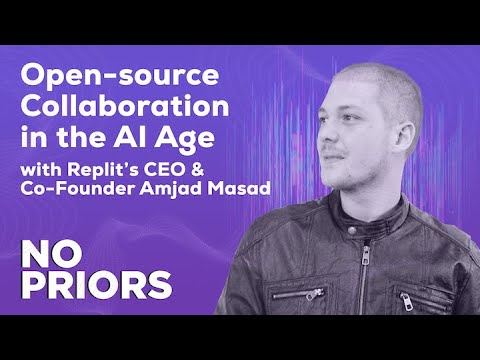
No Priors Ep. 33 | With Replit's CEO & Co-Founder Amjad Masad
Sarah Guo (host), Amjad Masad (guest), Elad Gil (host)
In this episode of No Priors, featuring Sarah Guo and Amjad Masad, No Priors Ep. 33 | With Replit's CEO & Co-Founder Amjad Masad explores replit’s Amjad Masad on AI Coders, Bounties, and Open-Source Futures Amjad Masad, CEO and co‑founder of Replit, explains how Replit evolved from a simple in‑browser coding prototype into a full-stack development platform with 22 million users and a deeply integrated AI suite called Ghostwriter. He argues that AI coding tools are still primitive and outlines a near-term path to agentic systems that can autonomously build features, manage files, and interact with infrastructure. Masad emphasizes Replit’s advantage as an end‑to‑end platform that captures rich feedback loops from coding through deployment, which can be used to train better models. He also discusses open‑source LLMs, Meta’s role with LLaMA, Replit’s bounty marketplace, and the future of money and payments for both human and AI “developer agents.”
Replit’s Amjad Masad on AI Coders, Bounties, and Open-Source Futures
Amjad Masad, CEO and co‑founder of Replit, explains how Replit evolved from a simple in‑browser coding prototype into a full-stack development platform with 22 million users and a deeply integrated AI suite called Ghostwriter. He argues that AI coding tools are still primitive and outlines a near-term path to agentic systems that can autonomously build features, manage files, and interact with infrastructure. Masad emphasizes Replit’s advantage as an end‑to‑end platform that captures rich feedback loops from coding through deployment, which can be used to train better models. He also discusses open‑source LLMs, Meta’s role with LLaMA, Replit’s bounty marketplace, and the future of money and payments for both human and AI “developer agents.”
Key Takeaways
AI-assisted coding is already boosting productivity but remains early-stage.
Tools like Ghostwriter and Copilot can deliver roughly 30–50% productivity gains in coding tasks, yet they still touch only a small slice of the overall software lifecycle such as debugging, deployment, and spec translation.
Get the full analysis with uListen AI
The next leap is agentic AI that can act inside dev environments.
Masad sees near-term (6–18 month) potential for agents that can read/write files, install packages, access the internet, and autonomously implement features like login flows, with multiple models orchestrated via new infrastructure.
Get the full analysis with uListen AI
Training code models on execution and full workflows can improve semantics.
Current models mostly learn from static code; feeding them execution results, editor interactions, debugging data, and deployment feedback could give them deeper semantic understanding and better performance on real-world tasks.
Get the full analysis with uListen AI
End‑to‑end platforms create stronger data moats than raw code corpora.
Masad argues Replit’s true edge is not just code data but the integrated journey from first line of code to deployment and production crashes, enabling richer reinforcement and more realistic training signals than a simple editor plugin.
Get the full analysis with uListen AI
Model training decisions should be driven by product needs, not prestige.
Replit trained a 3B-parameter code model mainly to deliver fast, cheap autocomplete when commercial APIs weren’t suitable, and Masad criticizes open-source one‑upmanship on benchmarks divorced from real user value.
Get the full analysis with uListen AI
Open-source LLMs depend on large sponsors willing to take political risk.
Meta’s combination of capital, talent, and “guts” has made LLaMA pivotal; Masad notes that AI safety politics and architectural complexity may make it harder for others to step into that role if Meta pulls back.
Get the full analysis with uListen AI
Human+AI hybrids and bounty marketplaces are changing who can build software.
Replit bounties let beginners globally, augmented by AI, deliver prototypes and MVPs for tens of dollars, enabling people with minimal formal background to earn and even build revenue-generating products quickly.
Get the full analysis with uListen AI
Notable Quotes
““I always thought that you can probably apply machine learning to [code tools]… and nothing ever really worked all that well up until GPT‑2… obviously GPT‑3 was like, ‘Okay, it’s here.’””
— Amjad Masad
““AI hasn’t touched yet… everything that we do just around the act of coding itself, and I think it will touch every part of the software development lifecycle.””
— Amjad Masad
““My feeling is this is within reach, even in the current capabilities… we’re within months of actually having really cool basic agentic experiences.””
— Amjad Masad
““The real advantage is the end‑to‑end journey from the first line of code, to the deployment, to getting crashes in production… and the real magic of Replit is putting all of that together.””
— Amjad Masad
““Can you create an AI that can go earn money for you while you sleep? And I think that that would be a really cool, cool idea.””
— Amjad Masad
Questions Answered in This Episode
How will agentic AI inside Replit concretely change the daily workflow of a senior engineer compared to today’s autocomplete and chat tools?
Amjad Masad, CEO and co‑founder of Replit, explains how Replit evolved from a simple in‑browser coding prototype into a full-stack development platform with 22 million users and a deeply integrated AI suite called Ghostwriter. ...
Get the full analysis with uListen AI
What guardrails or governance will be needed when AI agents can autonomously spend money, accept bounties, and deploy code to production?
Get the full analysis with uListen AI
How might training models on full project specs plus final products reshape software design practices and the role of human architects?
Get the full analysis with uListen AI
If Meta reduces its commitment to open‑source LLMs, what realistic models of industry collaboration could sustain a strong open ecosystem?
Get the full analysis with uListen AI
How could a native, programmable “currency of software” fix the misaligned incentives in open source and change how infrastructure and services are composed?
Get the full analysis with uListen AI
Transcript Preview
This week on No Priors, we explore Replit and its new AI tool, Ghostwriter. Replit now has more than 22 million users and recently started a partnership with Google. With Replit, anyone from beginners to experts can quickly build and release fully functional live apps in seconds, now with the help of AI. Amjad Masad, CEO, co-founder, and head engineer at Replit joins Elad and me this week on No Priors. Welcome.
Thank you.
Amjad, just to start, you were working as an engineer at Facebook. What made you decide to start Replit?
My journey with Replit actually starts way back in, in college. I was really interested in program languages, and I found it really difficult to just, like, keep setting up the development environment. I didn't have a laptop at the time, and so I was like, you know, "Why can't I open a browser window and start coding?" Turns out nobody has done that, and I was, I was kind of naive and, and thought I, you know, could probably try to do it, and got a prototype up pretty quickly. But my friends loved it in college. Everyone started using it. It was just, like, a simple webpage with a text box and, and a button that says run, which is still kind of in a lot of ways what Replit is. But then that started me on a, like, multi-year journey to actually build the first kind of in-browser sandbox, and at the time, we had a bit of a breakthrough. We were the first to compile Python, Ruby, and other languages to, to JavaScript. I open-sourced that project. Uh, that got me a job at Codecademy. I was a founding engineer there. And after that, I went to Facebook, and I was one of the founding engineers in React Native. We, like, made React and, uh, Jest, uh, Babel, and, uh, a bunch of tools that, uh, JavaScript developers use today. Our goal was to make mobile development as fun and easy and fast as web development, which I think we succeeded at. You know, towards the end of my time at Facebook, I just wanted to see what to do next and kind of looked around and, you know, whatever happened to this online coding space. And there was a bunch of online editors, but none of them really, uh, felt like web native, like you can just share a URL and someone can hop in and code with you, kind of like how Figma or Google Docs work, and, uh, we decided to start in 2016.
You have made a huge bet on AI as, uh, a company. Can you just talk about Ghostwriter and how it came about and the investment in this area?
Yeah, throughout my career, working on code that handles code, right? Whether it's at Codecademy for teaching programming, whether it's my own project, whether it's React and building the runtime around React Native, I always felt like our tools that were handling code, whether it's, like, compiling it, parsing it, minifying it, all that stuff, were very kind of rigid and very laborious. Um, in a lot of ways you're building sort of a classical intelligence system, very algorithmic, um, and a lot of heuristics and, and all of that. And I always thought that you can probably apply machine learning to it, and I started reading around whether anyone had done it. There was this seminal paper in 2012 called On the Naturalness of Software, and basically a bunch of researchers try to apply NLP to code. And what they found is that actually code can be modeled like any language. That's why they call it naturalnesses, because, hey, code is kind of repetitive like language you can do, things like n-gram, basic n-gram model can actually s- start to generate code that, that is compilable. That had a huge impact on me. And every year or two while starting Replit, I would go look at the state of the art on ML on code, and nothing ever really worked o- all that well up until GPT-2. And you can, like, take GPT-2 and fine-tune it and, like, try to make it write code and was, like, kind of okay, but obviously GPT-3 was like, "Okay, it's here." And that's when we started building what became Ghostwriter. Initially it was a bunch of tools kind of sprinkled all over the Replit IDE, explain code, you know, generate code here. And then we wrote our kind of autocomplete product, which is kind of like Copilot. As you're coding, it kind of gives you suggestions. And then we added the chat product, and that all became sort of Ghostwriter, our, our AI suite.
Install uListen to search the full transcript and get AI-powered insights
Get Full TranscriptGet more from every podcast
AI summaries, searchable transcripts, and fact-checking. Free forever.
Add to Chrome