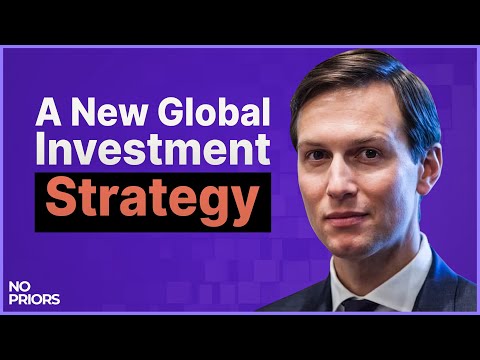
No Priors Ep. 131 | With Jared Kushner
Sarah Guo (host), Jared Kushner (guest), Elad Gil (host), Narrator
In this episode of No Priors, featuring Sarah Guo and Jared Kushner, No Priors Ep. 131 | With Jared Kushner explores jared Kushner on AI, global investing, and transforming Middle East ties Jared Kushner discusses how his firm Affinity Partners positions itself as a global, deeply involved investment partner that solves complex problems for governments and corporations, often in underpriced or misunderstood markets like Albania and Israel.
Jared Kushner on AI, global investing, and transforming Middle East ties
Jared Kushner discusses how his firm Affinity Partners positions itself as a global, deeply involved investment partner that solves complex problems for governments and corporations, often in underpriced or misunderstood markets like Albania and Israel.
He explains the origin and strategy of BrainCo, an AI implementation and platform company co-founded with Elad Gil and others, aimed at bringing frontier AI into the world’s largest institutions through high‑impact, data‑rich use cases.
Kushner connects his government experience—especially Middle East diplomacy and the Abraham Accords—to his current investing worldview, emphasizing macro tailwinds, governance quality, and cross‑border economic ties as engines of stability and growth.
He also advocates for private‑sector talent to serve in government, arguing that the experience radically broadens perspective, creates outsized impact, and complements later business-building, much like a high‑intensity “two‑year business school stint.”
Key Takeaways
Use macro tailwinds and governance quality as a first filter for investing.
Kushner stresses that understanding a country’s macro trends, leadership, and regulatory stance toward private capital is essential; surfing great waves with even mediocre skill beats being world‑class in bad conditions.
Get the full analysis with uListen AI
Look for underpriced geographies and institutions, not just underpriced stocks.
With only ~200 countries but thousands of tradable companies, Kushner argues that entire nations like Albania or Israel at moments of perceived risk can be mispriced, creating outsized return opportunities for patient, informed investors.
Get the full analysis with uListen AI
AI value comes from concrete, workflow‑integrated use cases, not hype.
BrainCo focuses on large institutions with rich data, clear command structures, and complex problems—such as hospital throughput, insurance claims, hospitality bookings, and construction permitting—where AI can materially cut cost, time, and corruption.
Get the full analysis with uListen AI
A dynamic AI platform must continuously track model advances to avoid obsolescence.
Because base models improve rapidly, Kushner argues that AI implementations must be designed as living systems—updated as capabilities change—rather than one‑off, static projects that quickly become outdated.
Get the full analysis with uListen AI
Cross‑border pattern recognition can create non‑obvious investment theses.
By comparing how similar businesses operate in India, the Middle East, Europe, and the US, generalist investors can import models and monetization approaches others miss, much like Yuri Milner did with early Facebook.
Get the full analysis with uListen AI
Economic integration can be a tool of diplomacy and conflict reduction.
Kushner views capital flows and shared commercial interests—e. ...
Get the full analysis with uListen AI
Private‑sector tours of duty in government yield asymmetric learning and network benefits.
He contends that despite stress, scrutiny, and pay cuts, time in government dramatically expands understanding of how the world works, builds unique relationships, and later enables more sophisticated and impactful business and policy initiatives.
Get the full analysis with uListen AI
Notable Quotes
“By being global, we’ve realized there are entire countries that are underpriced, not just companies.”
— Jared Kushner
“With AI, you can’t just assume tomorrow is going to be like yesterday.”
— Jared Kushner
“If I’m going to fail at a hard problem, at least let me fail in an original way.”
— Jared Kushner
“Change is like heaven—everyone wants to go there, but nobody wants to die.”
— Jared Kushner
“Once your mind expands, it never returns to its original size.”
— Jared Kushner (attributing the idea to Einstein)
Questions Answered in This Episode
How do you systematically evaluate whether a country’s governance and regulatory environment are truly investable versus cosmetically pro‑business?
Jared Kushner discusses how his firm Affinity Partners positions itself as a global, deeply involved investment partner that solves complex problems for governments and corporations, often in underpriced or misunderstood markets like Albania and Israel.
Get the full analysis with uListen AI
What criteria should enterprises use to prioritize which AI use cases to tackle first, given limited internal capacity and fast‑moving technology?
He explains the origin and strategy of BrainCo, an AI implementation and platform company co-founded with Elad Gil and others, aimed at bringing frontier AI into the world’s largest institutions through high‑impact, data‑rich use cases.
Get the full analysis with uListen AI
To what extent can economic normalization and cross‑border investment sustainably overcome deep‑rooted political and ideological conflicts in the Middle East?
Kushner connects his government experience—especially Middle East diplomacy and the Abraham Accords—to his current investing worldview, emphasizing macro tailwinds, governance quality, and cross‑border economic ties as engines of stability and growth.
Get the full analysis with uListen AI
How should policymakers balance the need to avoid over‑regulating AI with legitimate concerns about worst‑case scenarios and misuse?
He also advocates for private‑sector talent to serve in government, arguing that the experience radically broadens perspective, creates outsized impact, and complements later business-building, much like a high‑intensity “two‑year business school stint.”
Get the full analysis with uListen AI
For a technologist considering a government role, what specific skills or mindsets translate best from startup culture into effective public service?
Get the full analysis with uListen AI
Transcript Preview
(music plays) Hi, listeners. Welcome back to No Priors. I'm Sara Goa, and Elad and I are here today with Jared Kushner at the Miami headquarters of his investing firm, Affinity Partners. We're here to talk about Affinity, the new co they're launching, BrainCo, and his career in government, business, and investing. Welcome, Jared. Jared, thanks so much for doing this with us.
Oh, it's good to be with you guys.
So, you have a couple interesting new and new-ish projects. Let's start with Affinity. Um, you were an investor before, and you started a firm after your time, um, as a public servant. What did you do differently?
When I left government, I was thinking, "What could I do to apply the different learnings that I'd had to my next version of a business career?" And as I was studying all the different firms out there, I realized the world didn't need another, you know, couple billion dollar private equity firm. But I tried to focus as I would speak to my friends who were investors on what they needed, what value we could provide, and what we saw was that we had the ability to be, uh, complex problem-solvers. Uh, that's what I did in government, that's what we were good at, and we thought we could do that in partnership with a lot of other firms. So, the aspiration with Affinity is to be the most, uh, value-add and outcome determinative partner to, um, you know, the best entrepreneurs and the best companies in the world. And so we focused on finding the best companies, thinking through what are their, uh, biggest challenges, what are their biggest opportunities, and thinking through how we can, uh, partner with them, putting skin in the game by investing with them versus a consultant, and being in a position where we can then help them achieve, uh, their aspirations. And, uh, a lot of... You know, we have a very unique, uh, large network and, uh, are very trusted by the people we, we deal with. And so they open up to us about their challenges and opportunities, and then we're able to, you know, scope and look for different, uh, solutions, and then we validate them through investment, and then we're able to add value to the companies we're investing in by helping them find, uh, new customers and new opportunities.
In what ways do you think companies are not as globally ambitious as they should be, like if they knew what you knew, or had the network you did?
I think for most people to be very successful at something, they usually are very focused on an industry or on a geography. And to be exceptional, you have to be a fairly, uh, obsessive about whichever of the fields you are trying to be exceptional in. And so what happens is, is they usually have a lot of perspective in their field or in their geography, but they don't have the time or the knowledge or the network in order to see how people like them are doing similar things throughout the world. And so, by having a real global perspective, I was able to see that in most places, if you're successful, you've a fairly, um, positive and, uh, and local-centric view of yourself. But when you can look at a global, global view, I would say, wow, these guys in, in India, or these guys in, in, uh, in the Middle East, or these guys in Europe, they're doing, uh, the same business but in a different way. And so by, you know, giving those suggestions, sometimes connecting them together, you can help people who are very good at something accelerate or modify their business in order to do something hopefully better than they would have done without your perspective.
Install uListen to search the full transcript and get AI-powered insights
Get Full TranscriptGet more from every podcast
AI summaries, searchable transcripts, and fact-checking. Free forever.
Add to Chrome