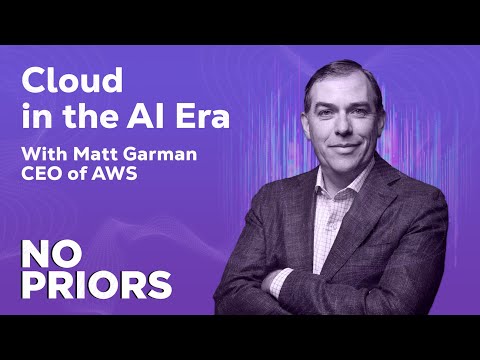
No Priors Ep. 78 | With AWS CEO Matt Garman
Matt Garman (guest), Sarah Guo (host), Elad Gil (host), Sarah Guo (host)
In this episode of No Priors, featuring Matt Garman and Sarah Guo, No Priors Ep. 78 | With AWS CEO Matt Garman explores aWS CEO Matt Garman on Cloud’s Past, AI Future, Startup Edge Matt Garman, the new CEO of AWS, traces AWS’s evolution from a secret internal project at Amazon to a $100B run-rate cloud leader, emphasizing how simple building blocks and customer obsession drove adoption. He explains why most global IT workloads still haven’t moved to the cloud and how generative AI is now a major new tailwind for migration and innovation. Garman outlines AWS’s AI strategy—chips, Bedrock, multiple model providers, open source, and strong data security—arguing that AI inference will become just another standard cloud primitive. He also discusses capital-intensive bets on data centers and GPUs, offers pragmatic advice to AI startups, and reiterates AWS’s commitment to serving both massive enterprises and early-stage companies.
AWS CEO Matt Garman on Cloud’s Past, AI Future, Startup Edge
Matt Garman, the new CEO of AWS, traces AWS’s evolution from a secret internal project at Amazon to a $100B run-rate cloud leader, emphasizing how simple building blocks and customer obsession drove adoption. He explains why most global IT workloads still haven’t moved to the cloud and how generative AI is now a major new tailwind for migration and innovation. Garman outlines AWS’s AI strategy—chips, Bedrock, multiple model providers, open source, and strong data security—arguing that AI inference will become just another standard cloud primitive. He also discusses capital-intensive bets on data centers and GPUs, offers pragmatic advice to AI startups, and reiterates AWS’s commitment to serving both massive enterprises and early-stage companies.
Key Takeaways
Start with familiar building blocks to drive paradigm-shifting adoption.
AWS succeeded early by offering developers standard compute, storage, and databases as on-demand services instead of forcing new programming models, lowering friction compared to competitors that tried to reshape how apps were built.
Get the full analysis with uListen AI
Enterprise cloud migration is still in early innings, despite huge AWS scale.
Garman notes that roughly 80–85% of workloads remain on-premise, with mainframes, tightly coupled enterprise systems, telco, and factory-floor workloads representing massive remaining opportunity and requiring more tooling and modernization support.
Get the full analysis with uListen AI
Security, data control, and model choice anchor AWS’s generative AI platform.
AWS designed Bedrock and its AI stack around three assumptions: customers won’t compromise on security, there will be many models (large and small), and enterprise data is the key IP that must never leak back into shared models.
Get the full analysis with uListen AI
A multi-model, open ecosystem is central to AWS’s AI differentiation.
AWS offers first-party Titan models alongside partners like Anthropic and Meta’s LLaMA, leans heavily into open source and open weights, and aims to let customers mix and match models without being locked into a single vendor or license.
Get the full analysis with uListen AI
GPU and power constraints will persist, making custom chips and long-term planning critical.
Garman expects AI capacity to remain tight for years given fab, memory, and power lead times; AWS is investing tens to hundreds of billions in land, power, renewable energy, and its own Trainium/Inferentia chips while partnering deeply with NVIDIA.
Get the full analysis with uListen AI
AI value will increasingly come from applications and real business problems, not just models.
He argues most companies won’t build frontier models; they’ll win by applying existing models to sales, manufacturing, customer support, and other workflows where AI drives measurable efficiency and new capabilities.
Get the full analysis with uListen AI
AI startups must manage capital intensity and avoid assuming endless funding.
Drawing on his own failed startup, Garman advises founders to have a clear path to monetization, maintain flexibility in spending on training/infrastructure, and remember that running out of money—not lack of ideas—kills companies.
Get the full analysis with uListen AI
Notable Quotes
“Original AWS thesis was we'd take care of the muck so you don't have to.”
— Matt Garman
“There's not a lot of business opportunities that are as big as cloud computing and as potentially transformational.”
— Matt Garman
“I want my customers to want to run on us as opposed to kind of locked into a Microsoft license or old school Oracle database that you can't get off of.”
— Matt Garman
“We actually took a half a step back and said, ‘Assuming this technology gets better and better, how do we make it so that every company out there can go build using those technologies?’”
— Matt Garman
“The only reason that any startup goes out of business is because they ran out of money.”
— Matt Garman
Questions Answered in This Episode
How will AWS further simplify migrating legacy mainframes and complex enterprise systems into modern, cloud-native and AI-enhanced architectures?
Matt Garman, the new CEO of AWS, traces AWS’s evolution from a secret internal project at Amazon to a $100B run-rate cloud leader, emphasizing how simple building blocks and customer obsession drove adoption. ...
Get the full analysis with uListen AI
In a world of powerful open weights and proprietary models, how will AWS decide when to invest in its own first-party models versus deepening partnerships?
Get the full analysis with uListen AI
What concrete milestones would signal that GPU and AI infrastructure capacity have finally caught up with demand?
Get the full analysis with uListen AI
How might Bedrock and AWS’s agentic tooling change the design of enterprise software over the next three to five years?
Get the full analysis with uListen AI
What specific advantages do Trainium and Inferentia need to demonstrate for customers to meaningfully diversify away from NVIDIA for large-scale AI workloads?
Get the full analysis with uListen AI
Transcript Preview
I don't know how many times in the first couple of years I had to explain why a bookseller was offering compute services and storage services. There's not a lot of business opportunities that are as big as cloud computing and, and as potentially transformational. Original AWS thesis was we'd take care of the muck so you don't have to. I want my customers to want to run on us. (electronic music)
Hi listeners, and welcome back to No Priors. Today we're talking to Matt Garman, who took over as CEO of AWS in May. Matt has been with AWS since it was a $0 billion business to today's $100 billion run rate business. Welcome, Matt.
Matt, thanks so much for joining us today. It's a real pleasure to have you. One thing that I think is really fascinating is you actually started on AWS in the very early days it was just getting started, and you did that as an intern while you were getting your MBA. Could you tell us a little bit about the, both the origins of AWS as well as your own involvement with it?
Sure. So it was in 2005. Uh, I did my business school internship at Amazon and, uh, as we were looking around for projects, uh, I talked actually at the time to Andy Jassy, uh, and he was, um, telling me that he was starting a new business inside of Amazon that was technology focused and he couldn't tell me about it, uh, before I started, but I thought it sounded interesting so I, I joined him and worked on that. And it was, uh, it was, it was AWS pre-launch. Uh, I got to work on that as an intern. It was a, it was a super cool opportunity. Um, I came back full time, uh, effectively as the first product manager for AWS, and I'm now on year 18, uh, or just, you know ... So, uh, been working on the, the, uh, the business the entire time and, uh, you know, it's a, it's a fascinating space. Even back then, uh, we saw the potential of what, what AWS could be. Um, obviously that was, you know, it was a startup, right, uh, in- inside of Amazon. And so it was, you know, we, we had visions of what we thought it could be, but, um, you know, there's a lot of hard work and some good luck and some things that have gone right for us, uh, and a great team over the last, uh, couple of decades to, to go build AWS. And, you know, the fascinating thing today is it's still in the very early stages of what the business can be. There's, there's not a lot of business opportunities that are as big as cloud computing and, and as potentially transformational, um, to, to every, uh, industry out there. And so, um, it is an exciting place to work, uh, just as much as it was, uh, in 2005 when I was an intern kind of writing the original business plan of, of who, uh, when we first launched our services, which companies might possibly be interested in using these things.
Install uListen to search the full transcript and get AI-powered insights
Get Full TranscriptGet more from every podcast
AI summaries, searchable transcripts, and fact-checking. Free forever.
Add to Chrome