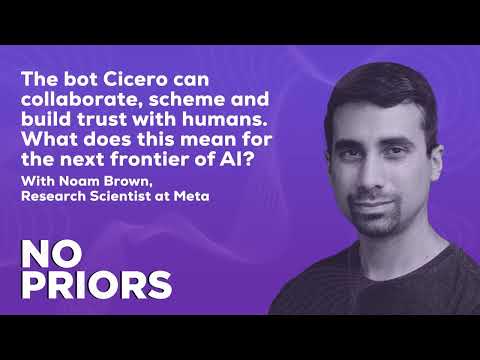
No Priors Ep. 1 | With Noam Brown, Research Scientist at Meta
Sarah Guo (host), Noam Brown (guest), Elad Gil (host), Narrator
In this episode of No Priors, featuring Sarah Guo and Noam Brown, No Priors Ep. 1 | With Noam Brown, Research Scientist at Meta explores from Poker Bots To Diplomacy: Noam Brown Redefines AI Reasoning Benchmarks Noam Brown recounts his path from finance to AI research, focusing on game-theoretic agents that master imperfect‑information and negotiation-heavy games like poker and Diplomacy.
From Poker Bots To Diplomacy: Noam Brown Redefines AI Reasoning Benchmarks
Noam Brown recounts his path from finance to AI research, focusing on game-theoretic agents that master imperfect‑information and negotiation-heavy games like poker and Diplomacy.
He explains why AlphaGo and large language models changed his expectations for AI progress, but argues that raw scale and next-token prediction are hitting limits without better reasoning and planning.
Brown details how Cicero, Meta’s Diplomacy bot, combined language models, human game data, and self-play to cooperate and negotiate with humans without being detected as an AI across 40 games.
Looking ahead, he sees the key research frontier as general-purpose reasoning and inference-time planning, with implications for theorem proving, complex code generation, negotiation agents, and real-world cooperative AI systems.
Key Takeaways
Reasoning and planning are now more critical than just scaling models.
Brown argues that simply making neural networks larger has diminishing returns; massive gains (e. ...
Get the full analysis with uListen AI
Cooperation with humans is a frontier benchmark, not just competition.
Cicero’s success in Diplomacy shows that AI must model human norms, mistakes, and communication patterns to collaborate effectively, which is closer to real-world deployment than beating humans in zero-sum games.
Get the full analysis with uListen AI
Human data alone is insufficient for expert-level strategic play.
Supervised learning on human game logs plateaued below expert performance; combining human behavior models with self-play and planning was necessary to surpass strong humans in poker and Diplomacy.
Get the full analysis with uListen AI
The Turing test is no longer a useful bar for intelligence.
With language models that often avoid detection as bots in rich dialogue settings, passing a Turing-like test no longer correlates well with general intelligence or robust reasoning abilities.
Get the full analysis with uListen AI
Sample efficiency remains a key human advantage over current AI.
Humans can become strong at tasks like chess, Diplomacy, or market reasoning with far fewer examples than current systems, which matters in domains where data is scarce or environments are non-stationary.
Get the full analysis with uListen AI
Game AIs are reshaping human strategy in their domains.
Poker professionals now train against bots, adopt AI-discovered tactics like extreme over-bets, and aim to approximate Nash-equilibrium play, mirroring how chess players use engines.
Get the full analysis with uListen AI
High-risk, neglected problems can yield outsized research impact.
Brown emphasizes committing to hard, slightly “science-fiction” goals—like natural language Diplomacy—rather than safe, incremental benchmarks, as these create more meaningful advances and new techniques.
Get the full analysis with uListen AI
Notable Quotes
“All research is high risk, high reward, or at least it should be.”
— Noam Brown
“The Turing test is no longer really a useful measure the way it was intended to be.”
— Noam Brown
“Everything I had done in my PhD up until that point was just a footnote compared to adding search and scaling search.”
— Noam Brown
“If you want truly general artificial general intelligence then this [reasoning] needs to be addressed.”
— Noam Brown
“It doesn’t seem crazy to me that you could have a model that can prove the Riemann hypothesis within the next five years if you can solve the reasoning problem in a truly general way.”
— Noam Brown
Questions Answered in This Episode
How would you architect a truly general reasoning module that can plug into today’s large language models without being domain-specific like Monte Carlo tree search?
Noam Brown recounts his path from finance to AI research, focusing on game-theoretic agents that master imperfect‑information and negotiation-heavy games like poker and Diplomacy.
Get the full analysis with uListen AI
What kinds of safeguards or governance structures are needed once negotiation agents begin operating in real financial, legal, or geopolitical settings?
He explains why AlphaGo and large language models changed his expectations for AI progress, but argues that raw scale and next-token prediction are hitting limits without better reasoning and planning.
Get the full analysis with uListen AI
Where do you expect the first real-world successes of AI negotiation agents to appear—consumer pricing, salary negotiation, procurement, or something else?
Brown details how Cicero, Meta’s Diplomacy bot, combined language models, human game data, and self-play to cooperate and negotiate with humans without being detected as an AI across 40 games.
Get the full analysis with uListen AI
How can we design new benchmarks that measure cooperation and alignment with human norms, rather than just raw performance or deception capability?
Looking ahead, he sees the key research frontier as general-purpose reasoning and inference-time planning, with implications for theorem proving, complex code generation, negotiation agents, and real-world cooperative AI systems.
Get the full analysis with uListen AI
At what point does inference-time compute become practically acceptable for users (seconds, minutes, hours) if it unlocks qualitatively new capabilities like theorem proving or full product-level code generation?
Get the full analysis with uListen AI
Transcript Preview
(instrumental music plays) Noam, welcome to No Priors.
Oh, thank you for having me.
Yeah. Thanks a lot for joining. So, you know, I think, uh, in the world today when a lot of people think about AI, they think about it as basically you put a... you put a couple words into a prompt and then you get out an image. Or you have, uh, ChatGPT summarize James Burnham's professional managerial class for you in a rhyming essay in the voice of a cat or something. (laughs) And I think you've pushed in really interesting, uh, directions, uh, that are very different in some ways from what a lot of people have been focused on, and you've been more focused on game theoretic actors interacting with humans and with each other. And in parallel, you're kinda known as, um, as Sara mentioned, as sort of one of these true 10X engineers and researchers pushing the boundaries on the... on A-... NAI. And so I'm sort of curious, like, what first sparked your interest in games and researching AI to defeat games like poker and Diplomacy?
Well, I think, uh, you know, my journey's a bit, uh, non-traditional. I mean, I started out in finance actually, towards the end of my undergrad career. And also, like, af-... right after undergrad I worked in algorithmic trading for a couple years, and I, I kinda realized that, uh, while it's, it's fun and, uh, it's, you know, exciting, it's kinda like a game. You know you gotta score at the end of the day, which is how much money you've made or lost. Uh, it's not really the most fulfilling thing that I wanna do with my life. Uh, and so I decided that I wanted to do research, and i- it wasn't really clear to me in what area. I was originally planning to do economics actually, and so I went to the Federal Reserve. I worked there for two years. Honestly, I wanted to figure out how to structure financial markets better to encourage more pro-social behavior. And so, in the process, I, I became interested in, in game theory and I, I thought I wanted to pursue a PhD, like, in economics th-... uh, focused on game theory. Two things happened. So first of all, I became a bit, a bit jaded with the pace of progress in economics, because if you come up with an idea, you, you have to get it passed through legislation and it's a very long process. Computer science is much more exciting in that way because you can just build something. You don't really need permission to do it. And then the other thing I figured out was that a lot of the most exciting work in game theory was actually happening in computer science. It wasn't happening in economics. And so I applied for, uh, grad schools with the intention of studying algorithmic game theory in a computer science department. And, uh, when I got to grad school, there was conveniently a professor that was looking for somebody to do research on AI for poker, and I thought this was, like, the perfect intersection of everything that I wanted to do. I was interested in game theory. I was interested in, you know, making something, uh, interested in AI. I had played poker when I was in high school and college, and you know, never for high stakes but always just kinda interested in the strategy of the game. I actually tried to make a, a poker bot when I was in undergrad, and it, it, it did terribly but it was a lot of fun a- along... and so to be able to do that for research in grad school, I thought this was like the, the perfect thing for me to work on. And also I felt like there, there was an opportunity here because it felt doable, and I, I, I kinda recognized that if you succeed in making an AI that can play poker, you're going to learn really valuable things along the way, and, and that could have, like, major implications for the future. So that's kinda how I, how I got started in that.
Install uListen to search the full transcript and get AI-powered insights
Get Full TranscriptGet more from every podcast
AI summaries, searchable transcripts, and fact-checking. Free forever.
Add to Chrome