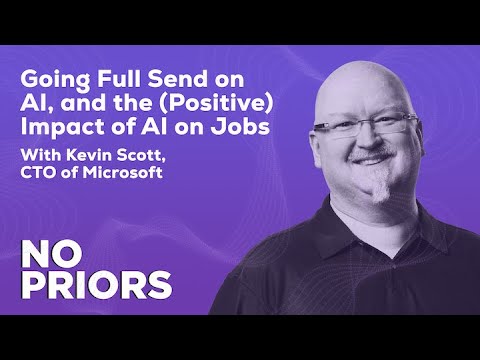
No Priors Ep. 18 | With Kevin Scott, CTO of Microsoft
Sarah Guo (host), Kevin Scott (guest), Elad Gil (host)
In this episode of No Priors, featuring Sarah Guo and Kevin Scott, No Priors Ep. 18 | With Kevin Scott, CTO of Microsoft explores microsoft CTO Kevin Scott on AI Platforms, Partnerships, and Purpose Kevin Scott traces his unlikely path from rural Virginia to Microsoft CTO and explains how that background shapes his conviction that AI must broadly benefit society. He details Microsoft’s strategic bet on large-scale AI: consolidating GPU resources, partnering deeply with OpenAI, and co-building supercomputing infrastructure with NVIDIA to enable platform-scale models. Scott argues that AI’s real impact comes from assistive, “copilot” products and a stack that blends large models, orchestration, retrieval, and safety layers, rather than models as standalone products. He also emphasizes balancing optimism about AI’s potential in areas like education and healthcare with serious, proactive work on safety, regulation, and responsible deployment.
Microsoft CTO Kevin Scott on AI Platforms, Partnerships, and Purpose
Kevin Scott traces his unlikely path from rural Virginia to Microsoft CTO and explains how that background shapes his conviction that AI must broadly benefit society. He details Microsoft’s strategic bet on large-scale AI: consolidating GPU resources, partnering deeply with OpenAI, and co-building supercomputing infrastructure with NVIDIA to enable platform-scale models. Scott argues that AI’s real impact comes from assistive, “copilot” products and a stack that blends large models, orchestration, retrieval, and safety layers, rather than models as standalone products. He also emphasizes balancing optimism about AI’s potential in areas like education and healthcare with serious, proactive work on safety, regulation, and responsible deployment.
Key Takeaways
Models and infrastructure are not products; hard problems are where value lies.
Scott stresses that simply “adding an LLM” is not enough; the most important products will be those that turn previously impossible tasks into hard but feasible ones, in the same way smartphones enabled non-obvious apps like TikTok and DoorDash rather than just early novelty apps.
Get the full analysis with uListen AI
Concentrated, conviction-driven investment in compute is a strategic advantage.
Microsoft stopped “peanut butter spreading” GPUs and instead centralized capital-intensive compute around high-conviction AI efforts, enabling the scale necessary for frontier models like GPT‑3 and beyond.
Get the full analysis with uListen AI
AI is evolving into a platform best delivered through assistive copilots.
From GitHub Copilot to Microsoft 365 and Bing Chat, Scott describes a generalized copilot pattern: LLMs orchestrated with tools, retrieval, prompts, plugins, and safety filters to assist humans in domain-specific workflows rather than replace them.
Get the full analysis with uListen AI
Open source and closed models will coexist in a portfolio of systems.
Real-world deployments already use multiple models for cost, latency, and quality tradeoffs; Scott is excited by open-source innovation but notes that robust safety and responsible AI practices must evolve alongside it.
Get the full analysis with uListen AI
AI can dramatically widen who can build with advanced tools.
Tasks that once required deep ML expertise and months of work can now be done in hours by far less specialized users; Scott sees this accessibility as a path to more equitable opportunity for people far from traditional tech hubs.
Get the full analysis with uListen AI
Optimism about AI’s benefits must coexist with serious safety and regulation.
He argues that regulation is a sign the technology matters, likening it to electricity standards, and calls for industry-wide norms and safeguards that enable widespread, trusted deployment while deterring harmful uses.
Get the full analysis with uListen AI
Human-centric roles and creativity will remain essential despite cognitive automation.
Scott expects continued demand for physically grounded jobs (e. ...
Get the full analysis with uListen AI
Notable Quotes
“Models aren’t products, and infrastructure isn’t a product.”
— Kevin Scott
“Probably the place where the most interesting products are, are where you’ve made the phase change from impossible to hard.”
— Kevin Scott
“We will no longer peanut butter these resources around.”
— Kevin Scott, on centralizing Microsoft’s GPU budget
“There’s no historical precedent where you get all of these beneficial things by starting from pessimism first. Pessimism doesn’t get you to optimistic outcomes.”
— Kevin Scott
“Nobody’s trying to regulate frivolous things.”
— Kevin Scott, on why regulation signals AI’s real importance
Questions Answered in This Episode
How should a non-tech company decide which ‘impossible-to-hard’ problems in its domain are worth building AI products around, rather than chasing shallow LLM features?
Kevin Scott traces his unlikely path from rural Virginia to Microsoft CTO and explains how that background shapes his conviction that AI must broadly benefit society. ...
Get the full analysis with uListen AI
What concrete practices has Microsoft found most effective for aligning large internal teams around high-conviction AI bets while avoiding wasteful experimentation?
Get the full analysis with uListen AI
How can the open-source community realistically tackle responsible AI and safety for powerful models without the resources of hyperscalers?
Get the full analysis with uListen AI
In education and healthcare, what are the most promising near-term AI deployments that could achieve “two-sigma” style gains without exacerbating inequality?
Get the full analysis with uListen AI
What kinds of regulatory frameworks would best balance rapid AI innovation with the need for safety, accountability, and public trust at the foundation-model level?
Get the full analysis with uListen AI
Transcript Preview
Microsoft, the behemoth productivity, cloud, and gaming company has taken a massive bet on AI. Everyone's paying close attention to its partnership with OpenAI, and the technical community has been amazed by its release of some of the first truly useful and broadly deployed AI products such as GitHub Copilot. Its full-on attack on web search with the new LLM-powered Bing Chat is making its incumbent competitors dance. Today on No Priors, we're thrilled to speak with Kevin Scott, CTO of Microsoft and the driving force behind their AI strategy. Kevin's leadership, both at Microsoft and prior at LinkedIn, Google, and AdMob as a technologist, is especially inspiring to me given his distance traveled from his childhood home in rural Central Virginia. In 2020, he published a book, Reprogramming the American Dream, about making AI serve us all. Kevin, welcome to No Priors. Thanks so much for joining us.
Thanks for having me, guys.
Can you start by sharing with us some of your story? How does one go from a farming community in Virginia where your parents didn't attend college to CTO of Microsoft?
Uh, I don't know. I think it is a very unlikely journey. Uh, it's, like, certainly not a thing that I, uh, I ever could have imagined. I, I think part of it is I was just super fortunate to be wired like a nerd, uh, and growing up when I grew up. So, you know, when I was a teenager in the early 80s, uh, personal computing was, uh, was happening and, like, that was the thing that I happened to fixate on. Um, and even though we were relatively poor, I managed to, you know, scrape together enough bucks to get myself a personal computer that I could have and just tinker with all the time. And it was, uh, like a, it was a RadioShack Color Computer, too, like one of these things with Chiclet keys that you, uh, you actually connected to a television. Like I had it hooked up to a 13-inch-
(laughs)
... TV and it had a cassette recorder that you, uh, stored and loaded your programs on and, you know, and, and it was just the thing that I was obsessed with and I, I stayed obsessed with computers, uh, from then on. And it was just me trying to find a path at each step where I could work on the most interesting thing that someone was, uh, dumb enough to give me permission to go work on. And, and a- and again, it's, it's a lot of luck. Like there's no way you can, uh, plan a path from rural Central Virginia to CTO of Microsoft, but you know, it, I think it does help to have a high-level vision in your head for what it is that you want to do. Like, just knowing what you're aiming for always helps.
What was that vision for you? Besides, like, you know, obsessed with computers, wanted to work on them.
Install uListen to search the full transcript and get AI-powered insights
Get Full TranscriptGet more from every podcast
AI summaries, searchable transcripts, and fact-checking. Free forever.
Add to Chrome