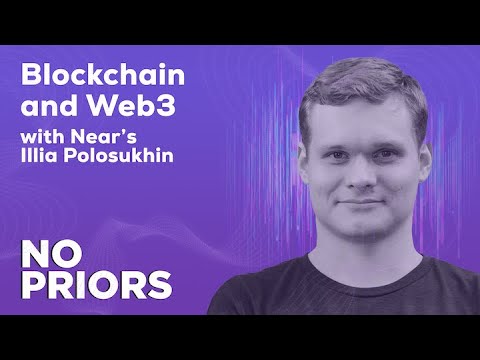
No Priors Ep. 32 | With NEAR’s Illia Polosukhin
Sarah Guo (host), Illia Polosukhin (guest), Elad Gil (host)
In this episode of No Priors, featuring Sarah Guo and Illia Polosukhin, No Priors Ep. 32 | With NEAR’s Illia Polosukhin explores transformers, NEAR, and AI Agents: Building a Verified, Decentralized Web3 Future Illia Polosukhin, co-author of the Transformers paper and co-founder of NEAR, discusses how his AI background led to building NEAR as a "blockchain operating system" that abstracts Web3 complexity for users and developers.
Transformers, NEAR, and AI Agents: Building a Verified, Decentralized Web3 Future
Illia Polosukhin, co-author of the Transformers paper and co-founder of NEAR, discusses how his AI background led to building NEAR as a "blockchain operating system" that abstracts Web3 complexity for users and developers.
He explores intersections of AI and blockchain, especially AI agents as economic actors, decentralized data and compute marketplaces, and blockchain-based identity and reputation for content authenticity.
Polosukhin argues that the real challenge is "human alignment"—building societal and technical systems resilient to misinformation at AI scale—rather than just AI alignment in isolation.
The conversation also covers decentralized inference, marketplaces for data labeling, the future of SaaS as database-plus-dynamic-UI powered by agents, and why Transformers are likely to remain the dominant model architecture given current hardware lock-in.
Key Takeaways
AI agents will become economic actors if given blockchain accounts.
Equipping language-model-based agents with on-chain identities and wallets lets them autonomously pay humans and other AIs, manage workflows, and even function as organizational "CEOs" tasked with goals and KPIs.
Get the full analysis with uListen AI
Blockchain provides critical primitives for content authenticity and provenance.
Cryptographic signing from secure hardware (e. ...
Get the full analysis with uListen AI
Human alignment and societal resilience to misinformation matter more than abstract AI alignment.
AI mainly scales pre-existing human problems like propaganda, fraud, and manipulation; robust identity, reputation graphs, and trust frameworks are needed to handle personalized, large-scale misinformation rather than focusing solely on aligning models in the abstract.
Get the full analysis with uListen AI
Decentralized inference is more practical and valuable than decentralized training.
Massive bandwidth requirements make distributed training across heterogeneous nodes impractical today, while inference requires far more total compute, has strong privacy needs, and can better leverage crypto tools like MPC and zero-knowledge proofs.
Get the full analysis with uListen AI
Open, tokenized data-labeling marketplaces can improve scalability and fairness.
Web3-based marketplaces allow global workers to participate without local subsidiaries, introduce economically meaningful quality controls (e. ...
Get the full analysis with uListen AI
The future of SaaS will center on user-owned data plus dynamic, AI-generated UIs.
Instead of dozens of siloed SaaS tools each holding their own database, blockchain-based data ownership plus LLMs can generate custom workflows and dashboards on top of a shared data layer, with agents orchestrating cross-tool business processes.
Get the full analysis with uListen AI
Transformers are likely locked in by hardware and ecosystem optimization.
Their architectural simplicity, fit with GPU/accelerator design, and the immense optimization around CUDA and transformer kernels make alternate architectures or chips hard to compete with unless there is a major form-factor or hardware paradigm shift.
Get the full analysis with uListen AI
Notable Quotes
“This is the first time that a machine is able to communicate with people in the same way.”
— Illia Polosukhin
“I have this view that we need human alignment instead of AI alignment.”
— Illia Polosukhin
“You can have organizations that are run completely by AI, where the CEO role is taken by an AI agent.”
— Illia Polosukhin
“We need to build a society that is actually able to deal with effective misinformation at scale.”
— Illia Polosukhin
“Right now what SaaS is, is one database with a specific UI for a specific problem.”
— Illia Polosukhin
Questions Answered in This Episode
What governance mechanisms and safeguards are needed before we allow AI agents to control real capital and make firing or funding decisions in organizations?
Illia Polosukhin, co-author of the Transformers paper and co-founder of NEAR, discusses how his AI background led to building NEAR as a "blockchain operating system" that abstracts Web3 complexity for users and developers.
Get the full analysis with uListen AI
How can we practically roll out cryptographic content-signing and identity infrastructure across phones, browsers, and major media platforms without breaking existing user experiences?
He explores intersections of AI and blockchain, especially AI agents as economic actors, decentralized data and compute marketplaces, and blockchain-based identity and reputation for content authenticity.
Get the full analysis with uListen AI
What are the social and ethical implications if most online political communication and persuasion becomes hyper-personalized and AI-generated?
Polosukhin argues that the real challenge is "human alignment"—building societal and technical systems resilient to misinformation at AI scale—rather than just AI alignment in isolation.
Get the full analysis with uListen AI
How can decentralized inference networks realistically balance latency, privacy, and cost against centralized providers in production-scale applications?
The conversation also covers decentralized inference, marketplaces for data labeling, the future of SaaS as database-plus-dynamic-UI powered by agents, and why Transformers are likely to remain the dominant model architecture given current hardware lock-in.
Get the full analysis with uListen AI
In a world where users own their data on-chain and UIs are generated on demand by AI, what will be the new sources of defensibility for SaaS companies?
Get the full analysis with uListen AI
Transcript Preview
(music plays) A blockchain operating system might just be the key to a democratized Web3. In fact, more than 25 million users are already getting a taste of this, thanks to NEAR. This week, Elad and I are joined by Ilya Polosukhin, the co-founder of NEAR and co-author of the landmark Transformers paper, to discuss the interaction of blockchain and AI technologies, what we should expect from AI agents, how to handle the content authenticity problem, and why the alignment problem in AI is really a human problem. Ilya, welcome to No Priors. Thanks for doing this.
Thanks for inviting me.
You are one of the authors of the original Transformers paper.
Mm-hmm.
We've also had Noam and Jacob on. How did you get involved with that seminal work in AI?
I worked on a team wi- on natural language understanding that focused on question answering, and the state of the art at this time was LSTMs, recurrent neural networks, which you could not launch in production at all, because they're too slow and take fair bit of time to process as documents scale. So Jacob at the time was using attention for query similarity, and he had this idea, like, using attention for encoder-decoder type. Um, I kind of jumped into it and, uh, with Ashish were playing around with, can we actually get it to train and understand the order of words and do translation just based on, you know, attention. So yeah, it was pretty cool to explore that, and obviously grew into something very interesting and awesome.
You originally co-founded NEAR in, I think, 2018, meaning for it to be an AI-focused company. What was that initial mission, and how did it become a blockchain company?
Yeah, so we started with the idea that we wanted to teach machines to code. You know, we had Transformers coming out. There was a lot of kind of really interesting push in '17, '16, '17, around AI, and so our expectation was we kind of would ride the exponential growth of AI, which has happened in (laughs) this year. We thought it will happen in '17, '18, and so with that, we got a really interesting dataset around language to code. But more interestingly, we had a whole community of developers, mostly students, who were doing crowdsourcing for us. So we would give them code. They would write descriptions. We would give them descriptions. They would write code for them, write tests, like all kinds of tasks. And we actually faced a challenge of paying them, because a lot of them were in China, in Eastern Europe, and kind of other countries where there's monetary control problems. People don't have bank accounts, and so we started looking into blockchain just, like, to solve our own problem. The AI kind of, uh, exponential explosion didn't happen at the time, and so we saw an opportunity of, we can actually build a blockchain that we would use to solve this first and focus on that, uh, while kind of waiting out the AI thing to, uh, really happen. And as you go into the blockchain rabbit hole, you realize there's a lot more that meets the eye.
Install uListen to search the full transcript and get AI-powered insights
Get Full TranscriptGet more from every podcast
AI summaries, searchable transcripts, and fact-checking. Free forever.
Add to Chrome