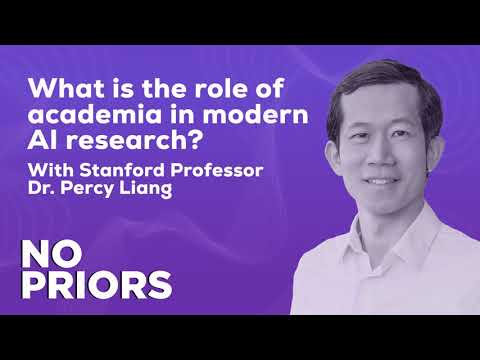
No Priors Ep. 7 | With Stanford Professor Dr. Percy Liang
Sarah Guo (host), Dr. Percy Liang (guest), Elad Gil (host), Sarah Guo (host), Elad Gil (host)
In this episode of No Priors, featuring Sarah Guo and Dr. Percy Liang, No Priors Ep. 7 | With Stanford Professor Dr. Percy Liang explores percy Liang on Foundation Models, Open Research, and AI’s Future Impact Stanford professor Percy Liang discusses his journey in natural language processing and how GPT-3 triggered his shift toward foundation models, leading to the creation of Stanford’s Center for Research on Foundation Models (CRFM).
Percy Liang on Foundation Models, Open Research, and AI’s Future Impact
Stanford professor Percy Liang discusses his journey in natural language processing and how GPT-3 triggered his shift toward foundation models, leading to the creation of Stanford’s Center for Research on Foundation Models (CRFM).
He explains why large language models are a paradigm shift, their emergent behaviors like in-context learning and chain-of-thought, and how academia’s role is moving from “making things work” to understanding principles and social impact.
Liang highlights CRFM’s work on transparency (e.g., the HELM evaluation benchmark), interdisciplinary research on risks and benefits, and efforts to keep models accessible despite increasing industry secrecy.
He also covers Together, a decentralized compute initiative for open models, and reflects on future directions for architectures beyond transformers, scientific discovery with AI, and how to think rigorously about AGI.
Key Takeaways
GPT-3’s training paradigm transformed how we conceptualize AI tasks.
Simply predicting the next word at scale, and then prompting models in natural language, turns a single foundation model into a flexible substrate for many tasks, dissolving rigid, task-specific system design.
Get the full analysis with uListen AI
Academia’s comparative advantage is shifting from scaling models to understanding them.
With industry able to “just scale” using massive data and compute, universities are better positioned to study principles, data/architecture effects, robustness, and social impacts rather than only chasing benchmark wins.
Get the full analysis with uListen AI
Transparency and openness are eroding and must be deliberately rebuilt.
Unlike earlier deep learning culture (open datasets, code, and models), top foundation models are now often API-only; CRFM and HELM aim to reintroduce norms of disclosure, comparability, and shared benchmarks.
Get the full analysis with uListen AI
Emergent behaviors like in-context learning and chain-of-thought weren’t hand-designed.
Capabilities such as learning from prompts, step-by-step reasoning, and stylistic “mix and match” arise from scale and training rather than explicit programming, suggesting deeper, still poorly understood structure.
Get the full analysis with uListen AI
Future AI progress likely requires both new architectures and better infrastructure.
Liang expects transformers not to be the final architecture and supports work on alternative models, while Together tackles the compute bottleneck via decentralized, weaker interconnects to make large-scale training more accessible.
Get the full analysis with uListen AI
Rigorous, holistic evaluation is essential for responsible deployment.
Projects like HELM show that evaluating language models must go beyond accuracy to cover calibration, robustness, toxicity, bias, efficiency, and security, continually updating as new models and applications emerge.
Get the full analysis with uListen AI
Foundation models could meaningfully accelerate scientific research, but reliability remains a barrier.
Liang envisions systems that read literature, form hypotheses, design and run experiments, and iteratively update beliefs; near-term uses will likely be “class-project-level” assistance, with humans still central to major breakthroughs.
Get the full analysis with uListen AI
Notable Quotes
“The idea of a task, which is so central to AI, begins to dissolve.”
— Percy Liang
“I really hope that in 10 years we won’t be using the transformer.”
— Percy Liang
“We coined the term foundation models because ‘large language models’ didn’t really capture the significance.”
— Percy Liang
“Up until now, the AI dream tops out at humans, but now we can actually go beyond in many, many ways.”
— Percy Liang
“Transparency is necessary but not sufficient; you need it just to even have a conversation about policy.”
— Percy Liang
Questions Answered in This Episode
How can we practically incentivize major AI labs to adopt stronger transparency norms without stifling innovation or competitiveness?
Stanford professor Percy Liang discusses his journey in natural language processing and how GPT-3 triggered his shift toward foundation models, leading to the creation of Stanford’s Center for Research on Foundation Models (CRFM).
Get the full analysis with uListen AI
What would a concrete, alternative architecture to transformers need to demonstrate at small scale to justify large-scale investment?
He explains why large language models are a paradigm shift, their emergent behaviors like in-context learning and chain-of-thought, and how academia’s role is moving from “making things work” to understanding principles and social impact.
Get the full analysis with uListen AI
How should regulators and institutions define and oversee the “values” that alignment processes bake into widely deployed foundation models?
Liang highlights CRFM’s work on transparency (e. ...
Get the full analysis with uListen AI
In what domains (e.g., medicine, law, scientific research) should we demand superhuman performance from AI systems rather than human parity, and how do we measure that?
He also covers Together, a decentralized compute initiative for open models, and reflects on future directions for architectures beyond transformers, scientific discovery with AI, and how to think rigorously about AGI.
Get the full analysis with uListen AI
What mechanisms could ensure that decentralized compute networks like Together remain secure, trustworthy, and resistant to abuse while staying open?
Get the full analysis with uListen AI
Transcript Preview
(music plays) Thanks, Percy.
Great, welcome.
Um, so I think just to start, can you tell us a little bit about how you got into, uh, the machine learning research field and your personal background?
Yeah. So I've been in the field of machine learning and natural language processing for over 20 years. I started getting into it in undergrad. I was an undergrad at MIT. I liked theory. I had a fascination with languages. I was fascinated by how humans could just, um, be exposed to just strings of, uh, text, uh, I mean, uh, speech, and somehow acquire very sophisticated understanding of the world and also syntax, and learn that in a fairly, uh, unsupervised way. And my dream was to get computers to do the, the same, so then I went to grad school, uh, at Berkeley, and then after that started at, uh, Stanford. And ever since, I've been in pursuit of, uh, you know, developing, uh, systems that can really truly understand natural language. Um, and of course, in the last four years, um, this once upon a time kind of dream has really kind of taken off in a s- in a sense. Um, maybe in a, not a way that I would necessarily ex- expect, uh, but with the coming out of, uh, large language models such as GPT-3, it's truly kind of astonishing how much of the structure of language and the world that these models can, can capture. Um, in some ways, it kind of hearkens back when I actually first started in NLP. I was, uh, training language models, but of a very different type. It was based on, uh, Hidden Markov Models. And there the goal was to discover hidden structure in, in text, and we were... I was very excited by the fact that it could learn about, um, tease apart what words were like city names versus days of the week and so on. Um, but now it's kind of on a d- completely different l- level.
Was there a moment, since y- you know, you've worked on multiple generations of NLP at this point, you know, pushing the forefront of semantic parsing, was there a moment at which you, um, decided that, you know, you were gonna focus on foundation models and large language models?
Yeah. There was a very decisive moment, and that moment was when GPT-3 came out.
Okay.
That was in the middle of the pandemic. Um, and it wasn't so much the capabilities of the model that, um, shocked me, but it was the way that the model was trained, which was basically taking a massive amount of text and asking the model to predict the next word over and over again, you know, billions of times. And just that simple, uh, objective and a very simple principle, what r- rose from it was not only a model that could generate fluent text, but also a model that could do in-context learning, which means that you can prompt a language model with instructions, uh, for example, summarize this document, give it some examples, and have the model on the fly in context figure out what the task was. And this was a paradigm shift in, in my opinion because it changed the way that we conceptualize machine learning and NLP systems from these bespoke systems where you're, it's trained to do question answering, to train to do this, to just a general, um, substrate where you can ask the model to do various things. And then the idea of a task which is so central to AI I think s- begins to dissolve, and I find that extremely exciting. Um, and that's the reason later, um, in 2021, uh, we founded the Center for Research on Foundation Models. We coined the term foundation models because we thought it, there was something that was happening in the world that was, that somehow large language models didn't really capture the significance. And it was not just about language, it was about images and multimodality, it was a more general phenomenon, and we coined the term foundation models and then, um, then the center started and it's been sort of, you know, a kind of a roller coaster ride, uh, ever since.
Install uListen to search the full transcript and get AI-powered insights
Get Full TranscriptGet more from every podcast
AI summaries, searchable transcripts, and fact-checking. Free forever.
Add to Chrome