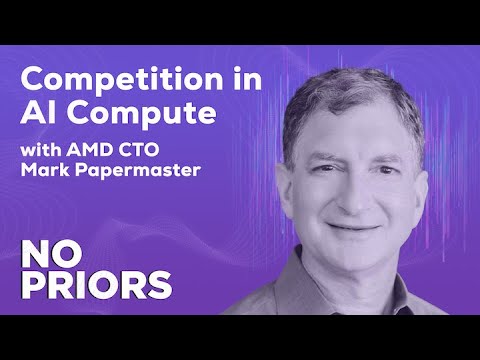
No Priors Ep. 53 | With AMD CTO Mark Papermaster
Sarah Guo (host), Mark Papermaster (guest), Elad Gil (host)
In this episode of No Priors, featuring Sarah Guo and Mark Papermaster, No Priors Ep. 53 | With AMD CTO Mark Papermaster explores aMD CTO Reveals Strategy Powering Next-Generation AI Chips and Computing AMD CTO Mark Papermaster discusses AMD’s decade-long transformation from a struggling PC-focused company into a central player in high-performance computing and AI. He explains how AMD built a competitive CPU and GPU portfolio, culminating in the MI300 accelerator for large-scale AI training and inference. The conversation covers open-source software strategy, supply-chain and packaging constraints, energy efficiency, and the impact of Moore’s Law slowing. Papermaster also outlines how AI will increasingly span cloud, edge, and end-user devices, making 2024 a major deployment year for AMD’s AI-enabled portfolio.
AMD CTO Reveals Strategy Powering Next-Generation AI Chips and Computing
AMD CTO Mark Papermaster discusses AMD’s decade-long transformation from a struggling PC-focused company into a central player in high-performance computing and AI. He explains how AMD built a competitive CPU and GPU portfolio, culminating in the MI300 accelerator for large-scale AI training and inference. The conversation covers open-source software strategy, supply-chain and packaging constraints, energy efficiency, and the impact of Moore’s Law slowing. Papermaster also outlines how AI will increasingly span cloud, edge, and end-user devices, making 2024 a major deployment year for AMD’s AI-enabled portfolio.
Key Takeaways
AMD’s AI strategy is built on a long-term CPU and GPU roadmap.
Before attacking AI head-on, AMD rebuilt its Zen CPU line and strengthened GPUs, enabling it to offer competitive heterogeneous systems that pair high-performance CPUs with massively parallel GPUs.
Get the full analysis with uListen AI
The MI300 targets leading-edge LLM training and inference workloads.
MI300 variants are designed for both high-performance computing and AI, with strong training performance and leading FP16 VLLM inference efficiency by tightly coupling math engines with high-bandwidth memory and advanced packaging.
Get the full analysis with uListen AI
Software ecosystem and openness are critical competitive levers against incumbents.
AMD’s ROCm stack is open source, tightly integrated with PyTorch, ONNX, TensorFlow, and platforms like Hugging Face, aiming to make porting workloads from CUDA-like environments straightforward and avoid vendor lock-in.
Get the full analysis with uListen AI
GPU supply constraints are easing, but power and packaging are rising bottlenecks.
Wafer capacity, advanced packaging, and substrates have been key constraints, but industry expansion—especially via partners like TSMC—is addressing them; long term, data center power availability and energy efficiency become the dominant challenges.
Get the full analysis with uListen AI
Innovation beyond Moore’s Law requires holistic, system-level design.
With node shrinks delivering less automatic benefit and higher cost, AMD leans on chiplets, heterogeneous compute engines, advanced 2D/3D packaging, and co-designed software stacks to keep performance-per-watt and capability improving.
Get the full analysis with uListen AI
AI will be distributed across cloud, edge, and end devices for latency and cost.
Massive LLMs will remain in hyperscale clouds, but fine-tuned and smaller models will increasingly live in tier-two data centers, at the edge, and on PCs/embedded devices to meet low-latency, application-specific needs.
Get the full analysis with uListen AI
Geographic diversification of semiconductor manufacturing is now a strategic necessity.
Given national security and geopolitical risks, AMD works with foundry partners like TSMC and Samsung as they build fabs and packaging capacity in the US, Europe, and additional regions to ensure more resilient supply chains.
Get the full analysis with uListen AI
Notable Quotes
“We’re not about locking in someone with a proprietary walled garden software stack. We want to win with the best solution.”
— Mark Papermaster
“It was clear that the industry needed that powerful combination of the serial computing of CPUs and the massive parallelization you get from a GPU.”
— Mark Papermaster
“With Moore’s Law slowing, it demands what I call holistic design—from transistor design all the way up through packaging and the software stack.”
— Mark Papermaster
“This is a huge year for us because we’ve just completed AI-enabling our entire portfolio—cloud, edge, PCs, embedded, and gaming.”
— Mark Papermaster
“The devices that are successful really serve a need… it’s got to be something that you love, and that creates a new category.”
— Mark Papermaster
Questions Answered in This Episode
How difficult is it in practice for large AI teams to migrate existing CUDA-based workloads to ROCm and AMD GPUs, and where are the main friction points?
AMD CTO Mark Papermaster discusses AMD’s decade-long transformation from a struggling PC-focused company into a central player in high-performance computing and AI. ...
Get the full analysis with uListen AI
What specific architectural bets (e.g., chiplet configurations, memory hierarchies) is AMD making for post-LLM AI workloads beyond today’s transformer-heavy landscape?
Get the full analysis with uListen AI
How will rising data center power constraints reshape GPU and system design over the next 5–10 years, and could this favor more specialized accelerators over general-purpose GPUs?
Get the full analysis with uListen AI
In a world of distributed AI between cloud, edge, and device, what are the missing abstractions or developer tools to orchestrate where different parts of a model run?
Get the full analysis with uListen AI
Given growing geopolitical risk, how far can geographic diversification of fabs and packaging realistically go without significantly increasing cost for customers?
Get the full analysis with uListen AI
Transcript Preview
(techno music) Hi, listeners. For potential AI founders, my early stage AI fund, Conviction, is accepting applications for its Embed Accelerator for two more days. Embed offers $150,000 in an uncapped safe, more than half a million of free compute and API credits, a hand-selected set of peers, and access to leading founder and research mentors. Apply at embed.conviction.com by March 1st. Hi, listeners, and welcome to another episode of No Priors. Today, we're excited to be talking to the CTO of AMD, Mark Papermaster. Mark has had a storied career in chips and hardware with previous leadership positions at IBM, Apple, and Cisco. We're excited to have Mark on to get into GPUs and the competition that's been driving this industry. Welcome, Mark.
Thanks there. Glad to be here with you and Elad.
Can you start by telling us a bit about your background? You've worked on all sorts of interesting things from the iPhone and the iPad to, like, the latest generation of AMD SuperComputing chips.
Well, sure. I've been around a while. So what's really fun is my timing was pretty good getting into the industry as an electrical and computer engineering grad, University of Texas, and got really interested in chip design. And so it was back at a time when chip design was radically changing. The kind of technology everyone uses today, CMOS, was just coming into, uh, you know, production usage. And so I got, uh, on s- IBM's very first CMOS projects and created some of the first designs. So I got to get my hands dirty and do just about every facet of, uh, chip design, and had a number of years at IBM and, uh, took on different roles, uh, took on, uh, driving the microprocessor development at, uh, IBM across, uh, first, their, uh, Power, uh, PCs and that wa- you know, meant working with Apple and, uh, Motorola as well as the big iron. The- the big computing chips that we had in the mainframe and the- and the big RISC servers. So, uh, really got all facets o- of technology there and included, uh, working on some of their, uh, server development, but then, uh, shifted over to, um, uh, to Apple, uh, Steve, uh, Jobs hired me to run the iPhone and, uh, iPod, uh, and so I was there for a couple years. But it was, uh, a- a time of a great transition in the opportun- in the, uh, industry and- and for me, it was a great opportunity because I ended up in 2011, fall of 2011, uh, taking the role here at AMD of being both CTO, uh, and- and really running the technology and engineering and right at a point where Moore's Law is starting to slow down and so, eh, you know, tremendous innovation was needed.
Yeah. I wanna get into that and sort of what we can expect in terms of computing innovation if we're not just draming more transistors on chips or we're un- unable to do that. Um, every one of our listeners I think has heard of AMD, but can you give, like, a- a very brief overview of the major markets you serve there?
Install uListen to search the full transcript and get AI-powered insights
Get Full TranscriptGet more from every podcast
AI summaries, searchable transcripts, and fact-checking. Free forever.
Add to Chrome