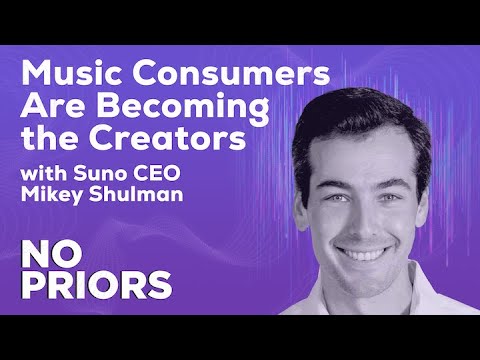
No Priors Ep. 64 | With Suno CEO and Co-Founder Mikey Shulman
Sarah Guo (host), Narrator, Mikey Shulman (guest), Elad Gil (host), Narrator
In this episode of No Priors, featuring Sarah Guo and Narrator, No Priors Ep. 64 | With Suno CEO and Co-Founder Mikey Shulman explores suno’s CEO on Democratizing Music Creation With AI-Generated Songs Suno CEO and co-founder Mikey Shulman discusses how Suno uses transformer-based AI models to generate complete songs—including lyrics, vocals, and instrumentation—from simple text prompts, with the goal of making music creation accessible to everyone. He explains why the team chose to focus on music rather than speech, emphasizing that quality is ultimately judged by human emotion and aesthetics, not standard AI benchmarks. The conversation covers Suno’s technical approach to tokenizing audio, emerging user behaviors around collaborative creation, and the potential impact on how people create, share, and experience music. Shulman predicts that AI tools will expand participation in music, accelerate cultural evolution in sound and song structure, and blur the line between creators and consumers.
Suno’s CEO on Democratizing Music Creation With AI-Generated Songs
Suno CEO and co-founder Mikey Shulman discusses how Suno uses transformer-based AI models to generate complete songs—including lyrics, vocals, and instrumentation—from simple text prompts, with the goal of making music creation accessible to everyone. He explains why the team chose to focus on music rather than speech, emphasizing that quality is ultimately judged by human emotion and aesthetics, not standard AI benchmarks. The conversation covers Suno’s technical approach to tokenizing audio, emerging user behaviors around collaborative creation, and the potential impact on how people create, share, and experience music. Shulman predicts that AI tools will expand participation in music, accelerate cultural evolution in sound and song structure, and blur the line between creators and consumers.
Key Takeaways
Aesthetics and emotional impact matter more than traditional AI benchmarks in music.
Unlike text models that optimize for test scores or factual accuracy, Suno evaluates success by how music feels to listeners, relying heavily on human listening, A/B tests, and taste rather than standardized metrics.
Get the full analysis with uListen AI
Transformers work well for audio, but smart tokenization is the real innovation lever.
Suno uses transformer architectures familiar from text AI, and focuses its R&D on turning continuous, high-sample-rate audio into discrete tokens in ways that preserve nuance and musicality.
Get the full analysis with uListen AI
Avoiding hard-coded music theory enables more novel and unexpected sounds.
Shulman emphasizes that they deliberately do not encode rules like “12 tones” or fixed instrument sets, instead letting the model learn structures implicitly via next-token prediction, opening space for new timbres and hybrids.
Get the full analysis with uListen AI
AI music tools can turn music creation into a mainstream, social activity.
Users aren’t just output-focused; they enjoy the creative process itself, co-writing lyrics, trading prompts, and effectively “jamming” with friends and the model, echoing the joy of live jam sessions.
Get the full analysis with uListen AI
The line between creator and consumer is likely to blur significantly.
Shulman expects future experiences where listening and modifying songs blend together, making “creation vs. ...
Get the full analysis with uListen AI
Business models for generative AI are still experimental and unsettled.
Suno uses a free tier plus subscription, but Shulman views current SaaS-like pricing as a legacy from previous tech waves, noting that alternatives like micropayments, ads, and marketplaces may emerge.
Get the full analysis with uListen AI
AI could accelerate cultural and musical evolution beyond production efficiency gains.
Just as DAWs democratized and sped up production, Suno’s tools may push faster evolution in song structures, chord progressions, and cross-genre blends, potentially countering trends toward ultra-short, formulaic tracks.
Get the full analysis with uListen AI
Notable Quotes
“Speech just needs to be right… and the real creativity was happening in a totally different part of audio, which is music.”
— Mikey Shulman
“Aesthetics matter… you have to use your ears in order to evaluate things.”
— Mikey Shulman
“The model shouldn’t know about music theory… If I tell my model, ‘There are only 12 tones,’ my model will only know how to output 12 tones.”
— Mikey Shulman
“Like a video game, music is fun by yourself and maybe more fun in multiplayer mode.”
— Mikey Shulman
“The machine doesn’t know that there is even a concept of voice… it’s just all sound.”
— Mikey Shulman
Questions Answered in This Episode
How might copyright, ownership, and royalties work when songs are fully AI-generated but users supply only text prompts?
Suno CEO and co-founder Mikey Shulman discusses how Suno uses transformer-based AI models to generate complete songs—including lyrics, vocals, and instrumentation—from simple text prompts, with the goal of making music creation accessible to everyone. ...
Get the full analysis with uListen AI
What new evaluation methods or benchmarks could better capture musical ‘taste’ and emotional impact in AI systems?
Get the full analysis with uListen AI
How could Suno’s tools be integrated into live performance or traditional studio workflows without displacing human musicians?
Get the full analysis with uListen AI
In what ways might widespread AI-assisted music creation reshape the economics and power structures of the music industry?
Get the full analysis with uListen AI
How can Suno prevent homogenization of sound and ensure that AI music actually increases, rather than reduces, musical diversity?
Get the full analysis with uListen AI
Transcript Preview
(techno music plays) Hi, listeners, and welcome to No Priors. Today, we're talking to Mikey Schulman, the co-founder and CEO of Suno, an AI music generation tool trying to democratize music making. Users can make a song complete with lyrics just by entering a text prompt. For example, I was playing with it this morning, and you guys will all get to hear, um, Kodo Boom Bop with lo-fi intricate beats.
Underneath sakura trees and their spring's embrace. Nature weaves tales in each gentle race. Ethereal petals fall, time slows its pace. Every fleeting cherry bloom, a hint of grace.
Okay. So, um, feeling really excited about quality here for a company that is just under two years old, but is making waves in the AI and music industries, um, since you came out of stealth mode late last year, Mikey?
That's right.
All right. Well, we're excited to talk to you about AI music models and how it's been going since launch. Uh, thanks so much for doing this. Welcome.
Thank you. I'm, I'm super excited to be here.
Okay, maybe just start us off with a little bit of background. Uh, you're a kid who loved music, playing in bands. How do you go from that to, um, you know, Harvard physics PhD building, you know, couple AI companies?
Uh, yeah, I guess a, a bit of a circuitous route. Um, uh, I've been playing music for a really long time, since I'm f- s- I started playing piano when I was four. I played in a lot of bands in, in high school and college growing up. Um, and the dirty secret is I'm not that good. Um, and so the, uh, smart move, I suppose, for me, was to, um, pursue the thing that I was relatively better at, which was physics. I went, I went, uh, to college and then to grad school and did a PhD in physics. Um, studied quantum computing. Uh, maybe for, for your next podcast, I can tell you about why, why you shouldn't go into quantum computing.
What did you think you were gonna do? Like, did you think you were gonna be, like, um, like, a theoretical physicist or, like, an academic?
Oh, goodness. Um, well, two things. Like, I've never had a master plan, so I don't think I-
Okay.
... thought what I was going to do or not going to do, but I am certainly not great at physics. Um, you know, I think I had a, a reasonably successful PhD, um, not because I'm good at physics. The, the quantum mechanics that I studied was worked out in, like, the '50s. Um, uh, there was a lot of very tricky, uh, low temperature microwave engineering that turns out to be really important for, for actually doing this stuff. I got lucky that I was, uh, relatively good at that compared to all the other physicists. So, um, you know, kind of something, kind of something on the boundary between two disciplines. Um, I enjoyed every second of that. I would do it all again, even knowing, um, what, you know, what I would be when I grew up or when I grew out of that. Um, still very close with my PhD advisor. Um, I still live walking distance from my old lab. Um, you know, it's, it's kind of a fun place to just walk around Cambridge, Massachusetts. But, um, yeah, quantum computing is cool. It's not what I wanted to do with my life. Um, I found a company called Kensho by accident. Not founded, found. Um, they were local, and I met them and, um, probably 10 people at the time, and I met all 10, and I really, really liked them. And I said, "Let's go do this." Um, and I was hired as a software engineer, and I think I got really, really lucky in terms of timing. About a month after I joined, the machine learning opportunities came along, and in 2014, guy with PhD in physics is what passes for a machine learning engineer. And so, I took full advantage of that opportunity, learned a ton, got to build a team, got to build some fun products. Um, uh, we were acquired by S&P Global in 2018, um, uh, and got to pursue a lot of fun stuff after that acquisition as well. So, I guess I found my way into AI somewhat by accident, um, but I really like it. Uh, it's, it's a lot of fun.
Install uListen to search the full transcript and get AI-powered insights
Get Full TranscriptGet more from every podcast
AI summaries, searchable transcripts, and fact-checking. Free forever.
Add to Chrome