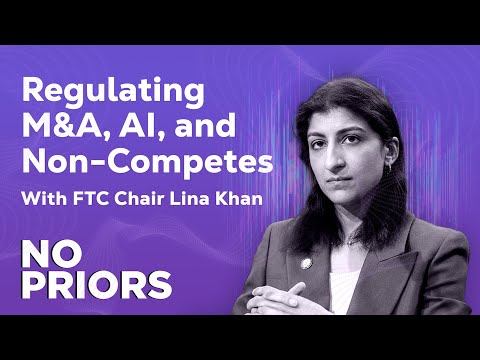
No Priors Ep. 84 | With Chair of the Federal Trade Commission Lina Khan
Sarah Guo (host), Elad Gil (host), Lina Khan (guest)
In this episode of No Priors, featuring Sarah Guo and Elad Gil, No Priors Ep. 84 | With Chair of the Federal Trade Commission Lina Khan explores lina Khan on AI, antitrust, and keeping markets truly open FTC Chair Lina Khan discusses how decades of market consolidation, especially in digital markets, have harmed consumers, workers, and entrepreneurs, and why stronger antitrust enforcement is needed. She explains merger review as an inherently predictive exercise, particularly critical at technological inflection points like AI, where incumbents may try to neutralize emerging threats. Khan defends robust scrutiny of acquisitions while emphasizing that most deals proceed, and illustrates how blocking anticompetitive deals can still allow beneficial transactions and innovation. She also addresses AI model openness, creator rights, simple versus incumbent-favoring regulation, the FTC’s non-compete ban, and how she manages and measures impact at a modern regulatory agency.
Lina Khan on AI, antitrust, and keeping markets truly open
FTC Chair Lina Khan discusses how decades of market consolidation, especially in digital markets, have harmed consumers, workers, and entrepreneurs, and why stronger antitrust enforcement is needed. She explains merger review as an inherently predictive exercise, particularly critical at technological inflection points like AI, where incumbents may try to neutralize emerging threats. Khan defends robust scrutiny of acquisitions while emphasizing that most deals proceed, and illustrates how blocking anticompetitive deals can still allow beneficial transactions and innovation. She also addresses AI model openness, creator rights, simple versus incumbent-favoring regulation, the FTC’s non-compete ban, and how she manages and measures impact at a modern regulatory agency.
Key Takeaways
Antitrust enforcement must look beyond short-term prices to market structure.
Focusing only on immediate price and output effects misses how dominance, gatekeeping, and consolidation can harm entrepreneurs, workers, and long-run innovation even when consumer prices appear low.
Get the full analysis with uListen AI
Merger review is predictive, especially crucial at technological inflection points like AI.
Agencies must assess whether deals may substantially lessen future competition, including in emerging markets, because inflection points are when incumbents are most likely to snuff out disruptive threats.
Get the full analysis with uListen AI
Digital markets can ‘tip,’ making late entry much harder than assumed.
Network effects and data advantages can entrench dominant firms, undermining the old belief that new entrants will automatically discipline tech monopolies, and justifying more active enforcement.
Get the full analysis with uListen AI
Most M&A still goes through; antitrust targets moat-deepening, not exits per se.
Khan stresses that less than ~3% of reportable deals are investigated, and challenges mainly focus on acquisitions by entrenched monopolists that would remove current or future rivals, not on all startup exits.
Get the full analysis with uListen AI
Who you sell to matters: deals with monopolists are riskier antitrust-wise.
Founders and investors can better predict risk by recognizing that sales to dominant incumbents in the same market are far likelier to raise issues than sales to firms without that entrenched position.
Get the full analysis with uListen AI
Open-weight AI models can lower barriers and spur innovation, but creator rights matter.
Khan supports openness as an innovation catalyst but highlights the unfairness and long-run risk of ingesting creators’ work without consent or compensation, which may erode incentives to produce quality information and art.
Get the full analysis with uListen AI
Simple, clear rules (like banning most non-competes) can boost competition without entrenching incumbents.
Unlike complex regulations that require armies of lawyers and favor large firms, straightforward rules help diffusion of talent and ideas, broaden opportunity, and avoid locking in the advantage of existing giants.
Get the full analysis with uListen AI
Notable Quotes
“How we structure markets is in fact a policy question. Do we want monopolies in every market, or do we want more competition?”
— Lina Khan
“Merger enforcement is inherently a predictive exercise.”
— Lina Khan
“Digital markets are different, and in fact, they can lend themselves to tipping.”
— Lina Khan
“If you reduce what antitrust is about, it's about making sure that the best ideas can win.”
— Lina Khan
“Not all rules and regulations are created equal… some are designed in a way to favor the big guys and end up having that effect.”
— Lina Khan
Questions Answered in This Episode
How should regulators balance the risk of stifling beneficial startup exits against the risk of allowing incumbents to consolidate power through acquisitions?
FTC Chair Lina Khan discusses how decades of market consolidation, especially in digital markets, have harmed consumers, workers, and entrepreneurs, and why stronger antitrust enforcement is needed. ...
Get the full analysis with uListen AI
What practical frameworks could founders use to assess whether a potential acquirer is likely to face antitrust scrutiny?
Get the full analysis with uListen AI
How can policy simultaneously encourage open-weight AI development and protect creators whose work is used for model training?
Get the full analysis with uListen AI
In what ways might future antitrust doctrine need to evolve to capture AI-era power dynamics based on compute, data, and distribution rather than price alone?
Get the full analysis with uListen AI
How should we measure the long-term innovation impact of blocking specific high-profile tech mergers, beyond immediate market outcomes?
Get the full analysis with uListen AI
Transcript Preview
(techno music) Hi, listeners, and welcome to No Priors. Today, we're talking to Lina Khan, Chair of the Federal Trade Commission. When she was appointed at 32 years old, she was the youngest chairperson in the history of the FTC, and one of the youngest leaders of a government agency today. Lina has made a significant impact during her time at the FTC, focusing on high-profile antitrust cases. Within tech, her FTC has challenged NVIDIA, Meta, and Microsoft, as well as taking actions within healthcare and pharma. We're gonna discuss how she thinks about AI, the structure of the markets best for consumers, non-competes, predicting whether or not M&A will happen, and her approach to increasing competition.
Well, Chair Khan, thank you so much for joining us today on No Priors.
Thanks so much for having me.
So when you were 32 years old, you were appointed the youngest chairperson in the history of the FTC. Um, can you tell us a little bit about your career and what led you to the FTC and government?
Yeah, happy to. So I got my start as a business reporter and journalist, and one of my jobs was to document how various markets across the US economy had evolved. So I had to do deep dives in areas like the airlines, uh, book publishing, uh, chicken farming, uh, the aluminum market, uh, really all sorts of nooks and crannies that gave me a deeper appreciation for the ways that over the last four decades, our markets had become much more consolidated, uh, primarily through waves of mergers and acquisitions, uh, which in part were permitted through a much more lax approach to antitrust laws and policing mergers. And through that research, I really got a direct view of how consolidation and concentration in markets affects everyday people, be it consumers who are having to drive much further to get to the nearest hospital, uh, to chicken farmers who can only sell to a single company, and that leads to all sorts of exploitation, uh, to entrepreneurs and small businesses about how, you know, when you have a handful of gatekeepers controlling access to markets, that can also, uh, lead to much worse terms for them. And so it really got me just interested in this question of market structure and the fact that how we structure markets is in fact a policy question. Uh, do we want monopolies in every market, or do we want more competition? And historically, America has chosen the path of more competition, and I believe that's what's contributed to just the phenomenal economic growth that we've seen and the birth, uh, of, of so many fantastic companies.
While you were at Yale, you published this very influential essay, um, uh, about Amazon and the antitrust paradox. Um, can you describe the theory behind the essay and, you know, how that might differ from traditional antitrust, and if it still applies in your, your thinking today?
Install uListen to search the full transcript and get AI-powered insights
Get Full TranscriptGet more from every podcast
AI summaries, searchable transcripts, and fact-checking. Free forever.
Add to Chrome