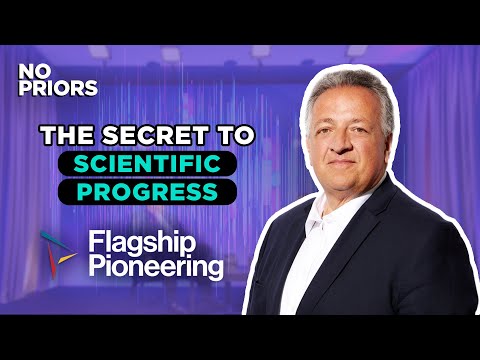
No Priors Ep. 104 | With Flagship Pioneering CEO and Co-Founder Noubar Afeyan
Sarah Guo (host), Noubar Afeyan (guest), Narrator
In this episode of No Priors, featuring Sarah Guo and Noubar Afeyan, No Priors Ep. 104 | With Flagship Pioneering CEO and Co-Founder Noubar Afeyan explores flagship’s Noubar Afeyan on Emergent Innovation, AI, and Polyintelligence Noubar Afeyan recounts how Flagship Pioneering was built to turn entrepreneurship from a one-off, “gamey” pursuit into an institutional, parallel, professional discipline for creating breakthrough biotech companies. He explains their philosophy of “emergent innovation,” where variation, selection, and iteration create unexpected breakthroughs, and how generative AI now supercharges this process for proteins, platforms, and even autonomous scientific discovery. The conversation covers Flagship’s sector choices, how they underwrite uncertainty beyond adjacent innovations, and why all their companies are built as platforms rather than single-asset bets. Afeyan also discusses AI’s role in drug development, regulatory and clinical bottlenecks, lessons from Moderna and Operation Warp Speed, and his concept of “polyintelligence” as a triangle between human, machine, and nature’s intelligence.
Flagship’s Noubar Afeyan on Emergent Innovation, AI, and Polyintelligence
Noubar Afeyan recounts how Flagship Pioneering was built to turn entrepreneurship from a one-off, “gamey” pursuit into an institutional, parallel, professional discipline for creating breakthrough biotech companies. He explains their philosophy of “emergent innovation,” where variation, selection, and iteration create unexpected breakthroughs, and how generative AI now supercharges this process for proteins, platforms, and even autonomous scientific discovery. The conversation covers Flagship’s sector choices, how they underwrite uncertainty beyond adjacent innovations, and why all their companies are built as platforms rather than single-asset bets. Afeyan also discusses AI’s role in drug development, regulatory and clinical bottlenecks, lessons from Moderna and Operation Warp Speed, and his concept of “polyintelligence” as a triangle between human, machine, and nature’s intelligence.
Key Takeaways
Treat entrepreneurship as a repeatable profession, not a one-off gamble.
Afeyan argues company creation should be systematic, parallel, and institutional—more like venture investing or law—rather than a random, romanticized, “gamey” activity left to lone geniuses.
Get the full analysis with uListen AI
Design systems for emergence instead of pretending we plan breakthroughs.
Flagship uses structured variation, selection, and iteration to let unexpected opportunities emerge, mirroring evolution in nature; they then resist rewriting history as if success was fully intentional.
Get the full analysis with uListen AI
Underwrite uncertainty, not just risk, to access truly novel value.
Most innovation targets adjacencies where probabilities can be estimated; Flagship deliberately goes further out where outcomes are uncertain and addresses that by running decisive experiments to collapse uncertainty.
Get the full analysis with uListen AI
Build platforms, not single assets, when venturing beyond adjacencies.
If you’re attacking brand‑new modalities (mRNA, gene writing, computational proteins), you need platform diversification, because unknown scientific, regulatory, or market shocks can easily kill a lone asset.
Get the full analysis with uListen AI
Use AI to expand and upgrade the drug discovery funnel, then fix downstream bottlenecks.
Generative and machine learning models can design proteins, RNAs, and other molecules and even generate hypotheses and run experiments, but clinical trial design, staging, and regulation remain slow constraints that also need innovation.
Get the full analysis with uListen AI
Rethink clinical development with granular biostaging and data-driven regulation.
Afeyan advocates finer-grained, molecular “biostages” of disease and adaptive, data‑informed trials to run smaller, more precise studies, speed approvals, and reduce cost—especially important for biotech startups.
Get the full analysis with uListen AI
Embrace polyintelligence: the future lies in human–machine–nature co-evolution.
He proposes a triangle of human, machine, and nature’s intelligence, where AI augments our ability to interrogate and harness nature, and all three adapt to each other, driving the next wave of scientific emergence.
Get the full analysis with uListen AI
Notable Quotes
“The single most value-creating invention humans have made is the startup.”
— Noubar Afeyan
“I don’t believe anything that I’ve been involved in innovating is actually the product of my work. It’s been emergent.”
— Noubar Afeyan
“What we can do is underwrite uncertainty.”
— Noubar Afeyan
“If you’re going to go do RNA for the first time, the notion that you do that to come back with one asset is the definition of insanity.”
— Noubar Afeyan
“It’s not a line between human and computer; it’s really a triangle where human intelligence and machine intelligence, coupled with nature’s intelligence, will inform each other.”
— Noubar Afeyan
Questions Answered in This Episode
How can other sectors beyond biotech practically implement Flagship’s emergent innovation playbook of variation, selection, and iteration?
Noubar Afeyan recounts how Flagship Pioneering was built to turn entrepreneurship from a one-off, “gamey” pursuit into an institutional, parallel, professional discipline for creating breakthrough biotech companies. ...
Get the full analysis with uListen AI
What governance or incentive structures are needed for regulators to safely adopt data-driven, adaptive trial designs at scale?
Get the full analysis with uListen AI
How should founders decide when a true platform strategy is warranted versus when it’s an overreach that will strain capital and teams?
Get the full analysis with uListen AI
In a world of polyintelligence, how do we ensure humans retain meaningful agency rather than deferring too much to machine-generated hypotheses and decisions?
Get the full analysis with uListen AI
What lessons from Operation Warp Speed could be generalized to accelerate treatments for chronic killers like cancer and neurodegenerative diseases, absent an acute crisis?
Get the full analysis with uListen AI
Transcript Preview
(music plays) Hi, listeners, and welcome to No Priors. Today, we're joined by Noubar Afeyan, founder and CEO of Flagship Pioneering, the firm behind Moderna and over 100 other biotech companies. We'll talk about his approach to building biotech startups, how AI is reshaping drug development, and his theory of polyintelligence. Welcome, Noubar.
Thanks again for doing this. And I look forward to the discussion.
Noubar, let's start with the roots. You've had this incredible journey personally. You arrived as a teenager after your family fled war-torn Beirut. You earned MIT's first PhD in biochemical engineering. And, you know, over the past three decades, you've created a force with Flagship that's changed the trajectory of global health with many important biotech companies and more than $100 billion of value. Can you just talk a little bit about your motivation to start Flagship originally and what you thought it might become?
I will work hard to fit the description you just gave of what I've done or, or what I'm trying to do. The motivation for Flagship, uh, stems from what I was doing before, which was that I started a company in 1987 when 24-year-old immigrants didn't start companies in this country, but instead it was kind of like former Merck senior executives or IBM senior executives were the only ones who were entrusted with the massive amounts of venture capital, namely $2, $3 million per round used to go into venture capital. So this was very early days. And I had the, the kind of chance opportunity to start a company right out of my graduate school and ended up raising quite a bit of venture money and eventually, um, kind of went down a path of entrepreneurship. Along the way, one of the things that interested me was why it is that kind of the entrepreneurial process was supposed to be random, improvisational, kind of idiosyncratic, almost emotional, gamey. All of those things I kind of thought was a bit of, bit of a put off, uh, when it comes to actually doing things in a serious, professional way. And I kind of used to go around in the very early '90s saying, "Why isn't entrepreneurship a profession?"
Hm.
And if it was going to be a profession, how could it be a profession? And at the time, you know, there were a lot, largely one or two competitions, you know, giving prizes, which of course reinforces the, the gamey nature of it. Uh, and so I started thinking about that. I then started thinking, well, one way to know you're doing it as a professional is if you can do many of them in parallel. And my motivation for that was investing because, of course, venture capital is a parallel investing activity. If it was the case that you could only do one of these at a time, you would have serial venture capitalists, not parallel entre- venture capitalists. And yet, people think entrepreneurs are supposed to be serial, but investors or lawyers or everybody else can operate in parallel. The learning cycles of doing things at the same time is completely different than if you actually force yourself to think about the essence of what you're doing and what's reproducible, what has to be different in each case. And so I got interested in that, and parallel entrepreneurship led me to say, "Well, how do you do that even?" So I spent the late '90s alongside running my first company, getting involved in the co-founding of several other companies where-
Install uListen to search the full transcript and get AI-powered insights
Get Full TranscriptGet more from every podcast
AI summaries, searchable transcripts, and fact-checking. Free forever.
Add to Chrome