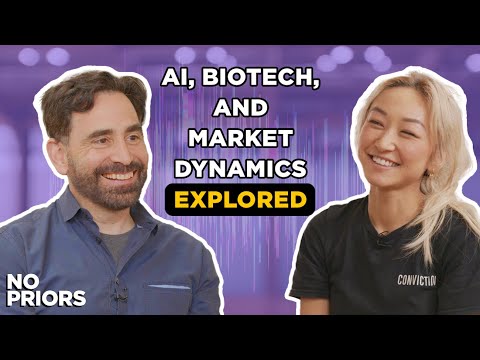
No Priors Ep. 116 | With Sarah and Elad
Sarah Guo (host), Elad Gil (host)
In this episode of No Priors, featuring Sarah Guo and Elad Gil, No Priors Ep. 116 | With Sarah and Elad explores aI Markets Crystallize As Founders Face Consolidation And New Frontiers Sarah and Elad discuss how parts of the AI market are finally consolidating, with clearer early winners emerging in areas like coding assistants, customer success, and healthcare applications. They contrast these with still-open arenas such as sales, finance, accounting, and pharma, where the right product approach or model capabilities have yet to fully materialize. Elad argues that startup–startup mergers will increasingly be rational to better fight entrenched incumbents, while Sarah highlights cultural and status barriers to such moves. The conversation then pivots to under-explored biotech opportunities and to AI research frontiers like world models and reinforcement learning as pathways toward more capable agents and eventual AGI.
AI Markets Crystallize As Founders Face Consolidation And New Frontiers
Sarah and Elad discuss how parts of the AI market are finally consolidating, with clearer early winners emerging in areas like coding assistants, customer success, and healthcare applications. They contrast these with still-open arenas such as sales, finance, accounting, and pharma, where the right product approach or model capabilities have yet to fully materialize. Elad argues that startup–startup mergers will increasingly be rational to better fight entrenched incumbents, while Sarah highlights cultural and status barriers to such moves. The conversation then pivots to under-explored biotech opportunities and to AI research frontiers like world models and reinforcement learning as pathways toward more capable agents and eventual AGI.
Key Takeaways
Several AI verticals are already consolidating around early leaders.
In coding, customer success, and healthcare/medical scribing, Elad sees a small number of companies emerging as clear near-term winners, reducing the sense of chaos that dominated the last two years.
Get the full analysis with uListen AI
Large opportunity spaces remain underclaimed in sales, finance, accounting, and pharma.
Despite obvious potential for AI-driven productivity in document-heavy industries, the right product workflows and model capabilities haven’t yet crystallized, leaving room for new entrants.
Get the full analysis with uListen AI
Startup–startup mergers may be a rational play to beat incumbents.
Elad argues founders who are #1 and #2 in a niche should consider merging to stop fighting each other on every deal and instead consolidate resources to compete with big-platform players.
Get the full analysis with uListen AI
Ego, culture fears, and valuation anxiety often block sensible consolidation.
Founders and investors frequently over-index on control, status, and integration worries rather than using simple metrics (users, revenue) to structure fair deals and focus on winning larger markets.
Get the full analysis with uListen AI
Biotech’s structure and culture push innovation toward pharma pipelines, not new categories.
Because biotech VCs design companies to be sold into pharma’s narrow set of priorities (cancer, cardio, neuroscience), huge markets like fertility, aging, baldness, and sensory decline are relatively neglected.
Get the full analysis with uListen AI
World models and RL are central to moving from text prediction to real agents.
Sarah explains that cloning human task traces is brittle, and that reinforcement learning in rich simulated environments (world models) may be needed to teach models to plan, act, and adapt toward goals.
Get the full analysis with uListen AI
Unconstrained optimization can reveal non-intuitive strategies humans can later adopt.
Elad notes that AI systems in Go, and evolutionary experiments in biology, often discover surprising solutions; similar approaches in coding or science could expose new, superior patterns humans haven’t explored.
Get the full analysis with uListen AI
Notable Quotes
“AI is the one market in my career where I've consistently said the more I learn, the less I know.”
— Elad
“For the first time in like two years, it feels like some subset of things are consolidating back down.”
— Elad
“If I was a number one or number two in a market and I was a startup, I'd consider merging with the other party, because the real threat will be fighting the incumbents.”
— Elad
“People will feel like it is capitulating, but it's capitulating in service of winning.”
— Sarah
“Scaling up model size and training data has given us this really powerful foundation of knowledge and pattern recognition, but what people want from here is not just predicting text.”
— Sarah
Questions Answered in This Episode
How should founders decide whether to keep competing or pursue a merger with their nearest startup rival in an AI niche?
Sarah and Elad discuss how parts of the AI market are finally consolidating, with clearer early winners emerging in areas like coding assistants, customer success, and healthcare applications. ...
Get the full analysis with uListen AI
What concrete product characteristics or workflows will likely differentiate eventual winners in still-open markets like sales and finance?
Get the full analysis with uListen AI
Given the structural incentives in biotech, what new funding or company-building models could unlock neglected areas like fertility, aging, and tooth regrowth?
Get the full analysis with uListen AI
How can labs practically design world models and reward structures that are rich enough to teach general problem solving without overfitting to narrow environments?
Get the full analysis with uListen AI
What safeguards and norms are needed as we approach technologies like cell-derived gametes, mind uploading, or direct modulation of emotions and attention?
Get the full analysis with uListen AI
Transcript Preview
(instrumental music plays) Elad, what's going on?
How you doing, Sarah?
I'm good. I can't tell if it is a very stable time in the market, like it's crystallizing into known businesses and models, or it's as, as fluid. What's your take?
You know, it's interesting. AI is the, um, the one market in my career where I've sort of consistently said the more I learn, the less I know, right? Every other market, you kinda learn more, you know more, you keep advancing. And I actually feel like that's shifted in the last couple months, where I feel for a subset of areas, despite the rapid pace of innovation, all the really exciting new models and research findings and everything else, I actually feel like a bunch of markets have sort of consolidated. And it's kinda clear now who are the likely players or winners in, like, two or three big areas. And that may change, right? In three years, another new startup may launch and displace everybody, or an incumbent may make a bold move, or whatever it may be. But I feel like in the foundation model market, at least for, uh, LLMs, there's a clearer view of sort of what's important and what isn't. At the application level, I think it's kinda clear who the winners are gonna be in sort of at least the first set of services for healthcare-related, uh, things like medical scribing or other flows. Encoding, it seems like it's consolidated into two or three players. Um, you know, may- maybe that's Cursor or Codium Cognition, and then Microso- Microsoft's, like, Copilot, right? But, um, there aren't probably, like, two dozen companies that are all still competing there. In, uh, customer success, it seems like things are kinda consolidating against Sierra and Decagon. So you kinda go through market by market and you're like, okay, there's a bunch of markets where it's kinda clear who we think some of the winners may end up being, or at least the ones who are gonna be important for the next two, three years. And then I think there's a set of markets where it's still wide open, right? So you look at, um, sales productivity tooling. There's gonna be something really important there. There's gonna be some financial analyst thing that's gonna be really important. There's gonna be an accounting company that's really important. And the question is, um, has that not consolidated yet because of nobody yet doing the exact right product approach? Is it because the models aren't good enough and the capabilities have to get better? So it feels like there's a bunch of stuff that is still unknown, but it's way clearer than I think it was a year ago. I feel like for the first time in, like, two years or something. You know, when I first started investing in generative AI, you just went and you backed the things that the people seemed really good and the market seemed interesting, 'cause there wasn't a lot of competition, right? So that's when I led the seed round for Perplexity or invested in Character or Harvey or some of these other things. That was, you know, pre-ChatGPT or pre-Midjourney.
Install uListen to search the full transcript and get AI-powered insights
Get Full TranscriptGet more from every podcast
AI summaries, searchable transcripts, and fact-checking. Free forever.
Add to Chrome