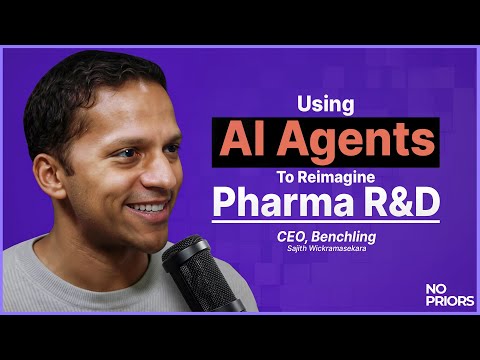
No Priors Ep. 140 | With Benchling Co-Founder and CEO Sajith Wickramasekara
Sarah Guo (host), Sajith (Saji) Wickramasekara (guest), Narrator
In this episode of No Priors, featuring Sarah Guo and Sajith (Saji) Wickramasekara, No Priors Ep. 140 | With Benchling Co-Founder and CEO Sajith Wickramasekara explores aI agents, biotech data, and rethinking how we develop new drugs Benchling CEO Sajith Wickramasekara explains how Benchling became the system of record for biotech R&D, digitizing previously paper-based, bespoke workflows across 1,300+ biotech and pharma companies. He outlines why drug development is so slow, risky, and artisanal, and argues that AI’s biggest near‑term impact will be reducing cost and cycle time rather than magically “discovering drugs” end‑to‑end.
AI agents, biotech data, and rethinking how we develop new drugs
Benchling CEO Sajith Wickramasekara explains how Benchling became the system of record for biotech R&D, digitizing previously paper-based, bespoke workflows across 1,300+ biotech and pharma companies. He outlines why drug development is so slow, risky, and artisanal, and argues that AI’s biggest near‑term impact will be reducing cost and cycle time rather than magically “discovering drugs” end‑to‑end.
Wickramasekara details Benchling’s AI strategy: embedding simulation models directly into scientists’ workflows and deploying AI agents over structured R&D data to recommend experiments, surface institutional memory, and automate analysis. He also reflects on macro biotech cycles, China’s emergence as a fast, low‑cost drug engine, and how pharma is cautiously but seriously investing in AI and proprietary models.
The conversation closes with lessons on building a vertical software company in a complex, regulated domain, integrating scientists and software cultures, and why biotech and pharma must learn to communicate their stories as effectively as leading tech companies.
Key Takeaways
Drug development is an extremely long, fragile, and artisanal process.
Going from target identification to commercial drug takes 7–10 years, often costs over $2 billion, and most candidates fail late in clinical trials. ...
Get the full analysis with uListen AI
The biggest near‑term AI gains in bio are about speed and cost, not magic end‑to‑end ‘AI scientists.’
Instead of instantly generating drugs from a text prompt, AI is more realistically going to improve individual steps—better molecule design, smarter experiment selection, faster analysis and manufacturing optimization—compounding into shorter timelines and cheaper programs.
Get the full analysis with uListen AI
Structured, unified R&D data is a prerequisite for useful AI in biotech.
Benchling’s core value is turning messy, heterogeneous lab data into a consistent, queryable model. ...
Get the full analysis with uListen AI
AI agents can unlock institutional memory and prevent wasteful, repeated experiments.
Benchling’s deep research agent, built on models like Anthropic’s Claude, can read years of experimental history and internal reports. ...
Get the full analysis with uListen AI
Pharma and large biotechs will differentiate via proprietary models and data generation.
Big pharma already runs large‑scale, high‑quality experiments and is starting to train its own predictive models and share them via federated schemes (e. ...
Get the full analysis with uListen AI
China is becoming a permanent, formidable player in biotech by optimizing for speed and cost.
Chinese biotechs can move molecules into early clinical trials much faster and cheaper, prompting global pharma to in‑license more assets from China instead of US startups. ...
Get the full analysis with uListen AI
Building successful vertical AI tools requires deep customer immersion and cultural translation.
Wickramasekara emphasizes continuous, direct conversations with customers and tight, hands‑on partnerships with a small set of design partners. ...
Get the full analysis with uListen AI
Notable Quotes
“It is probably easier at this point to send things to space or to put people on the moon than it is to get a new medicine approved.”
— Sajith Wickramasekara
“Right now in bio, we’ve got GPT but there’s no chat.”
— Sajith Wickramasekara
“Drugs are this amazing ROI… a drug today is only going to get cheaper over time, and it works just as effectively.”
— Sajith Wickramasekara
“The AI that wins is going to be the one that people actually use.”
— Sajith Wickramasekara
“If we don’t do this for our customers, who is going to do it?”
— Sajith Wickramasekara
Questions Answered in This Episode
How far can AI‑driven simulation and experiment recommendation realistically reduce the 7–10 year drug development timeline?
Benchling CEO Sajith Wickramasekara explains how Benchling became the system of record for biotech R&D, digitizing previously paper-based, bespoke workflows across 1,300+ biotech and pharma companies. ...
Get the full analysis with uListen AI
What technical and organizational steps are needed for a traditional wet lab to make its data ‘AI‑ready’ in the way Benchling describes?
Wickramasekara details Benchling’s AI strategy: embedding simulation models directly into scientists’ workflows and deploying AI agents over structured R&D data to recommend experiments, surface institutional memory, and automate analysis. ...
Get the full analysis with uListen AI
How should Western biotechs and pharma adapt strategically to China’s speed‑and‑cost advantage without compromising safety and ethics?
The conversation closes with lessons on building a vertical software company in a complex, regulated domain, integrating scientists and software cultures, and why biotech and pharma must learn to communicate their stories as effectively as leading tech companies.
Get the full analysis with uListen AI
What governance, validation, and audit mechanisms are necessary before AI co‑scientists can be trusted for high‑stakes experimental or clinical decisions?
Get the full analysis with uListen AI
Could new data marketplaces or federated learning schemes meaningfully change how negative and preclinical data is shared and monetized across the industry?
Get the full analysis with uListen AI
Transcript Preview
(music plays) Hi, listeners. Welcome back to No Priors. Today, I'm here with Saji, the co-founder and CEO of Benchling, the system of record for biotech R&D. Today, we talk about the state of AI in bio, Benchling's bet on AI agents to help scientists make better decisions, experiment faster, and deliver drugs more effectively, why drug programs are so expensive and fail so often, and how to build a culture of science and software together. Saji, thanks so much for being here.
Thanks for having me, Sara. Excited to be here.
Okay, so for our general listener base, can you just give us an overview of what Benchling is and sort of the scale of the business today?
Sure. Uh, so I'm one of the co-founders of Benchling. Uh, we make modern software for scientific progress. Uh, so I started the company about 13 years ago. It's been, been a long time.
Oh my God, yeah.
I know. Uh, so I, I'm a software engineer by background, but I worked in a biology lab. I was like really interested in medicine, um, and coming from the world of software, uh, and software developers have amazing tools for working on code and for, for collaborating. And when I got to the la- the biology lab, I found that scientists had paper notebooks and spreadsheets that would sit on their desktops, and like, it was terrible. Uh, and so it was really hard to work together, and I think that was really frustrating for me personally and, you know, I thought, a little bit naive at the time, I, I thought like, "How hard would it be to build good tools for, for scientists?" And so I started working on Benchling, uh, which helps scientists design molecules, plan their experiments out, run those experiments in the lab, get the data, organize it, analyze it, and then share it with their colleagues. Today, we work with about 1,300 biotech and pharma companies, uh, scientists at over 7,000 academic, uh, institutions, universities all, all around the world, and, uh, our software powers, you know, household names like Moderna and Sanofi and Eli Lilly and, and Regeneron but also, like, cutting-edge biotech startups, you know, the, you know, future AI biotechs like Isomorphic Labs and Zera and, and, and companies like that. So we get to, we get to see the innovation happening across the entire biotech sector and then build software that helps power it.
I'm super excited to, like, actually use that vantage point and ask you a bunch of questions about bio in the macro, but just so people who don't come from the domain can picture it a little bit better, I think, like, you know, I can picture like gene sequences-
Sure.
... and like the assay like said yes or no. Like what other types of... What is the data that's actually in Benchling?
Uh, I think w- what's really interesting for everyone to understand is like making a drug, there's like 9,999 steps in making a drug after you come up with a molecule. So you have to... To, to make a medicine, you have to find a biologically meaningful target in, in the body, something you want to drug.
Install uListen to search the full transcript and get AI-powered insights
Get Full TranscriptGet more from every podcast
AI summaries, searchable transcripts, and fact-checking. Free forever.
Add to Chrome