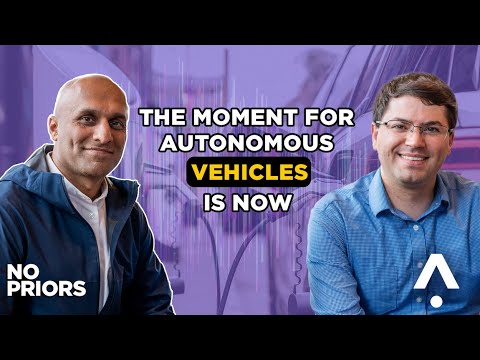
No Priors Ep. 119 | With Applied Intuition's Qasar Younis and Peter Ludwig
Elad Gil (host), Qasar Younis (guest), Peter Ludwig (guest), Sarah Guo (host)
In this episode of No Priors, featuring Elad Gil and Qasar Younis, No Priors Ep. 119 | With Applied Intuition's Qasar Younis and Peter Ludwig explores applied Intuition quietly builds vehicle intelligence powering autonomy’s real future Applied Intuition CEO Qasar Younis and CTO Peter Ludwig discuss how their now-profitable, 1,000+ person company builds “vehicle intelligence” for cars, trucks, construction equipment, and defense systems. They explain their three-part business—engineering tools, a vehicle operating system, and autonomy applications—and how it mirrors Microsoft’s historical tools–OS–apps strategy, but for vehicles instead of PCs. The conversation covers Chinese EV competition, industrial policy, synthetic data and autonomy models, safety and regulation of self‑driving, and why the next 5–10 years will see rapid, mainstream deployment of autonomous systems. They also touch on in-cabin AI experiences, defense use cases, and the kind of deeply technical talent and designers they’re hiring to build this ecosystem.
Applied Intuition quietly builds vehicle intelligence powering autonomy’s real future
Applied Intuition CEO Qasar Younis and CTO Peter Ludwig discuss how their now-profitable, 1,000+ person company builds “vehicle intelligence” for cars, trucks, construction equipment, and defense systems. They explain their three-part business—engineering tools, a vehicle operating system, and autonomy applications—and how it mirrors Microsoft’s historical tools–OS–apps strategy, but for vehicles instead of PCs. The conversation covers Chinese EV competition, industrial policy, synthetic data and autonomy models, safety and regulation of self‑driving, and why the next 5–10 years will see rapid, mainstream deployment of autonomous systems. They also touch on in-cabin AI experiences, defense use cases, and the kind of deeply technical talent and designers they’re hiring to build this ecosystem.
Key Takeaways
Staying quiet early let Applied Intuition refine its identity and products without rigid external expectations.
By not loudly branding themselves too early, they avoided being locked into a premature definition of “what they do,” giving room to evolve from simulation tools into a broader vehicle intelligence platform.
Get the full analysis with uListen AI
Applied is executing a Microsoft-style strategy for vehicles: tools → OS → applications.
They started with engineering tools, expanded into a vehicle operating system, and now build autonomy and in-cabin applications—similar to how Microsoft went from developer tools to Windows to Office, but targeting cars, trucks, and defense platforms instead of PCs.
Get the full analysis with uListen AI
A modern vehicle OS can centralize functionality, cut costs, and unlock new features.
Instead of dozens of disparate embedded controllers doing basic I/O like seat warmers, Applied’s OS pulls signals into central compute, simplifying wiring, reducing hardware cost, and enabling Tesla-like over-the-air updates and more sophisticated in‑vehicle behavior.
Get the full analysis with uListen AI
Chinese EVs and autonomy systems are already very strong and heavily state-backed.
BYD, Xiaomi, and others deliver vehicles that Applied’s team finds “super impressive,” often outperforming Tesla locally, aided by industrial policy and subsidies that treat automotive as a strategic national asset and jobs engine.
Get the full analysis with uListen AI
Autonomy techniques have largely converged post‑transformer, enabling faster commercialization.
End‑to‑end, camera-heavy systems and modern ML architectures have reached a performance plateau where everyone in the field broadly knows how to build competitive stacks; the key questions are now business models, monetization, and scale—not raw technical possibility.
Get the full analysis with uListen AI
Autonomous systems are already safer than humans, but regulation and media lag reality.
Metrics like accidents per mile and mean time to disengagement show strong safety gains, yet regulators cling to legacy frameworks and media incentives amplify rare failures instead of net lives saved, especially when machine mistakes “look” different from human errors.
Get the full analysis with uListen AI
The next 5–10 years will see rapid, mainstream rollout and eventual commoditization of autonomy.
Within about five years in the US, FSD‑like features should be generally available across major OEMs, with city-scale robotaxis expanding; by 2030–2035, pricing pressure will likely push self‑driving capabilities toward being an expected, near‑free feature like basic navigation.
Get the full analysis with uListen AI
AI will deeply reshape industrial work, defense, and in‑cabin experiences—not just chat interfaces.
Applied is building systems where heavy equipment recognizes operators, collaborates via multimodal AI, and where a single warfighter can coordinate hundreds of autonomous drones or vehicles—expanding AI’s impact far beyond consumer chatbots.
Get the full analysis with uListen AI
Notable Quotes
““Applied Intuition is a $15 billion profitable AI company… we build vehicle intelligence.””
— Qasar Younis
““Android figured out how to run applications uniformly on a huge variety of hardware… We’ve taken inspiration from those techniques for vehicles.””
— Peter Ludwig
““We’re almost like a Tesla minus the hardware.””
— Qasar Younis
““The Chinese autonomy systems are super impressive… better than Tesla, to be very, very clear.””
— Qasar Younis
““The next five years are probably the most exciting period imaginable… we don’t see a real rate limit to how fast we can advance technology.””
— Peter Ludwig
Questions Answered in This Episode
How will incumbent OEMs differentiate themselves once autonomy and vehicle OS capabilities become largely commoditized?
Applied Intuition CEO Qasar Younis and CTO Peter Ludwig discuss how their now-profitable, 1,000+ person company builds “vehicle intelligence” for cars, trucks, construction equipment, and defense systems. ...
Get the full analysis with uListen AI
What specific regulatory changes or frameworks would most accelerate safe, wide-scale deployment of self-driving systems?
Get the full analysis with uListen AI
How can Western countries rebuild industrial know‑how using robotics and autonomy without repeating past offshoring mistakes?
Get the full analysis with uListen AI
In defense contexts, what governance and ethical guardrails are needed when one operator can control swarms of autonomous machines?
Get the full analysis with uListen AI
What does an ideal multimodal in‑cabin experience look like when cars fully “know” the driver and can both drive and converse intelligently?
Get the full analysis with uListen AI
Transcript Preview
(instrumental music plays) Kasra and Peter, thank you so much for joining me today on No Briars.
Thanks for having us.
Thanks for having us.
I, uh, I came as casual as I could for the San Francisco- I was worried about you. You look, usually you're buttoned up. (laughs)
(laughs)
You're wearing something nice. I was kinda- Thanks. ... I was concerned. Is everything okay? Yeah, it is. It is.
(laughs)
Uh, two- two things. One is, you know, I wanted to fit in with the San Francisco vibe, you know, Sunnyvale. I, I usually dress more like Peter, to be honest.
Yeah. (laughs)
(laughs)
(laughs)
I, I think that's my outfit. Uh-
(laughs)
... I think that's my outfit.
(laughs)
And then secondly, you know, I g- I got this Carhartt, you know, thing. And I don't know if you guys know, Carhartt is suddenly cool. Uh, I got the memo from the, you know-
Wow.
... Cool Club newsletter.
Yeah.
It's a Detroit brand, if anybody doesn't know.
Yeah, yeah.
We're representing Detroit in Silicon Valley.
Wow.
So... (laughs)
Nice. Very nice. Yeah, I just thought, um, I thought-
You're not impressed. It's okay. (laughs)
(laughs) I, I'm extremely impressed. I thought it was one of those things where, um, I think you guys just raised at a $15 billion valuation.
Yeah.
And so I thought it was more, like, kinda-
Woo!
... you're done.
(laughs)
You just checked out now.
No, no, no, no.
You're done building the business, so-
So, last night, we were having dinner with, uh, with one of the top three global OEM CTOs. And he says, you know, I, I can't reveal who it is only because it's active, active in negotiations on a deal. And he says, "Well, you know, congratulations on the fundraise. How do you feel?" And I said, "Well, you know, honestly, I feel a little nervous. You know, we have, we have, you know, big goals ahead of us." He said, "Don't be a coward." (laughs)
(laughs)
"Attack."
Yeah.
And I was like, "Okay."
Yeah.
"I will send that message to my team. Don't be cowards. Attack." (laughs)
(laughs) I mean, I guess, um, in general when I think about you also, I've known y- I've known you for, um, over a decade.
Yeah.
I think I've led two of your rounds. And I, I feel like you're the most successful, most quiet company in AI. You've, you're now at over 1,000 people. You're in the hundreds of millions of revenue. You've been profitable the whole time, so you haven't spent a dime, I think, of any of the money that you've ever raised, which is pretty insane from a-
Unbelievable to me as well.
Install uListen to search the full transcript and get AI-powered insights
Get Full TranscriptGet more from every podcast
AI summaries, searchable transcripts, and fact-checking. Free forever.
Add to Chrome