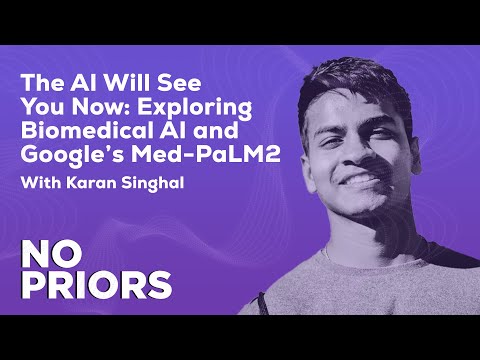
No Priors Ep. 17 | With Karan Singhal
Sarah Guo (host), Karan Singhal (guest), Elad Gil (host)
In this episode of No Priors, featuring Sarah Guo and Karan Singhal, No Priors Ep. 17 | With Karan Singhal explores google’s Med-PaLM 2 Aims to Safely Transform Healthcare With AI Karan Singhal, a lead researcher on Google’s Med-PaLM 2, explains how large language models are being adapted for high‑stakes medical use, with a focus on safety, accuracy, and responsible deployment. He traces the evolution from PaLM to PaLM 2 and Med-PaLM, detailing methods like instruction prompt tuning and improved pretraining objectives. The discussion digs into evaluation challenges, regulatory and privacy barriers, and why medical workflows can be a powerful testbed for AI alignment and safety research. Looking ahead, Singhal expects LLMs to raise the global standard of care, augment clinicians and scientists, and help solve key scientific and medical problems—if society can set realistic, benefit-aware safety bars.
Google’s Med-PaLM 2 Aims to Safely Transform Healthcare With AI
Karan Singhal, a lead researcher on Google’s Med-PaLM 2, explains how large language models are being adapted for high‑stakes medical use, with a focus on safety, accuracy, and responsible deployment. He traces the evolution from PaLM to PaLM 2 and Med-PaLM, detailing methods like instruction prompt tuning and improved pretraining objectives. The discussion digs into evaluation challenges, regulatory and privacy barriers, and why medical workflows can be a powerful testbed for AI alignment and safety research. Looking ahead, Singhal expects LLMs to raise the global standard of care, augment clinicians and scientists, and help solve key scientific and medical problems—if society can set realistic, benefit-aware safety bars.
Key Takeaways
Start from strong general models, then cheaply align to the medical domain.
Med-PaLM builds on PaLM/PaLM 2’s general reasoning and knowledge, then uses data-efficient techniques like instruction prompt tuning with doctor-written examples to adapt behavior for long-form medical QA without costly full retraining.
Get the full analysis with uListen AI
Choose tuning method based on how much labeled domain data you actually have.
If you have only a handful of examples, use prompting; with tens of examples, consider prompt tuning; and once you have 100+ high-quality labeled examples, full fine-tuning tends to deliver the best performance relative to cost.
Get the full analysis with uListen AI
Robust evaluation in medicine must go beyond benchmarks to human review in real workflows.
Existing medical AI work often relied on limited multiple‑choice benchmarks; Med-PaLM emphasized systematic automated evaluation plus detailed human evaluation by clinicians and laypeople, but Singhal stresses the need for workflow‑embedded, outcomes‑aware studies.
Get the full analysis with uListen AI
The bar for safety should be “better than the realistic status quo,” not perfection.
While stakes are high in medicine, patients and physicians already rely on imperfect web searches and time‑pressed clinicians; indecision or inaction is also a decision, so policy must weigh both risks and missed benefits of withholding capable systems.
Get the full analysis with uListen AI
Near-term impact will come from assistant and back-office roles, then higher-stakes support.
LLMs are already being piloted for documentation and billing; Singhal expects next waves in radiology assistance, report QA, telemedicine augmentation, and clinical decision support—initially as physician co-pilots, not replacements.
Get the full analysis with uListen AI
Medical AI exposes core alignment problems early, like scalable oversight and hallucinations.
As models like Med-PaLM 2 approach physician-level performance, even experts struggle to judge answers, making simple RLHF less reliable; this forces exploration of techniques like self-critique, debate, and AI‑assisted oversight that matter for broader AI safety.
Get the full analysis with uListen AI
Grounding in authoritative sources and privacy-preserving infrastructure will be essential for trust.
To overcome institutional risk aversion, Singhal highlights tools that can query and cite trusted medical sources (e. ...
Get the full analysis with uListen AI
Notable Quotes
“Indecision is a decision as well.”
— Karan Singhal
“The ideal thing would be to have access to all of the data, but in a privacy-preserving way.”
— Karan Singhal
“It’s hard to tell the difference between models and physicians.”
— Karan Singhal
“There is a chance to go for the jugular here in terms of health information.”
— Karan Singhal
“In the long term when things go really well with AI, it’s going to be because we’ve solved a lot of the most pressing scientific problems of today.”
— Karan Singhal
Questions Answered in This Episode
What specific real-world clinical trials or deployments would best demonstrate that Med-PaLM 2 meaningfully improves patient outcomes and safety over the current standard of care?
Karan Singhal, a lead researcher on Google’s Med-PaLM 2, explains how large language models are being adapted for high‑stakes medical use, with a focus on safety, accuracy, and responsible deployment. ...
Get the full analysis with uListen AI
How should regulators and health systems define an acceptable risk–benefit threshold for medical LLMs, given that human clinicians and web search are far from perfect?
Get the full analysis with uListen AI
What concrete mechanisms could give patients more control over how their health data trains or interacts with large models, while still enabling powerful AI capabilities?
Get the full analysis with uListen AI
Once AI systems surpass human clinicians in some diagnostic tasks, who should be legally and ethically accountable when the model’s recommendation conflicts with a doctor’s judgment?
Get the full analysis with uListen AI
How can the medical community ensure that improvements from AI—like better diagnostics or decision support—translate into reduced health inequities rather than amplifying them?
Get the full analysis with uListen AI
Transcript Preview
Welcome to No Priors. Today, we're speaking with Karan Singhal, a researcher at Google where he is a leader on medical AI, specifically on Med-PaLM 2, where he and a team are working on a responsible path to generative AI in healthcare. Google just announced the launch of its next generation language model, PaLM 2, which improved multilingual reasoning and coding capabilities, which is behind Med-PaLM 2, so it's a great time to be speaking with Karan about everything he and his team are working on. Karan, welcome to No Priors.
Hey, guys.
So, you've been working in this field for a long time. Um, tell us about how you ended up working on medical AI at Google. I- I think, uh, I saw you started a fake news detector for using AI as a, as a 19-year-old.
Yeah, that was one of my first AI projects. I, I really got into AI thinking about how it could be used in socially responsible ways, and for me, I was thinking around the time of the 2016 election that, um, maybe a little bit naively, that we could, you know, AI-based solutions could be, uh, a bit of, uh, help for, you know, things like misinformation and, and detecting that. I think in the, in the longer run, I mean, I- I've thought about it as kind of a more naive project, and I think in the longer run I've been thinking more about, you know, how I can help shape the trajectory of AI to be more beneficial more broadly, and I think for me, thinking about the medical setting has been motivated largely by thinking about the fact that, you know, it's, it's a great place to think about concerns around safety, reducing hallucination and misinformation as well here, um, you know, thinking about how we can produce, uh, medical, uh, question answers that are less likely to be harmful and all these kinds of things. And, you know, that motivation I think has driven us to this point where really going for the jugular in terms of thinking about how to train these models and make them better in this setting. And so, very excited about that kind of work.
Have you been working on the medical domain your, your entire time with Google?
No. I mean, for me, this is just something I've gotten into in the last, like, year and a half. So, I- I've been new to it, I've been learning from an excellent team, and it's been an amazing journey so far.
What, what else has been the most interesting in your, your work at Google so far?
Yeah. I started working out, um, in representation learning and federated learning, uh, so this is kind of the technology, representation learning in particular is kind of the technology underlying a lot of the, you know, deep neural networks of today, including GPT-3, GPT-4 and so on. And so this is largely about, um, learning, uh, representations of text, of images, of other modalities such that you can efficiently encode them, you can learn from them in the future, you can generalize to new, uh, texts and images and so on. And so work for this really started, you know, back in the beginnings of the deep learning era, like in 2013 with convolutional neural networks and scaling those up, and Word2vec around 2015, an- and GloVe and all these things. And I think since then, you know, we've been working on technol- technologies around self-supervised learning, um, around, you know, doing that in a privacy-preserving way. And so, you know, after a couple of years of working on that at Google, I had the opportunity to kind of quickly grow and start to lead a team. Um, I kind of got to the point where I was thinking, like, "Okay. I've upskilled in a lot of ways. I've, I've, I've gotten to the point where I can mentor many other researchers in, in a lot of ways. Uh, now's a great time to be thinking about my next thing and, you know, going for something ambitious in terms of shaping the trajectory of AI." And so, you know, about a year and a half ago, a few of us had the idea to think about this medical setting as, as kind of a setting in which, you know, these concerns are especially important, and it, it was a ripe opportunity to think about this paradigm of foundation models in medical AI. And so within Google, we had the opportunity to pitch, um, what's called a Brain Moonshot, which is kind of like an internal, um, incubator program for ambitious research projects, and this has ... You know, a lot of cool research projects that you've heard of from Google have eventually come out of this, um, program. And so we pitched that. We, we got it accepted and funded. We got the ability to kind of get a bunch of compute, to bring other folks on board with the sponsorship of a bunch of leaders, and our first thing together was really Med-PaLM, and so that was, you know, a really amazing thing for us, uh, to be able to work on together.
Install uListen to search the full transcript and get AI-powered insights
Get Full TranscriptGet more from every podcast
AI summaries, searchable transcripts, and fact-checking. Free forever.
Add to Chrome