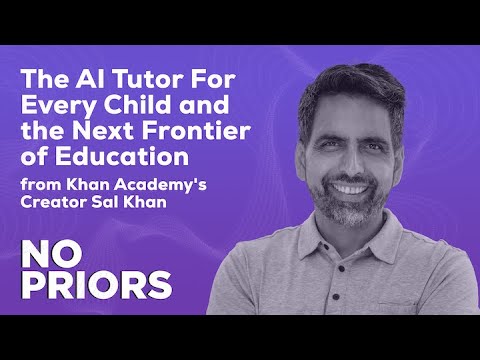
No Priors Ep. 28 | With Khan Academy’s Creator Sal Khan
Sarah Guo (host), Sal Khan (guest), Narrator, Elad Gil (host), Sarah Guo (host), Elad Gil (host)
In this episode of No Priors, featuring Sarah Guo and Sal Khan, No Priors Ep. 28 | With Khan Academy’s Creator Sal Khan explores sal Khan Envisions AI Tutors Transforming Education, Equity, And Learning Sal Khan recounts the origins of Khan Academy, from tutoring his cousin to building a global nonprofit reaching 150 million learners with mastery-based, personalized education content.
Sal Khan Envisions AI Tutors Transforming Education, Equity, And Learning
Sal Khan recounts the origins of Khan Academy, from tutoring his cousin to building a global nonprofit reaching 150 million learners with mastery-based, personalized education content.
He explains Khan Academy’s evolution into a broad ecosystem: core curriculum from pre-K through college, physical and online schools, and now Khanmigo, an AI-powered tutor and teaching assistant built with OpenAI.
Khan argues that generative AI can finally approximate one‑on‑one tutoring at scale, boosting teacher productivity, student engagement, and learning outcomes, while mitigating issues like cheating with careful guardrails.
Looking ahead, he predicts AI will reshape classroom practice, accelerate learning, democratize high-quality instruction and creative expression, and pressure universities toward competency-based, ROI-driven credentials.
Key Takeaways
Filling knowledge gaps through mastery learning can dramatically change trajectories.
Khan’s early tutoring showed most struggling students were blocked by missing fundamentals (like basic arithmetic), not lack of ability; systems that let learners revisit and master concepts before moving on can turn ‘remedial’ students into advanced ones.
Get the full analysis with uListen AI
Digital tools can approximate tutoring, but generative AI brings us much closer to true one-on-one support.
Videos, exercises, and data dashboards moved classrooms toward personalized support; with GPT‑4, Khanmigo can now conduct Socratic dialogues, adapt explanations, and provide on-demand help that resembles a human tutor’s ‘moves’.
Get the full analysis with uListen AI
AI can free teachers’ time and improve instruction rather than replace teachers.
Khanmigo is positioned as a ‘tutor for every student and a teaching assistant for every teacher,’ taking over lesson planning, rubric creation, and some grading, so teachers can spend more time in high-value, face-to-face work with students.
Get the full analysis with uListen AI
Careful guardrails and transparency are essential for safe, non-cheating use of AI in education.
Khanmigo is prompt-engineered not to give answers outright, logs all interactions for parents and teachers, uses a separate moderation model, and doesn’t feed user data back into training—aiming to support learning while addressing cheating and safety concerns.
Get the full analysis with uListen AI
AI will likely accelerate, not diminish, the importance of core skills like reading, writing, and math.
Khan argues that in a world where everyone has ‘armies’ of AI assistants, those who deeply understand language, math, and coding will be best positioned to architect, direct, and quality-check what AI produces.
Get the full analysis with uListen AI
The biggest systemic gains may come from combining AI with new school models and credentials.
Khan Lab School and Khan World School already show 1. ...
Get the full analysis with uListen AI
Mid-tier, high-cost universities face growing pressure as alternatives and accountability emerge.
Elite and community colleges will likely endure, but expensive, average institutions may struggle if employers increasingly accept alternative credentials and if universities are pushed to share responsibility for poor student debt outcomes.
Get the full analysis with uListen AI
Notable Quotes
“Real wealth is being able to do what you feel is your purpose in life, as long as you have enough to put food on the table.”
— Sal Khan
“The gold standard was always to have a personal tutor… and we’ve never been able to give that to everyone—until now.”
— Sal Khan
“I didn’t think this was going to happen in my lifetime… already Khanmigo can do some things that are maybe even beyond what The Young Lady’s Illustrated Primer did.”
— Sal Khan
“These kids are learning about three to four times faster. Not 3% faster or 30% faster—three to four times faster.”
— Sal Khan, on Khan World School results
“The more that you are fluent with your mathematics, that you have information and concepts at the tip of your fingers, these tools will accelerate you more than anyone else.”
— Sal Khan
Questions Answered in This Episode
How can traditional public schools practically integrate AI tutors like Khanmigo without widening inequities between well-resourced and under-resourced districts?
Sal Khan recounts the origins of Khan Academy, from tutoring his cousin to building a global nonprofit reaching 150 million learners with mastery-based, personalized education content.
Get the full analysis with uListen AI
What kinds of new assessments or credentials would best capture mastery and competency in an AI-rich learning environment?
He explains Khan Academy’s evolution into a broad ecosystem: core curriculum from pre-K through college, physical and online schools, and now Khanmigo, an AI-powered tutor and teaching assistant built with OpenAI.
Get the full analysis with uListen AI
How should teachers be trained and supported to shift from lecturers and graders to facilitators and ‘architects’ of AI-enhanced learning?
Khan argues that generative AI can finally approximate one‑on‑one tutoring at scale, boosting teacher productivity, student engagement, and learning outcomes, while mitigating issues like cheating with careful guardrails.
Get the full analysis with uListen AI
Where is the line between healthy AI assistance and over-reliance that harms students’ development of independent thinking and problem-solving?
Looking ahead, he predicts AI will reshape classroom practice, accelerate learning, democratize high-quality instruction and creative expression, and pressure universities toward competency-based, ROI-driven credentials.
Get the full analysis with uListen AI
If mid-tier universities struggle to justify their cost, what realistic alternative pathways (powered by platforms like Khan Academy) might become mainstream for teenagers over the next decade?
Get the full analysis with uListen AI
Transcript Preview
(instrumental music plays) Sal Khan democratized learning with his educational YouTube videos that turned into Khan Academy, which has 150 million learners from all over the world today. 15 years later, he's as energized as ever about making learning personalized with artificial intelligence. This week on the podcast, Elad and I talk with Sal about the impact of AI on education. He says, surprisingly, we're on the cusp of the biggest positive transformation that education has ever seen. Khan Academy has recently created Khanmigo, a chatbot tutor that can nudge learners in the right direction if they get stuck. Sal, welcome to No Priors.
Thanks for having me.
Sal, can you start by giving us some background on yourself and how you ended up starting Khan Academy?
Sure. (laughs) Y- you know, you go way back, my original background was in tech. I go to business school, I end up being an analyst at a small hedge fund, and it was shortly into that, it was 2004, I was a year out of business school, I had just gotten married, I was based in Boston at the time. I was born and raised in New Orleans. My family was visiting me up in, up in Boston after the wedding, and it just came out of conversation, my 12-year-old cousin, Nadia, was having trouble with school, math in particular. She was being placed into a slower math track. Her parents, my aunt and uncle, hadn't gone to school in this country, so I don't think they understood the implications that, on that track, she wouldn't end up taking calculus in high school, et cetera, et cetera. So I took it pretty seriously. I said, "Hey, I'm up for tutoring you, Nadia, if you're up for receiving it." And she agreed, so she goes back to New Orleans, I start tutoring her remotely. She actually gets caught up with her class. She was actually having trouble with unit conversion. She gets a little ahead of her class. I call up her school. I said, "I really think Nadia Rahman should be able to retake that placement exam." They say, "Who are you?" (laughs) I say, "I'm her cousin."
(laughs)
And, and they let her. And that same Nadia that started off as, for lack of a better word, a remedial student, was then put into an advanced math track. So I was, I was hooked. I, it was fun to s- stay connected with family. I really enjoyed geeking out on the math and it was, it seemed to be really helping my family. And so, I started tutoring her younger brothers. Word spreads in my family free tutoring is going on.
Mm-hmm.
Before I know it, I'm tutoring 10, 15 cousins. And, you know, my, m- I still had the day job. I was working as an analyst at a hedge fund. And I saw a common pattern with my cousins. Uh, they just, the main reason they were struggling was they had gaps in their knowledge. Oftentimes, the reason they were having trouble with that algebra equation was because they weren't fluent in dividing decimals, or negative numbers, or exponents. And so, I started making software for them, which I did for fun, 'cause I, that, that part of my brain wasn't being used fully in my hedge fund job. (laughs) I started making software that would generate problems for them, give them immediate feedback, provide hints if they needed them, allowed me to keep track. I put a little database behind it and allowed me to keep track of what they were doing and when they were doing it, and what they were getting wrong and right. And I, I called that Khan Academy. That was the domain name, it was available! It was kind of a fun family project. And a- about a year later now, we're about 2006, and I was showing this off at a dinner party. A- and by this point, my family had moved out here to Silicon Valley.
Install uListen to search the full transcript and get AI-powered insights
Get Full TranscriptGet more from every podcast
AI summaries, searchable transcripts, and fact-checking. Free forever.
Add to Chrome