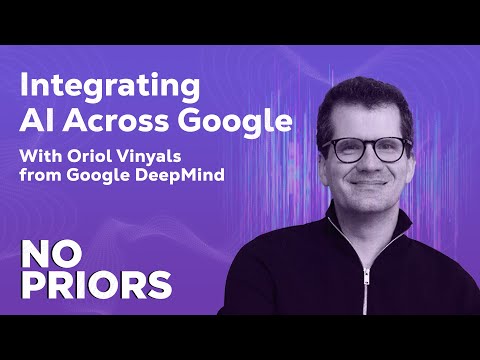
No Priors Ep. 74 | With Google DeepMind VP of Research Oriol Vinyals
Sarah Guo (host), Oriol Vinyals (guest), Elad Gil (host), Narrator
In this episode of No Priors, featuring Sarah Guo and Oriol Vinyals, No Priors Ep. 74 | With Google DeepMind VP of Research Oriol Vinyals explores google DeepMind’s Oriol Vinyals on Gemini, AGI, and Infinite Context Oriol Vinyals, VP of Research at Google DeepMind and Gemini co-lead, explains how Google Brain and DeepMind were unified into Google DeepMind and how the Gemini project emerged as Google’s core, multimodal foundation model. He outlines how Gemini powers products from Search and Ads to Cloud, developer tooling, and the Gemini chatbot, and why Google remains agnostic between chat-first and search-first interfaces. Vinyals highlights long and “infinite” context windows, hybrid retrieval-plus-neural architectures, and improved reasoning/reward models as the next major frontiers for LLMs. He is optimistic about AGI arriving around the 2028–2030 timeframe but argues the focus should be on practical impact, scientific progress, and how humans adapt to and collaborate with these systems.
Google DeepMind’s Oriol Vinyals on Gemini, AGI, and Infinite Context
Oriol Vinyals, VP of Research at Google DeepMind and Gemini co-lead, explains how Google Brain and DeepMind were unified into Google DeepMind and how the Gemini project emerged as Google’s core, multimodal foundation model. He outlines how Gemini powers products from Search and Ads to Cloud, developer tooling, and the Gemini chatbot, and why Google remains agnostic between chat-first and search-first interfaces. Vinyals highlights long and “infinite” context windows, hybrid retrieval-plus-neural architectures, and improved reasoning/reward models as the next major frontiers for LLMs. He is optimistic about AGI arriving around the 2028–2030 timeframe but argues the focus should be on practical impact, scientific progress, and how humans adapt to and collaborate with these systems.
Key Takeaways
Long context windows unlock qualitatively new use cases, but product-market fit is still emerging.
Gemini’s ability to handle millions of tokens allows users to query hour-long videos or large document corpora directly, yet truly mainstream, high-value applications for extreme context length are still being discovered.
Get the full analysis with uListen AI
Chat and search will likely coexist, each enhanced by LLMs rather than replaced.
Vinyals views chatbots as LLM-first experiences that can call search as a tool, while traditional search will incorporate AI summaries and reasoning; different query types will naturally gravitate toward different interfaces.
Get the full analysis with uListen AI
Future LLM progress hinges on making reasoning more reliable, not just bigger models.
Current models can solve very hard problems yet still make trivial mistakes; improving “crisp and accurate” reasoning likely requires better search-like procedures, redundancy, and explicit reasoning steps layered on top of base models.
Get the full analysis with uListen AI
Reward modeling beyond games is both critical and unsolved at scale.
Unlike Go or chess, real-world tasks lack perfect, binary rewards; Vinyals expects progress from better reward models, RL with human feedback, and models that can increasingly judge and self-correct their own outputs.
Get the full analysis with uListen AI
Hybrid systems combining retrieval with long context models are here to stay.
While infinite context reduces the need to compress documents into single vectors, retrieval and hierarchical memory are still essential for efficiency and will likely be integrated tightly with neural models.
Get the full analysis with uListen AI
General models and specialized systems will co-evolve and bootstrap each other.
Gemini-like generalists may reach “20% at everything,” but for high-stakes domains (protein folding, fusion, weather, climate), DeepMind will continue to build specialized models that both use and improve the general foundation models.
Get the full analysis with uListen AI
For individuals, the key is learning to collaborate with AI in your own domain.
Vinyals advises people—whether technologists or not—to project how AI will transform their field and proactively use tools like Gemini to scale their capabilities, rather than picking careers solely by projected demand.
Get the full analysis with uListen AI
Notable Quotes
“The goal of Gemini is to create an awesome core model to power the technology that LLMs are enabling all around the world.”
— Oriol Vinyals
“It just feels like that search experience will be tremendously enhanced by these models.”
— Oriol Vinyals
“You can put a whole one-hour video in and just ask anything and it feels superhuman.”
— Oriol Vinyals
“We now have very powerful general models that, from an AGI definition standpoint, start to tick many boxes.”
— Oriol Vinyals
“I’m not sure it matters that we achieve AGI; it’s going to be a distribution of capabilities rather than a single moment of parity with humans.”
— Oriol Vinyals
Questions Answered in This Episode
How will Google decide when to prioritize a chat-first versus search-first user experience for a given product or query type?
Oriol Vinyals, VP of Research at Google DeepMind and Gemini co-lead, explains how Google Brain and DeepMind were unified into Google DeepMind and how the Gemini project emerged as Google’s core, multimodal foundation model. ...
Get the full analysis with uListen AI
What concrete techniques are showing the most promise for making LLM reasoning more “crisp and accurate” without prohibitive inference costs?
Get the full analysis with uListen AI
In which domains does DeepMind currently believe specialized models can deliver breakthroughs that general models cannot yet match?
Get the full analysis with uListen AI
How might self-judging and self-correcting reward models change the pace and safety of AI capability gains in the next five years?
Get the full analysis with uListen AI
If AGI arrives around 2028–2030, what governance or alignment practices does Vinyals think are most urgently needed inside large labs like Google DeepMind?
Get the full analysis with uListen AI
Transcript Preview
Hi listeners, and welcome to No Priors. Today we're talking to Oriol Vinyals, the VP of research at Google DeepMind, and technical co-lead for Gemini. His storied career in machine learning includes leading the AlphaStar team, which built a professionally competitive and pioneering StarCraft agent all the way to today. And we're really excited to get his historical perspective on where we are in machine learning. Welcome to the show, Oriol.
Yeah, amazing. Thanks, Tara, for in- the invitation. And likewise, thanks a lot for, for hosting me.
Yeah, thanks for joining.
Last year was an eventful year at Google and DeepMind. Um, you know, how is that research effort organized now, and what do you, what do you think of the mission as internally?
Yeah. So sure, I mean, I'm happy to obviously discuss the different phases that research, uh, organizations have gone through in the last many years. But focusing on last year, two major events happened. One was that, uh, the Gemini project was formed, um, as a result of having two sort of parallel efforts on LLMs, uh, mostly led by, uh, Google Brain and, and what we now call Legacy DeepMind. So, uh, earlier in the year, there was, uh, an effort to merge the two, the two projects, and that's when sort of Geoff, Geoff and I came together and brought the two teams together to create the very first Gemini model, which, uh, was eventually released later in the year. Then the second big event was to, uh, take the, all the organizations, uh, that were doing, uh, AI research or AGI research and also form a singular organization. That's what today is called Google DeepMind. Um, and it comes from, uh, Google Brain and Legacy DeepMind coming again together under one roof. Obviously Gemini being a very large and very important project within that organization. Um, and really the goal, uh, of Gemini itself is to create an awesome core model to power, uh, the technology that of course LLMs today are, um, powering all around the world. And we obviously expect this to all increase.
How do you interact with the rest of the company and, like, Google as a business? And I'm like, I feel like I have to ask you, uh, does AI replace traditional search?
So even running that from a research standpoint, um, is super interesting, right? There's, there's, um, two major centers, one in California, one in London, given the organizations that we come from. So that in itself is very interesting. In a way we, we have the project running 24/7, which is helpful when you train these large models. And, and then you have to do a few things, right? One of the things we do, of course, is trying to build state-of-the-art technology, showing from sort of a research, knowing where the field is coming from and where it's going to, trying to really, um, showcase from our, our own sort of intuitions and ambition what might come next, right? So a, a prime example of this was, for example, the long context that we released earlier in the year, right? Millions, millions of, uh, tokens now are be- being able to be processed by, by our models. But then of course we also, um, sort of take into consideration all the different needs, right? From the different products that we work with. Google has a lot of product areas. So we try to focus, of course, initially especially to form the project, we try to focus on critical projects. And you see that very much, um, by how Gemini's first surfaced to, to users or to enterprises, right? So obviously cloud, um, and enterprise is very important. Developers as well. Uh, super cool to put these models in the hands of creative minds that are gonna do things you, you didn't even anticipate these models could do. Um, and then very important formerly known Bard, now Gemini app, which is sort of the chatbot surface of our models. And then maybe the last, uh, very important piece indeed is, is search, which, uh, is trying to integrate, of course, this technology into their product. Um, and of course has a lot of users. So it's extremely exciting to, to think, well, the decisions you make at modeling, uh, eventually and eventually means just maybe a few couple months after or so will make it into, into the users that maybe are signing up for a beta, et cetera. So, super exciting and it, and it's obviously connected. It's the core of, of the company really, especially for the products that require very intelligent, um, AI systems like the ones we're creating today.
Install uListen to search the full transcript and get AI-powered insights
Get Full TranscriptGet more from every podcast
AI summaries, searchable transcripts, and fact-checking. Free forever.
Add to Chrome