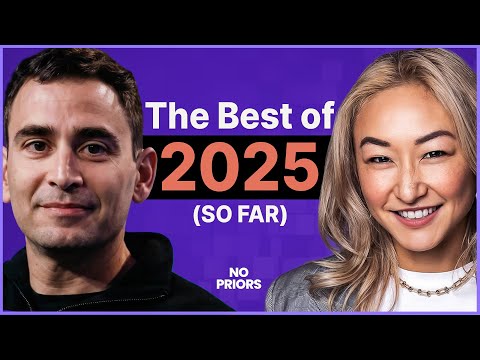
No Priors Ep. 138 | The Best of 2025 (So Far) with Sarah Guo and Elad Gil
Sarah Guo (host), Winston Weinberg (guest), Fei-Fei Li (guest), Brendan Foody (guest), Elad Gil (host), Sarah Guo (host), Dan Hendrycks (guest), Noubar Afeyan (guest), Elad Gil (host), Brandon McKinzie (guest), Eric Mitchell (guest), Isa Fulford (guest), Guest (founder describing building a search product) (guest)
In this episode of No Priors, featuring Sarah Guo and Winston Weinberg, No Priors Ep. 138 | The Best of 2025 (So Far) with Sarah Guo and Elad Gil explores aI’s Hinge Moment: Work, Wealth, Safety, and Human Impact in 2025 This highlight episode of No Priors showcases pivotal 2025 conversations about how AI is reshaping industries, work, and global dynamics. Founders and researchers from Harvey, OpenAI, Glean, Abridge, and others describe discovering hidden opportunities as models quietly became good enough to transform “bad” markets like legal advice and enterprise search. Guests explore frontier capabilities such as spatial and visual reasoning, tool-using models, and AI-assisted research, alongside the labor displacement and geopolitical risks of approaching superintelligence. The episode closes on the deeply human side of AI, with healthcare AI enabling doctors to reclaim time, purpose, and connection with their families.
AI’s Hinge Moment: Work, Wealth, Safety, and Human Impact in 2025
This highlight episode of No Priors showcases pivotal 2025 conversations about how AI is reshaping industries, work, and global dynamics. Founders and researchers from Harvey, OpenAI, Glean, Abridge, and others describe discovering hidden opportunities as models quietly became good enough to transform “bad” markets like legal advice and enterprise search. Guests explore frontier capabilities such as spatial and visual reasoning, tool-using models, and AI-assisted research, alongside the labor displacement and geopolitical risks of approaching superintelligence. The episode closes on the deeply human side of AI, with healthcare AI enabling doctors to reclaim time, purpose, and connection with their families.
Key Takeaways
Hidden AI capabilities can unlock ‘impossible’ markets when paired with the right workflow.
Harvey’s early GPT-3 experiments in legal Q&A showed attorneys would ethically send most AI-generated answers unchanged, revealing a large, underexploited opportunity in legal reasoning before the wider market recognized it.
Get the full analysis with uListen AI
Spatial and visual reasoning remain hard problems where AI could surpass everyday human abilities.
Fei-Fei Li notes that even trained humans struggle to mentally model 3D environments, suggesting huge potential for AI tools that make 3D understanding, manipulation, and editing easy and fluid for non-experts.
Get the full analysis with uListen AI
AI will rapidly displace many digital roles, pushing more human work into the physical and interpersonal world.
Brendan Foody anticipates quick, painful displacement in fields like customer support and recruiting, with slower automation in physical and human-interaction jobs such as robotics data collection, hospitality, and therapy.
Get the full analysis with uListen AI
Superintelligence raises destabilizing geopolitical dynamics reminiscent of nuclear deterrence.
Dan Hendricks argues that as AI becomes pivotal to national power, states may both deter each other from AI ‘first strikes’ and consider preemptive cyber operations on rivals’ data centers to avoid being technologically crushed.
Get the full analysis with uListen AI
Entrepreneurship in high-stakes areas like health and climate can be made more systematic and less random, with AI as a key enabler.
Noubar Afeyan critiques the ‘gamey’ culture of startups and advocates for treating company creation as a professional, methodical discipline, where AI can help design and validate ambitious biotech and deep-tech concepts more reliably.
Get the full analysis with uListen AI
Reasoning models that use tools can allocate compute far more efficiently and solve harder tasks.
OpenAI’s Brandon McKenzie and Eric Mitchell describe how models that recognize their own uncertainty and call external tools—like vision crops or small programs—achieve steeper performance gains than models reasoning in-context alone.
Get the full analysis with uListen AI
The most meaningful AI wins often show up as reclaimed human time and emotional wellbeing, not just productivity metrics.
Abridge’s clinical documentation AI lets doctors finish work earlier and be present with their families, with users describing it as career-extending and life-changing, illustrating AI’s potential for deep qualitative impact.
Get the full analysis with uListen AI
Notable Quotes
“We took about 100 landlord-tenant questions… and 86 out of 100 was yes.”
— Winston Weinberg (Harvey CEO)
“Imagine you do it at your fingertip much more easily and allow much more fluid interactivity and editability. That would just be a whole different world for people.”
— Dr. Fei-Fei Li
“I think displacement in a lot of roles is going to happen very quickly, and it's going to be very painful, and a large political problem.”
— Brendan Foody (Merck Core CEO)
“Later on, it becomes so destabilizing that China just says, 'We're going to do something preemptive, like do a cyberattack on your data center,' and the US might do that to China.”
— Dan Hendricks (Center for AI Safety Director)
“Mommy's gonna be able to eat dinner with us every night now.”
— Doctor at Tanner Health, via Shiv Rao (Abridge CEO)
Questions Answered in This Episode
How should policymakers and companies coordinate to soften the social impact of rapid AI-driven job displacement while still encouraging innovation?
This highlight episode of No Priors showcases pivotal 2025 conversations about how AI is reshaping industries, work, and global dynamics. ...
Get the full analysis with uListen AI
What concrete applications of advanced spatial intelligence could most transform everyday life if AI surpasses typical human 3D reasoning?
Get the full analysis with uListen AI
How can we design international norms or agreements to prevent preemptive cyberattacks on AI infrastructure as models approach superintelligence?
Get the full analysis with uListen AI
What does a truly ‘professionalized’ and scientific approach to entrepreneurship look like in practice, and how can AI tools be embedded into that process?
Get the full analysis with uListen AI
Where is the line between empowering professionals (lawyers, doctors, engineers) with AI and over-automating their judgment in ways that could harm trust and accountability?
Get the full analysis with uListen AI
Transcript Preview
(instrumental music plays) 2025 has been another remarkable year in AI. This week on No Priors, we're sharing our favorite moments from the podcast from the year so far. We've talked to visionary leaders at Harvey, OpenAI, Glean, Abridge, and more. We also talked to legends of science like Dr. Fei-Fei Li and Noubar Afeyan. But first, let's start with the moment that captures the magic of leaning into new capabilities at the right time. Harvey CEO, Winston Weinberg, discovered an extraordinary opportunity hidden in plain sight.
Gabe and I actually had met a, a couple of years before, and I definitely didn't know anything about the startup world and didn't have a plan of, of doing a startup. And what had happened was, he showed me GPT-3, which at the time was, you know, public, and, and I was, first of all, just incredibly surprised that no one was talking about GPT-3 and no one was using it in any way, shape, or form. Um, and he showed me that, and I showed him kind of my legal workflows, and we started the, the kind of aha moment was we went on, uh, r/legaladvice, which is basically, you know, a subreddit where people ask a bunch of legal questions and almost every single answer is, "So who do I sue?" Um, almost every single time. And we took about 100 landlord-tenant questions, and we came up with kind of some chain of thought prompts, and this is before, you know, anyone was talking about chain of thought or anything like that, and we applied it to those landlord-tenant questions and we gave it to three landlord-tenant attorneys. And we just said nothing about AI. We just said, "Here's a question that a potential client asked, and here is an answer. Uh, would you send this answer without any edits to that client? Would you be fine with that? You know, is that ethical? Is it a, a good enough, um, answer to s- to send?" And 86 out of 100 was yes. Um, and actually we cold emailed the general counsel of OpenAI and we sent him these results, and his response basically was, "Oh, I had no idea the models were this good at legal." (laughs)
Nice.
Um, and we, we met with the, the C-suite of OpenAI a couple weeks after.
Now, from legal reasoning to spatial intelligence. The legendary Dr. Fei-Fei Li opened our eyes to an entirely different dimension of AI capability.
I think from a neural and cognitive science point of view that spatial intelligence is a really hard problem that evolution has to solve for animals, and what's really interesting is, I think animals have solved it to an extent, but not fully solved it. It's one of the hardest problem because, um, what is the problem animal has to so- solve? Animals have to evolve the capability of collecting lights in something which we call eyes mostly, and then with that collection of eyes, it has to reconstruct a 3D world in their mind somehow so that they can navigate and they can do things, and of course, they can interact. For humans, we're the most capable animal in terms of m- manipulation. We can do a lot of things. And all this spatial intelligence, to me that's, um, that's just rooted in, in our intelligence. What is interesting is, it's not a fully solved problem, even animals. We, uh... For example, uh, for humans, right? Um, if I ask you to close your eyes right now and draw out or, or, or build a 3D model of the environment around you-
Install uListen to search the full transcript and get AI-powered insights
Get Full TranscriptGet more from every podcast
AI summaries, searchable transcripts, and fact-checking. Free forever.
Add to Chrome