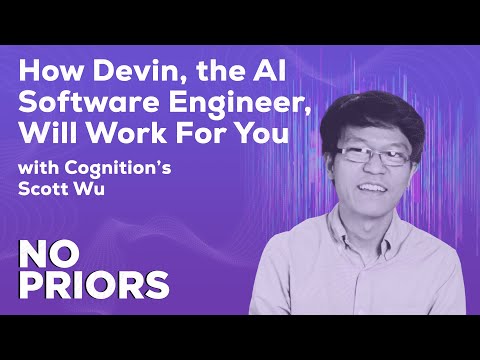
No Priors Ep. 62 | With Cognition CEO and Co-Founder Scott Wu
Sarah Guo (host), Scott Wu (guest), Elad Gil (host)
In this episode of No Priors, featuring Sarah Guo and Scott Wu, No Priors Ep. 62 | With Cognition CEO and Co-Founder Scott Wu explores cognition’s Devin Reimagines Software Engineering With Autonomous AI Teammates Cognition CEO Scott Wu discusses Devin, an autonomous AI software engineer designed to handle end‑to‑end coding tasks, from reading docs and using the shell to debugging and deployment.
Cognition’s Devin Reimagines Software Engineering With Autonomous AI Teammates
Cognition CEO Scott Wu discusses Devin, an autonomous AI software engineer designed to handle end‑to‑end coding tasks, from reading docs and using the shell to debugging and deployment.
He explains how his background in competitive programming and math shaped Cognition’s focus on reasoning and problem-solving, rather than just raw code generation.
Wu argues that Devin will multiply, not replace, human engineers by offloading execution work so humans can focus more on problem definition, architecture, and product thinking.
The conversation also covers agent UX design, the future of software work, the technical frontier for agents, and Cognition’s approach to assembling a high‑ownership founding team.
Key Takeaways
Autonomous agents work best when users can observe and steer them.
Devin’s UI (planning, shell, code, browser views) is explicitly designed so humans can periodically check in, give quick feedback, and redirect work—more like managing a junior engineer than firing-and-forgetting a black-box agent.
Get the full analysis with uListen AI
AI engineers will multiply developer output rather than eliminate engineering jobs.
Wu argues demand for software vastly exceeds current supply; by automating execution and setup, tools like Devin enable engineers to build far more, pushing them toward higher-level problem-solving instead of displacing them.
Get the full analysis with uListen AI
Reasoning, planning, and tool use are as critical as base model quality.
Cognition invests heavily in how Devin plans, chooses actions, and uses tools (shell, browser, tests) to iteratively debug and build, rather than relying on a model to emit a perfect diff in one shot.
Get the full analysis with uListen AI
Best early use cases involve long, multi-step workflows with clear goals.
DevOps setup, infrastructure debugging, and end-to-end data analysis are strong fits because they require many small decisions, tool interactions, and iterations that Devin can handle autonomously once the target is specified.
Get the full analysis with uListen AI
Future software engineers will look more like technical architects and product thinkers.
Wu predicts engineers will spend much more time defining problems, enumerating edge cases, and specifying desired behavior, while AI handles most of the translation into code and mechanical debugging.
Get the full analysis with uListen AI
Fundamentals in math, algorithms, and computer systems remain valuable, even as English becomes the main “programming language.”
Understanding how computers, networks, and logic actually work will still differentiate people who can design robust systems and effectively direct powerful AI tools.
Get the full analysis with uListen AI
High-ownership, founder-like teammates are crucial in ambitious AI startups.
Cognition has deliberately hired people who were founders or prospective founders, optimizing for ownership, creativity, and outcome-focus over hierarchy or narrow roles.
Get the full analysis with uListen AI
Notable Quotes
“Devin is an AI software engineer that is fully able to make all of its own decisions in the same way that a human software engineer would.”
— Scott Wu
“There’s so much more that could be built with code that I think multiplying every single developer is going to give us more developers, not less.”
— Scott Wu
“I think the role of a software engineer five or ten years from now looks something like a mix between a technical architect and a product manager today.”
— Scott Wu
“We think of Devin as: you provide the precise formulation of what you want built, and Devin is the one that is doing the thoughtful execution of that.”
— Scott Wu
“Ten years from now, people will look back and think, ‘Isn’t it crazy that you had to learn all these esoteric languages just to be able to communicate with your computer?’”
— Scott Wu
Questions Answered in This Episode
How should teams redesign their development workflows to best integrate an AI engineer like Devin without creating bottlenecks or quality issues?
Cognition CEO Scott Wu discusses Devin, an autonomous AI software engineer designed to handle end‑to‑end coding tasks, from reading docs and using the shell to debugging and deployment.
Get the full analysis with uListen AI
What kinds of specification practices or documentation habits will help humans clearly communicate requirements to autonomous coding agents?
He explains how his background in competitive programming and math shaped Cognition’s focus on reasoning and problem-solving, rather than just raw code generation.
Get the full analysis with uListen AI
Where are the ethical or safety boundaries for letting an AI agent autonomously deploy and modify production systems?
Wu argues that Devin will multiply, not replace, human engineers by offloading execution work so humans can focus more on problem definition, architecture, and product thinking.
Get the full analysis with uListen AI
How might education in computer science and software engineering need to change if most implementation is delegated to AI within a decade?
The conversation also covers agent UX design, the future of software work, the technical frontier for agents, and Cognition’s approach to assembling a high‑ownership founding team.
Get the full analysis with uListen AI
In a world where reasoning agents handle execution, what becomes the most defensible human skill in building technology companies?
Get the full analysis with uListen AI
Transcript Preview
(instrumental music plays) Hi, listeners, and welcome to No Priors. Today, we are talking to a very good human software engineer and the co-founder and CEO of Cognition, Scott Wu. The team at Cognition calls themselves an AI lab focused on reasoning, and recently, they released a demo of Devin, an AI software engineer that can increasingly handle entire tasks end-to-end, with leading results on SWE-Bench, a software engineering benchmark of real-world GitHub issues. The demo broke the internet, at least among tech Twitter, and so we're really excited to have Scott. Welcome, Scott.
Hey. Great to be here. Thanks for having me.
So, you have been coding, um, and then coding competitively since you were a kid. What first got you interested?
(laughs) Um, I think I always really, really liked math growing up actually. Um, my older brother, Neil, was, um, was the first to get me into programming, so I think I learned how to program when I was around nine years old. I just fell in love with it. I think the ability to, to take ideas and then make them into reality was, was always really exciting for me. I did a lot of math and programming competitions, you know, throughout school, and by the time I finished high school, I was, I was pretty set on going into tech, so...
Can you explain, um, for our listeners who may, um, of some set of our listeners that are not familiar, like what IOI is?
Yeah, sure. So IOI is the International Olympiad of Informatics, um, so it's the olympiad of code basically, um, and it's, uh, it works just like the, uh, the other Olympics. Um, every, every country sends in their own team of, of their best coders, and it's a competitive programming competition, um, and you know, there's gold medals, silver metals, bronze metals, and so on. And, uh, you know, the whole idea is it's very algorithmic problem-solving. And so you're given tasks to solve, and, you know, you have to figure out the, the optimal algorithms for those, and then also implement those into code.
It's like an interesting topic for somebody who, uh, was world-class at IOI. Like, what is practice like for getting better at competitive programming?
Yeah, I used to, um, you know, programming in math competitions used to be my entire life when I was growing up. Um, I, uh, you know, it's what you think about in the shower, it's what you're spending all your time on, it's, you know, how, how, how v- every, every problem in life that I run into I would frame as, as a, an algorithms problem basically. Um, and a lot of it is, is, um, like a lot of other disciplines, it's just, you know, putting a lot of effort into it and being willing to, to think really analytically and, um, you know, be very brutal about your own shortcomings and, you know, focus on the things that you're not doing well and just continue to push and improve.
Install uListen to search the full transcript and get AI-powered insights
Get Full TranscriptGet more from every podcast
AI summaries, searchable transcripts, and fact-checking. Free forever.
Add to Chrome