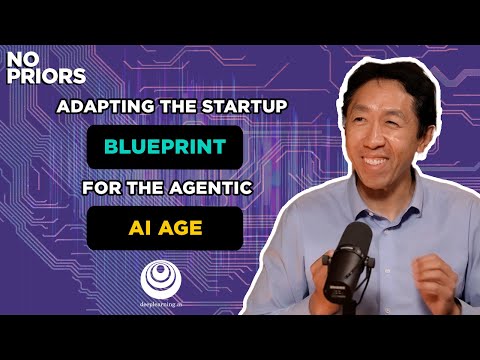
No Priors Ep. 128 | With Andrew Ng, Managing General Partner at AI Fund
Sarah Guo (host), Andrew Ng (guest), Elad Gil (host), Narrator
In this episode of No Priors, featuring Sarah Guo and Andrew Ng, No Priors Ep. 128 | With Andrew Ng, Managing General Partner at AI Fund explores andrew Ng on Agentic AI, Rapid Engineering, and Founder Mindsets Andrew Ng discusses where future AI capabilities will come from, arguing that while scale still helps, real progress now depends on agentic workflows, better tooling, and disciplined engineering rather than sheer model size.
Andrew Ng on Agentic AI, Rapid Engineering, and Founder Mindsets
Andrew Ng discusses where future AI capabilities will come from, arguing that while scale still helps, real progress now depends on agentic workflows, better tooling, and disciplined engineering rather than sheer model size.
He defines “agentic AI” as a spectrum of systems with varying degrees of autonomy, with coding agents currently being the most successful and economically valuable examples.
Ng explains how AI-assisted coding is radically shrinking engineering headcount needs and shifting the bottleneck from software development to product management, thereby raising the bar for technical, high-empathy founders and product leaders.
He also forecasts that individuals who aggressively adopt AI tools across professions will be dramatically more capable than their peers, and that small, highly skilled, AI-leveraged teams will increasingly outperform large, traditional organizations.
Key Takeaways
Agentic AI is a spectrum, not a binary category.
Ng coined “agentic AI” to capture varying degrees of autonomy—from simple LLM-driven steps to multi-step planning agents—so teams stop arguing about definitions and instead focus on building useful workflows.
Get the full analysis with uListen AI
The main bottleneck to agentic AI adoption is talent and disciplined engineering, not core model capability.
Teams that systematically use evals and error analysis to refine agents vastly outperform those tinkering randomly, and there aren’t yet enough people with these skills.
Get the full analysis with uListen AI
Coding agents are currently the most valuable and mature form of agentic AI.
Tools like Claude Code can autonomously plan and execute multi-step coding tasks, creating huge productivity gains, while more general “computer use” agents remain mostly demo-grade.
Get the full analysis with uListen AI
AI-assisted coding is shifting the startup bottleneck from engineering to product management.
Because one engineer can now do what used to take a small team, the real constraint becomes deciding what to build, how to prioritize, and how quickly to iterate based on customer insight.
Get the full analysis with uListen AI
Technical, AI-native founders have a decisive advantage in this era.
Ng believes founders who deeply understand fast-evolving AI capabilities will out-execute more traditional, business-only leaders, especially during periods of rapid technological disruption.
Get the full analysis with uListen AI
Small, highly skilled teams with heavy AI leverage can beat large organizations.
He sees small, co-located teams using AI tools outproducing much larger, lower-cost or bloated teams, suggesting future companies can stay lean yet highly impactful if they adopt AI aggressively.
Get the full analysis with uListen AI
Individuals who fully embrace AI tools will become dramatically more capable within a few years.
Just as AI transformed programmer productivity in two years, Ng expects similar capability jumps across other jobs, with early adopters gaining a large performance edge over peers.
Get the full analysis with uListen AI
Notable Quotes
“The single biggest barrier to getting more agentic AI workflows implemented is actually talent.”
— Andrew Ng
“Vibe coding makes people think it's easier than it is. After a day of AI-assisted coding, I'm exhausted mentally.”
— Andrew Ng
“Today, the bottleneck is deciding what we actually want to build.”
— Andrew Ng
“In moments of technological disruption, having a good feel for what this technology can and cannot do is the real knowledge.”
— Andrew Ng
“People who embrace this will be so much more powerful and so much more capable than they probably can imagine.”
— Andrew Ng
Questions Answered in This Episode
How can non-technical professionals practically build the kind of AI instincts Ng says are now essential?
Andrew Ng discusses where future AI capabilities will come from, arguing that while scale still helps, real progress now depends on agentic workflows, better tooling, and disciplined engineering rather than sheer model size.
Get the full analysis with uListen AI
What concrete frameworks or playbooks exist for doing the disciplined eval- and error-analysis Ng sees as key to building effective agents?
He defines “agentic AI” as a spectrum of systems with varying degrees of autonomy, with coding agents currently being the most successful and economically valuable examples.
Get the full analysis with uListen AI
Where are the next “coding agent–style” breakthrough use cases likely to emerge outside of software engineering?
Ng explains how AI-assisted coding is radically shrinking engineering headcount needs and shifting the bottleneck from software development to product management, thereby raising the bar for technical, high-empathy founders and product leaders.
Get the full analysis with uListen AI
How can startups avoid the trap of staying too lean and underhiring while still maximizing AI-driven leverage?
He also forecasts that individuals who aggressively adopt AI tools across professions will be dramatically more capable than their peers, and that small, highly skilled, AI-leveraged teams will increasingly outperform large, traditional organizations.
Get the full analysis with uListen AI
What does Ng think are the most realistic near-term risks of agentic AI in production workflows, and how should teams mitigate them?
Get the full analysis with uListen AI
Transcript Preview
(instrumental music plays) Hi, listeners. Welcome back to No Priors. Today, Elade and I are here with Andrew Ng. Andrew is one of the godfathers of the AI revolution. He was the co-founder of Google Brain, Coursera, and the venture studio AI Fund. More recently, he coined the term agentic AI and joined the board of Amazon. Also, he was one of the very first people a decade ago to convince me that deep learning was the future. Welcome, Andrew. Andrew, thank you so much for being with us.
No, always great to see you.
I'm not sure where we should begin because you, you have such a broad view of these topics. But I feel like we should start with the biggest question, which is, um, you know, if you look forward at capability growth from here, uh, where does it come from? Does it come from more scale? Does it come from data work?
Multiple vectors of progress. So I think, um, there is probably a little bit more juice out of the scalability lemon that we squeeze, so hopefully you can see many products there, but it's getting really, really difficult. Um, society's perception of AI has been very skewed by the PR machinery of a handful of companies with amazing PR capabilities and because that number of companies drove scales and narrative, people think of scale first of, as a vector progress. But I think, you know, agentic workflows, um, uh, the way we build multimodal models, we have a lot of work to build concrete applications. I mean, there are multiple vectors of progress as well as wild cards like brand new technologies like diffusion models which are used to generate images for the most part. Will that also work for generating text? I think that's exciting. So I think there'll be multiple ways for AI to make progress.
You actually came up with the term agentic AI. What did you mean then?
So when I, uh, decided to start talk about agentic AI, which wasn't a thing when I started to use the term, my team was slightly annoyed at me. One of my team members that I won't name, he actually said, "Andrew, the world does not need you to make up another term." But I decided to do it anyway and for whatever reason, it stuck. And the reason I started to talk about agentic AI was because, um, uh, like couple years ago, I saw people were spending a lot of time debating, "Is this an agent? Is this not an agent? What is an agent?" And I felt there's a lot of good work, and there was a spectrum of degrees of agency where there are highly autonomous agents that could plan, take multiple steps if using, do a lot of stuff by themselves, and then things that were lower degrees of agency where it would prompt an LLM for effect in its output. And, and I felt like rather than debating this is an agent or not, let's just, um, say the degrees of agency and say it's all agentic so we can spend our time actually building this. So I started to push the term agentic AI. What I did not expect was that, uh, several months later, a bunch of marketers would get ahold of this term and use it as a sticker to stick it on everything in sight. And so I think the term agentic AI really took off. I feel like the marketing hype has gone like that insanely fast, but the real business progress has also been, you know, rapidly growing, but maybe not as fast as the marketing hype.
Install uListen to search the full transcript and get AI-powered insights
Get Full TranscriptGet more from every podcast
AI summaries, searchable transcripts, and fact-checking. Free forever.
Add to Chrome