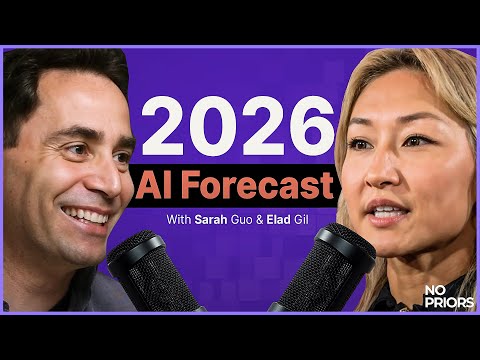
No Priors Ep. 144 | The 2026 AI Forecast with Sarah & Elad
Sarah Guo (host), Elad Gil (host), Guest (guest), Guest (guest), Guest (guest), Guest (guest), Guest (guest), Guest (guest), Guest (guest), Guest (guest), Guest (guest), Guest (guest), Guest (guest), Guest (guest), Guest (guest), Guest (guest), Guest (guest), Narrator
In this episode of No Priors, featuring Sarah Guo and Elad Gil, No Priors Ep. 144 | The 2026 AI Forecast with Sarah & Elad explores aI’s 2026 Outlook: Agents, Robotics, New Labs, and Real-World Impact Sarah and Elad look ahead to 2026, arguing that despite market volatility and hype cycles, AI’s real economic and professional impact is only in the early innings. They highlight rapid enterprise adoption in conservative fields like medicine and law, consolidation in key verticals, and an impending wave of robotics and self‑driving deployments that will test current hype. The conversation explores foundation model competition, “neo labs,” alternative architectures, and evolutionary approaches to AI, alongside capital markets dynamics such as IPOs, M&A, and infrastructure constraints. A series of guest predictions round out the episode, focusing on reasoning, agents, context-rich products, energy efficiency, AI drug discovery, and the broader social and political consequences of AI’s rise.
AI’s 2026 Outlook: Agents, Robotics, New Labs, and Real-World Impact
Sarah and Elad look ahead to 2026, arguing that despite market volatility and hype cycles, AI’s real economic and professional impact is only in the early innings. They highlight rapid enterprise adoption in conservative fields like medicine and law, consolidation in key verticals, and an impending wave of robotics and self‑driving deployments that will test current hype. The conversation explores foundation model competition, “neo labs,” alternative architectures, and evolutionary approaches to AI, alongside capital markets dynamics such as IPOs, M&A, and infrastructure constraints. A series of guest predictions round out the episode, focusing on reasoning, agents, context-rich products, energy efficiency, AI drug discovery, and the broader social and political consequences of AI’s rise.
Key Takeaways
AI’s real impact is rising even as hype and skepticism oscillate.
The hosts argue that reports downplaying AI’s productivity gains miss the long diffusion curve; adoption in areas like coding, medical documentation, and legal work is already substantial and will compound over the decade regardless of short-term sentiment swings.
Get the full analysis with uListen AI
Professional services and conservative sectors are becoming leading AI adopters.
Doctors, lawyers, compliance, and accounting—historically slow to adopt tech—are embracing AI for documentation and decision support, suggesting that reasoning over unstructured data maps particularly well to high-value expert workflows.
Get the full analysis with uListen AI
Robotics and self-driving will face a reality check before unlocking major value.
Humanoid and semi-humanoid robots are expected to see small-scale deployments that won’t fully match the hype, creating a sentiment pullback similar to early self-driving; long term, self-driving and industrial robotics should still become highly consequential markets, likely with strong roles for incumbents like Tesla, Waymo, and Chinese firms.
Get the full analysis with uListen AI
Foundation model competition will hinge on capital, architectures, and evolution-like methods.
While scale and capital advantage push the field toward a few dominant labs, the hosts see room for alternative architectures (diffusion, SSMs, continual learning) and evolutionary or self-improvement approaches that more closely resemble specialized biological systems and may unlock new performance leaps.
Get the full analysis with uListen AI
Consumer AI is underdeveloped, leaving room for breakout agentic products.
Apart from chat-style interfaces, there are few truly novel consumer AI experiences; the hosts expect new agentic, context-aware products and hardware experiments (many of which may fail) and note that only a relatively small pool of truly elite consumer PMs may be capable of inventing enduring new interfaces before incumbents copy them.
Get the full analysis with uListen AI
AI is catalyzing shifts in adjacent domains: defense, biotech, and energy.
They foresee accelerated defense-tech innovation (especially drones and autonomy), broader adoption of GLP‑1 and peptide therapies with follow-on investment in bio, and growing pressure for energy- and chip-efficient AI as data center build-outs hit power and infrastructure limits.
Get the full analysis with uListen AI
2026 will feature agents, context, and reasoning as central product themes.
Guest predictions converge on proactive AI agents embedded in workflows, heavy use of user context and memory, improved reasoning across domains (including science and drug discovery), enterprise-grade agent harnesses/evals, and a major push toward energy-efficient, non‑NVIDIA‑monoculture AI infrastructure.
Get the full analysis with uListen AI
Notable Quotes
“The reality of the technology will always take ten years to propagate, and people are getting enormous value out of AI already and they're gonna get way more out of it in the future.”
— Elad
“All the people who always never adopt technology are now adopting this stuff fast… physicians, lawyers, certain accounting types, compliance. I do think that's really notable and very under-discussed.”
— Elad
“There'll be a couple of anecdotal one-offs in science that will make people say, 'Look, science is solved,' and they'll realize science isn't solved, and then later science will be solved.”
— Elad
“I always thought that eventually you end up with evolutionary systems as really how you build AI… where you just evolve these systems with some utility function they’re evolving against.”
— Elad
“I did not believe that we were gonna see that many unique consumer experiences besides ChatGPT… but I am seeing magical experiences of really different consumer agent software that I actually want and will use.”
— Sarah
Questions Answered in This Episode
How can founders design AI agents and consumer products that are defensible against fast-following big labs with superior distribution?
Sarah and Elad look ahead to 2026, arguing that despite market volatility and hype cycles, AI’s real economic and professional impact is only in the early innings. ...
Get the full analysis with uListen AI
What specific technical or market signals should we watch to distinguish a temporary robotics sentiment collapse from a genuine failure of current approaches?
Get the full analysis with uListen AI
How might evolutionary or self-improving AI systems be governed and evaluated differently from today’s monolithic trained models?
Get the full analysis with uListen AI
In which professional domains beyond medicine, law, and coding are we most likely to see the next wave of rapid AI adoption, and what constraints will they face?
Get the full analysis with uListen AI
As energy and chip constraints bite, how should companies balance investments between more efficient models, new hardware, and power infrastructure for AI workloads?
Get the full analysis with uListen AI
Transcript Preview
Hi, listeners. Welcome to No Priors. How can we even begin to wrap this year up? The AI field has grown, breaking out into the mainstream and taking center stage with policymakers. ChatGPT shipped massive numbers and asked for massive dollars. Gemini and Google roared back strong. And on the application front, AI coding has shifted to agents, and it's eating up all of our inference capacity. Doctors are adopting clinical decision support en masse. And in law and customer support, enterprise adoption is accelerating. What's next? On the research front, the race has multiple live players with open source closing the gap too. A handful of neo labs, new research labs, got funded this year, and the narrative is changing. Ilya is calling it the age of research. People are trying different ideas around diffusion, self-improvement, data efficiency, EQ, large-scale agent collaboration, continual learning, energy transformers. It's more open than it's ever been. Finally, we had a lot of attempts to make AI reach into the real world, with renewed optimism around robotics. Next year, those companies are going to start making contact with reality. From a prediction standpoint, personally, I think we're gonna see somebody make a lot of money, hundreds of millions of dollars, trading markets with LLMs next year. It's inevitable. So, we're in the second or third inning. Markets are running a little hot and a little volatile. It's hot in the hot tub. So get into it with me and Elad. Okay. Elad, it's been a year.
I know. How's it going? It's 2026, baby.
Are you feeling the AGI? Are you feeling AI, AI winter in a good way?
I think I'm actually just feeling microplastics. I think I'm now 80% microplastics. I'm just increasing my microplastic consumptions. A friend of mine actually launched a new water brand that, uh, has no microplastics by the way. It's called Lute, and it's gonna have, like, glass bottles and also the cap doesn't have plastic.
Does it come with continual testing?
Yeah. That's a good idea though but-
Does it come with continual testing for you? Yeah.
They, they, they did actually try to take out all the microplastics and so they, uh... I guess bottled water in actual bottles has more microplastics than plastic bottles because of the cap.
Okay. We'll check back in with you in '27 to see if you feel-
Yeah, when I'm just completely ossified out of plastic. I'm actually real- really worried about microglastics. What about all the little glass particles? Aren't you worried about that? People talk about microplastics but not microglastics. I'm much more concerned about that.
I don't think those particles end up embedded for you permanently.
Silicon? (laughs) You're not worried about silicones. (laughs) I go to the beach, I'm like, "Oh, no, microglastics everywhere."
I'm actually very willing to insert silicon in my body eventually in my
(laughs)
(laughs) Wow, that was... Yeah. I'm not gonna say anything. We can keep going.
Install uListen to search the full transcript and get AI-powered insights
Get Full TranscriptGet more from every podcast
AI summaries, searchable transcripts, and fact-checking. Free forever.
Add to Chrome