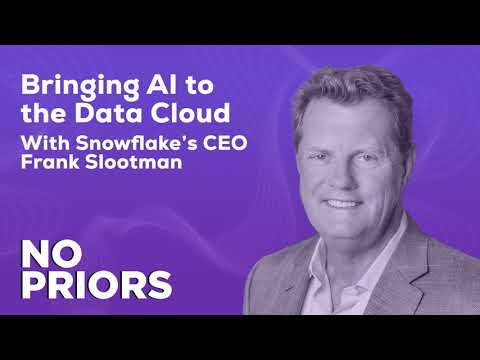
No Priors Ep. 23 | With Snowflake's CEO Frank Slootman
Sarah Guo (host), Frank Slootman (guest), Elad Gil (host), Narrator
In this episode of No Priors, featuring Sarah Guo and Frank Slootman, No Priors Ep. 23 | With Snowflake's CEO Frank Slootman explores frank Slootman on urgency, data clouds, and AI’s real frontier Frank Slootman discusses his career arc across Data Domain, ServiceNow, and Snowflake, emphasizing how deliberate choices of industry, company, and culture combine with relentless execution to create outsized outcomes.
Frank Slootman on urgency, data clouds, and AI’s real frontier
Frank Slootman discusses his career arc across Data Domain, ServiceNow, and Snowflake, emphasizing how deliberate choices of industry, company, and culture combine with relentless execution to create outsized outcomes.
He explains Snowflake’s evolution from a “cloud data warehouse” perception to a full-spectrum data cloud and application platform built on separating storage and compute and bringing work to the data rather than re-siloing it.
On AI, Slootman distinguishes hype around large language models from the harder, higher-value problem of reasoning over proprietary, structured enterprise data with strong governance, search, and domain-specific models.
Throughout, he returns to themes from his book ‘Amp It Up’: cultivating urgency, pruning organizations continuously instead of via mass layoffs, and using culture to attract people who can thrive in a high-intensity environment.
Key Takeaways
Choose industry and company deliberately; role is secondary.
Slootman argues you’ll have many roles, but your trajectory is largely set by the industry you enter and the quality of the company and people around you, so optimize those rather than chasing a perfect first title.
Get the full analysis with uListen AI
Leaders must actively create urgency and confrontation.
Left alone, organizations drift toward low tempo and avoidance; CEOs and managers need to “amp it up” in every meeting, email, and decision, driving tempo, standards, and alignment even when it feels uncomfortable.
Get the full analysis with uListen AI
Culture should sort people in and out by design.
A high-intensity culture is meant to attract those who thrive on pace and accountability and to push out those who don’t; losing people who can’t handle the environment is a feature, not a bug.
Get the full analysis with uListen AI
Bring work to the data to avoid destructive siloing.
Snowflake’s data cloud vision centers on consolidating data and running diverse workloads (analytics, ML, transactional, apps) inside one governed perimeter, rather than spinning up new app-specific databases and pipelines for every use case.
Get the full analysis with uListen AI
AI value in enterprises hinges on structured, governed data.
LLMs are transformative for natural language access, but mission-critical questions in domains like insurance, healthcare, and pharma require models grounded in high-quality, well-organized proprietary data, not just web-scale text.
Get the full analysis with uListen AI
Visualization and search must live inside the governance perimeter.
Acquisitions like Streamlit and Neeva are about making ML models, search, and interactive apps usable by business users without compromising security and compliance, by running them “inside” Snowflake’s trusted environment.
Get the full analysis with uListen AI
Manage headcount and productivity continuously, not in crises.
Slootman criticizes episodic mass layoffs at big tech firms; he prefers constant “pruning of the tree” and tight alignment of supply and demand so downturns don’t require sudden, destabilizing cuts.
Get the full analysis with uListen AI
Notable Quotes
“You need to have a reason to get up in the morning and have something to prove.”
— Frank Slootman
“Leaders need to drive tempo and pace and intensity and urgency, because people naturally slow down.”
— Frank Slootman
“The work comes to the data. The data does not go to the work.”
— Frank Slootman
“If they leave, they should leave. Culture sorts and sifts.”
— Frank Slootman
“Data doesn’t have opinions. It just is what it is.”
— Frank Slootman
Questions Answered in This Episode
How can an early-stage founder practically apply Slootman’s “amp it up” mindset without burning out themselves or their initial team?
Frank Slootman discusses his career arc across Data Domain, ServiceNow, and Snowflake, emphasizing how deliberate choices of industry, company, and culture combine with relentless execution to create outsized outcomes.
Get the full analysis with uListen AI
What concrete steps should a large enterprise take to transition from a siloed data landscape to a true data cloud strategy?
He explains Snowflake’s evolution from a “cloud data warehouse” perception to a full-spectrum data cloud and application platform built on separating storage and compute and bringing work to the data rather than re-siloing it.
Get the full analysis with uListen AI
How might domain-specific “business models” for AI be built and governed differently from today’s large language models?
On AI, Slootman distinguishes hype around large language models from the harder, higher-value problem of reasoning over proprietary, structured enterprise data with strong governance, search, and domain-specific models.
Get the full analysis with uListen AI
Where is the line between a high-intensity, high-expectation culture and an unsustainably toxic one, and how would Slootman draw it?
Throughout, he returns to themes from his book ‘Amp It Up’: cultivating urgency, pruning organizations continuously instead of via mass layoffs, and using culture to attract people who can thrive in a high-intensity environment.
Get the full analysis with uListen AI
If subscription pricing favors investors but consumption favors customers, how should next-generation enterprise startups think about designing their business models?
Get the full analysis with uListen AI
Transcript Preview
Our guest today needs no introduction. Frank Slootman is the legendary three-time CEO of Data Domain, ServiceNow, and Snowflake, and one of the most looked-up-to leaders in technology for his relentless execution. We're excited to talk to him about what's on the horizon for Snowflake, and how he looks at the AI opportunity. Frank, good to see you. Thanks for being here.
Absolutely. Good to see you, Sarah.
Let's start with just a little bit of personal background. You, uh, have had an amazing journey. You grew up in Holland. You're the first person in your family to go to college. What were you like as a kid and, uh, in college, and, uh, how did you end up, um, in, in product management and computing in the US?
Yeah, that's kind of a c- you know, big wide-ranging, uh, question. I sometimes have to, you know, go back and, uh, figure out wha- what was the method to the madness because, you know, sometimes your life looks like a random walk, you know? In other words, it's just a series of events that kind of, you know, go from one to the other. But, uh, you know, I, I was always a relatively focused, disciplined kid, if, if, if, if I were to describe myself, in almost any, uh, realm, whether it was school or sports or any of those things. It's just the nature of the beast, um, you know, I would say. And, you know, definitely, uh, you know, a bit of a chip on my shoulder, uh, which I generally like in people, by the way. (laughs) You need to have a reason to get up in the morning, and, and, and have something to prove to the world or whoever. Those are all useful things. You know, obviously, I ended up in the US because I think the US is a- is, is obviously a much better... maybe not obvious, but it's obvious to me that it's a much better canvas to, uh, for, for, for people like me. And obviously, we see it all around us, right? People that come from all over the world here because they have, you know, far greater opportunity than they would have where they came from. And, um, you know, it certainly is true for me. I mean, there's no doubt that I would've done in where I came from, uh, what I've done here. So, uh, I'm very grateful, you know, uh, having had that opportunity. I always tell younger people, you know, it's, it's very important where you decide to be. Don't just go where your friends are. (laughs)
To the point of, of choosing the right place, be it geography, yes, and thank you America, my parents were also immigrants, you talk about being on the right elevator, and some of the companies you worked at, you know, weren't the hottest companies at the time when you joined. Like, tell us about those choices.
Install uListen to search the full transcript and get AI-powered insights
Get Full TranscriptGet more from every podcast
AI summaries, searchable transcripts, and fact-checking. Free forever.
Add to Chrome