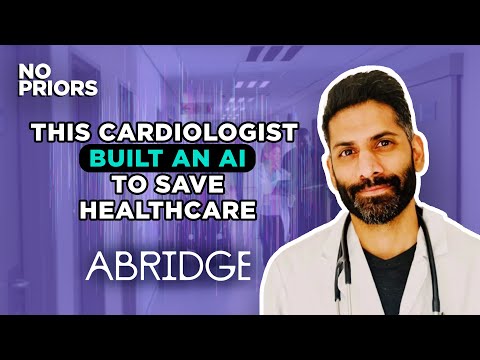
No Priors Ep. 108 | With Abridge Founder and CEO Shiv Rao, MD
Sarah Guo (host), Shiv Rao (guest), Elad Gil (host), Elad Gil (host), Sarah Guo (host)
In this episode of No Priors, featuring Sarah Guo and Shiv Rao, No Priors Ep. 108 | With Abridge Founder and CEO Shiv Rao, MD explores aI-powered medical notes relieve burnout and reshape healthcare’s front line Abridge founder and CEO (and practicing cardiologist) Shiv Rao explains how the company uses specialized speech recognition and generative AI to turn clinician–patient conversations into high‑quality clinical and billable notes in seconds, dramatically reducing documentation burden. He describes the post‑pandemic burnout crisis, why Abridge chose the hardest enterprise health-system segment first, and how trust, integrations, and research depth let them compete head‑to‑head with incumbents like Microsoft. Rao details Abridge’s technical stack—from multilingual, medical-grade ASR to orchestration of models for documentation, billing, and patient summaries—and how feedback at scale fuels continuous preference tuning. He also outlines the broader roadmap: automating orders, revenue cycle, clinical trial matching, and ultimately clinical decision support, while emphasizing the enduring centrality of human clinicians and patient agency.
AI-powered medical notes relieve burnout and reshape healthcare’s front line
Abridge founder and CEO (and practicing cardiologist) Shiv Rao explains how the company uses specialized speech recognition and generative AI to turn clinician–patient conversations into high‑quality clinical and billable notes in seconds, dramatically reducing documentation burden. He describes the post‑pandemic burnout crisis, why Abridge chose the hardest enterprise health-system segment first, and how trust, integrations, and research depth let them compete head‑to‑head with incumbents like Microsoft. Rao details Abridge’s technical stack—from multilingual, medical-grade ASR to orchestration of models for documentation, billing, and patient summaries—and how feedback at scale fuels continuous preference tuning. He also outlines the broader roadmap: automating orders, revenue cycle, clinical trial matching, and ultimately clinical decision support, while emphasizing the enduring centrality of human clinicians and patient agency.
Key Takeaways
Target high-frequency, lower-stakes workflows first to unlock adoption.
By focusing on documentation rather than direct diagnosis or treatment, Abridge found a high-impact wedge where clinicians remain in the loop, reducing perceived risk and accelerating enterprise adoption.
Get the full analysis with uListen AI
Depth in domain-specific models matters even when generic APIs exist.
Medical conversations require recognizing mispronounced drugs, specialty-specific jargon, and multiple languages; small error-rate differences in speech recognition can meaningfully affect both care quality and billing accuracy.
Get the full analysis with uListen AI
Enterprise healthcare sales hinge on simultaneously convincing CMIOs, CIOs, and CFOs.
Abridge framed its value as better clinician experience and quality (CMIO), robust integration and reliability (CIO), and measurable revenue and billing uplift (CFO), aiming to satisfy at least two of three to close initial deals.
Get the full analysis with uListen AI
Trust and ecosystem integration are as critical as raw model performance.
Becoming ‘core infrastructure’ for health systems required deep integrations (e. ...
Get the full analysis with uListen AI
Real-world edits are a powerful training signal for continuous improvement.
Millions of AI-generated notes are corrected by clinicians, providing rich feedback for preference tuning (DPO, reward modeling, RL), making the system progressively ‘less imperfect’ in specialty- and institution-specific ways.
Get the full analysis with uListen AI
Conversations are a foundational signal that can drive many downstream workflows.
Starting from the clinician–patient dialogue, Abridge can generate notes, orders, claims, after-visit summaries, trial matches, and eventually decision-support suggestions, all from the same upstream signal.
Get the full analysis with uListen AI
Clinician and patient agency are central to meaningful healthcare AI.
Rao frames success not just as productivity gains, but as restoring control over time for clinicians and making patients ‘main characters’ in their care via clearer documentation and accessible summaries.
Get the full analysis with uListen AI
Notable Quotes
“We’re not compensated as doctors for the care that we deliver. We’re compensated for the care that we documented that we deliver.”
— Shiv Rao
“We decided to run into the hardest part of the market… the barrier to ‘good enough’ is really, really high.”
— Shiv Rao
“If we go down, the entire health system goes down. They’re not making money anymore because these notes are essentially bills.”
— Shiv Rao
“No technology has ever done this in healthcare… we’re reducing cognitive burden by like 60% within six weeks and burnout by about 50%.”
— Shiv Rao
“I literally took my phone out and explained to him that Abridge is a new tool that lets Mommy come home early and eat dinner with her family.”
— Anonymous physician user (as recounted by Shiv Rao)
Questions Answered in This Episode
How should regulators and health systems evaluate and certify AI tools that affect both clinical quality and billing, given the high financial and patient-safety stakes?
Abridge founder and CEO (and practicing cardiologist) Shiv Rao explains how the company uses specialized speech recognition and generative AI to turn clinician–patient conversations into high‑quality clinical and billable notes in seconds, dramatically reducing documentation burden. ...
Get the full analysis with uListen AI
What guardrails are needed to ensure AI-generated documentation and decision support don’t entrench existing biases in diagnosis and treatment patterns?
Get the full analysis with uListen AI
As AI begins to suggest orders and differential diagnoses, how does the responsibility and liability balance shift between clinicians, vendors, and institutions?
Get the full analysis with uListen AI
In what ways could giving patients more direct access to AI-explained notes and summaries change the doctor–patient power dynamic—for better or worse?
Get the full analysis with uListen AI
How might the widespread adoption of tools like Abridge reshape medical training, clinical workflows, and the skills future clinicians are expected to master?
Get the full analysis with uListen AI
Transcript Preview
(instrumental music plays) Hi, listeners, and welcome to No Priors. This week, we're speaking to Shiv Rao, CEO and founder of Abridge, an AI company that processes medical conversations to unburden clinicians from clerical and financial work, allowing them to focus on patient care. A practicing cardiologist at UPMC, Dr. Rao has recently led Abridge to secure a 250 million dollar Series D raise. Join us as we explore how AI is transforming healthcare delivery. Shiv, welcome to No Priors.
So excited to be here. Thank you, Elan. Thank you, Sarah.
So Abridge has been around for about seven years. Um, can you tell us a little bit about how the company has evolved over time, what your starting point was, and what you're focused on now?
Yeah. Absolutely. So we started Abridge in 2018 so it's been a minute. And everything that we've been building since then is really based on the same thesis, so that hasn't changed. And the thesis for us in healthcare delivery is that we don't think doctors or nurses are gonna get fully automated over the next 10 years, and so w- what- what's the first signal in healthcare delivery? And we think it's a conversation. It's the, it's a dialogue between a professional and a patient, and we believe that those dialogues are really upstream of so many workflows in healthcare and- and that's where we focus. And so we focus on clerical work first, but then that's a sort of wedge for us to expand into any- any number of, like, different value propositions over time.
Could you tell us a bit, a little bit more about some of the products that you have currently and how people use them day to day and what sort of customers you work with? Just to give context to our listeners in terms of what business do you have and what do you focus on?
I guess, sort of starting at the top, what we do is we unburden clinicians from all the clerical work that crushes their souls at night, and a little bit more color on that, so two out of five doctors don't want to be doctors in the next two to three years, and 27% of nurses per a JAMA article that was published last year don't want to be nurses in the next 12 months. And so we have this crazy supply-demand mismatch. It's like, it's a really, it's public health emergency. Patients are having to drive five, six hours from rural health settings to see a clinician in an inner city setting that could save their life. And so we've got to do something up, about it, and I think that's where technology has a role that, uh, uh, is finally sort of being recognized and acknowledged at the highest level. Like, uh, uh, the entire healthcare industry understands now they- they- they just need to find a way to assist, augment, and automate any number of different workflows. And so where we come in is that we unburden clinicians from a lot of that clerical work that they hate to do so they can walk in a room, they can, you know, hit Abridge, have a normal conversation, and talk about any number of different topics in whatever order. But when they hit stop and swivel their chair, their note's there. But it's not the note that you might expect, you know, s- that my 14-year-old daughter could sort of create using, you know, an off-the-shelf model. It's a note that checks off all the different boxes across not just who the clinician is, what their specialty is, what system they're a part of, who this patient is, what insurance plan do they have, in what geography, not just like the clinical note but also what the billable note is, if that makes sense.
Install uListen to search the full transcript and get AI-powered insights
Get Full TranscriptGet more from every podcast
AI summaries, searchable transcripts, and fact-checking. Free forever.
Add to Chrome