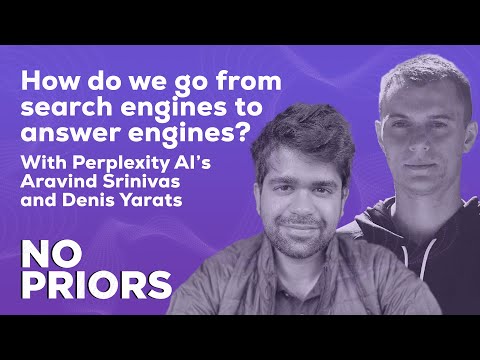
No Priors Ep. 9 | With Perplexity AI’s Aravind Srinivas and Denis Yarats
Sarah Guo (host), Aravind Srinivas (guest), Denis Yarats (guest), Elad Gil (host), Sarah Guo (host)
In this episode of No Priors, featuring Sarah Guo and Aravind Srinivas, No Priors Ep. 9 | With Perplexity AI’s Aravind Srinivas and Denis Yarats explores perplexity Founders Reimagine Search As Trustworthy Conversational Answer Engine Perplexity AI founders Aravind Srinivas and Denis Yarats discuss how they built a small, extremely fast-iterating team to create a citation-first, conversational search product aimed at becoming the most trusted information service.
Perplexity Founders Reimagine Search As Trustworthy Conversational Answer Engine
Perplexity AI founders Aravind Srinivas and Denis Yarats discuss how they built a small, extremely fast-iterating team to create a citation-first, conversational search product aimed at becoming the most trusted information service.
They emphasize hiring for raw drive and engineering excellence over prior ML/LLM pedigree, drawing on lessons from academia, OpenAI, DeepMind, and big-tech research cultures.
A core product philosophy is factual accuracy via mandatory citations and reinforcement learning from human feedback, positioning Perplexity as an 'answer engine' rather than a traditional link-based search engine.
They explore the future of search, likely monetization paths, the changing relationship with publishers, and offer advice to researchers choosing between academia, industry, and startups in today’s AI boom.
Key Takeaways
Speed of iteration is the core startup advantage over incumbents.
Perplexity’s founders deliberately built a tiny, highly capable team, prioritized fast experimentation, and avoided spreading efforts across too many products, recognizing that speed is their only durable edge against large search incumbents.
Get the full analysis with uListen AI
Hire for drive and general engineering excellence, not narrow LLM credentials.
They prioritize candidates with strong systems/engineering skills and a 'burning desire' to work on AI, often using trial work periods to assess fit, and explicitly reject the idea that only prior LLM experts can succeed in an AI-first company.
Get the full analysis with uListen AI
A citation-first design can fundamentally improve trust in AI answers.
Perplexity is built to never state facts it cannot cite, treating citations as foundational rather than an add-on, which both constrains hallucinations and gives users transparency into sources and the ability to prune irrelevant ones.
Get the full analysis with uListen AI
Answer engines will shift user behavior from link-clicking to consuming synthesized responses.
They expect search to evolve toward conversational, follow-up-rich 'answer engines' that surface a few high-quality sources, reduce tab overload, and increasingly perform actions on behalf of users.
Get the full analysis with uListen AI
Publisher incentives may realign around quality rather than SEO hacks.
Because LLMs assess semantic relevance, the founders believe high-quality content will be cited more than keyword-stuffed pages, potentially reducing classic SEO gaming and making citation ranking closer to academic-style PageRank.
Get the full analysis with uListen AI
Monetization likely comes after product-market fit, via multiple possible channels.
They outline options such as APIs, prosumer subscriptions (e. ...
Get the full analysis with uListen AI
For researchers, the biggest opportunities lie beyond incremental transformer work.
They advise aspiring academics either to pursue radically new architectures or domains (e. ...
Get the full analysis with uListen AI
Notable Quotes
“Iteration speed is the only thing you can hope for if you don’t yet know your product or market.”
— Aravind Srinivas
“Perplexity is a citation-first service; it’ll never say anything that it cannot cite.”
— Aravind Srinivas
“I would rather get somebody who has this burning desire to work on these things than somebody who already has a lot of experience.”
— Denis Yarats
“The companies that made the most progress over the last six years were the ones with extremely good engineers.”
— Denis Yarats
“It’s best to look for alternatives to the transformer; I would work on trying to write the next transformer paper.”
— Aravind Srinivas
Questions Answered in This Episode
How can Perplexity systematically detect and correct subtle aggregation errors, like merging information about different people with the same name?
Perplexity AI founders Aravind Srinivas and Denis Yarats discuss how they built a small, extremely fast-iterating team to create a citation-first, conversational search product aimed at becoming the most trusted information service.
Get the full analysis with uListen AI
What specific product features will most clearly differentiate Perplexity from a Google or Bing answer engine once they fully deploy LLM-based search?
They emphasize hiring for raw drive and engineering excellence over prior ML/LLM pedigree, drawing on lessons from academia, OpenAI, DeepMind, and big-tech research cultures.
Get the full analysis with uListen AI
How might Perplexity design an ad or monetization model that preserves trust and avoids the pitfalls of blending ads into core answers?
A core product philosophy is factual accuracy via mandatory citations and reinforcement learning from human feedback, positioning Perplexity as an 'answer engine' rather than a traditional link-based search engine.
Get the full analysis with uListen AI
In what ways could users be safely empowered to collaboratively correct or curate Perplexity’s answers without opening the door to manipulation or censorship?
They explore the future of search, likely monetization paths, the changing relationship with publishers, and offer advice to researchers choosing between academia, industry, and startups in today’s AI boom.
Get the full analysis with uListen AI
What radical post-transformer directions in AI architectures do the founders find most promising, and how might those affect Perplexity’s long-term roadmap?
Get the full analysis with uListen AI
Transcript Preview
(music plays) Arvin and Denis, welcome to the podcast.
Thank you for having us here.
Thanks.
Ah, thanks so much for joining. Um, so the two of you, alongside, um, Andy Chodakowski created Perplexity around August or so of 2022. Um, Arvin, do you wanna give us a little bit of a sense of why you started this company and what the core thesis of Perplexity is?
Yeah, sure. Actually, Elad, you're- you're our first ever investor who offered to invest in us so that was the founding days. Um, in fact, I remember the first ever idea we talked about in Noe Valley where we were sitting in the open space opposite Marta and I was telling you how it would be cool to have a visual search engine, the only way to disrupt Google was to not do text-based search but to actually do it from camera pixels, and you were like, "Uh, this is not gonna work."
(laughs)
"You need to think about distribution." And search was always the core motivation for Per- like, for me and Denis, and there's many others at the company. We were just bouncing around ideas then I was still at OpenAI around the time and then we lef- uh, left, and Denis also was still at Meta and he also left, and Andy came in to help us sort of, uh, inc-incorporate and get the company rolling. So that's sort of how the company started. The space of LLMs was exciting, generative- generative models were really exciting, and, uh, in general, we were motivated about search, whether it be gen- general search or vertical search, and we were bouncing around several different ideas. One of the ideas that you gave us was the working on text-to-SQL, uh, and like we were pretty excited about that and started prototyping ideas around that. And I think Denis also like was hacking with us on building like a Jupyter Notebook extension with like, uh, Copilot for every cell, um, and then we were trying it with, uh, SQL around databases. But it's all like a bunch of nonlinear pathways to eventually get to where we are right now.
Yeah, absolutely. And, uh, hopefully I caveated whatever feedback I gave with, I'm probably wrong, but since, uh, I think I'm often wrong on (laughs) -
No, I think, I think-
... a hundred percent. (laughs)
... whatever you said, whatever you said still applies. Uh, search is tremendously a distribution game as much as a technology game.
Yeah. I think one of the really impressive things about Perplexity is the rate of iteration. And to your point you've- you've gone through things like, um, text-to-SQL, Copilot for the next gen data stack, and I've always been impressed by how rapidly you've just been able to point in a direction, iterate really fast, prototype something, see if it's working, and then move on to the next thing. And, uh, to your- to your point, you always had search in the back of your mind. I remember even as you were prototyping these things you were talking about indexing aspects of Twitter or other sort of data feeds and then providing search on top of them. Um, how did you end up building a- a team that can iterate that rapidly as well as a culture of fast iteration? Like, are there specific things that- that you all do as a team to help- help reinforce that?
Install uListen to search the full transcript and get AI-powered insights
Get Full TranscriptGet more from every podcast
AI summaries, searchable transcripts, and fact-checking. Free forever.
Add to Chrome