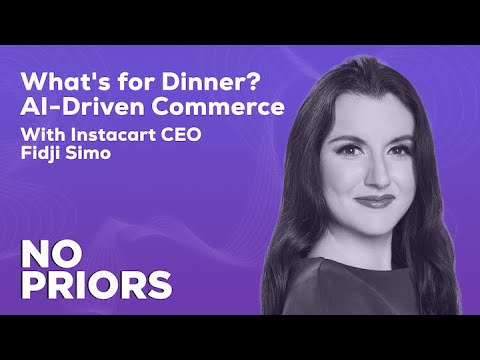
No Priors Ep. 22 | With Instacart CEO Fidji Simo
Sarah Guo (host), Fidji Simo (guest), Elad Gil (host)
In this episode of No Priors, featuring Sarah Guo and Fidji Simo, No Priors Ep. 22 | With Instacart CEO Fidji Simo explores instacart’s CEO on AI-Native Commerce, Leadership, and Curing Chronic Illness Fidji Simo, CEO of Instacart and co-founder of the Metrodora Institute, discusses her mission-driven career from eBay to Facebook to Instacart, and how authenticity underpins her leadership style.
Instacart’s CEO on AI-Native Commerce, Leadership, and Curing Chronic Illness
Fidji Simo, CEO of Instacart and co-founder of the Metrodora Institute, discusses her mission-driven career from eBay to Facebook to Instacart, and how authenticity underpins her leadership style.
She explains how Instacart evolved from a pandemic “darling” into core retail infrastructure, and details how the company is becoming AI-native across search, personalization, logistics, and in-store experiences like Caper smart carts.
Simo argues that generative AI is a paradigm shift that lets commerce match how people actually think and talk about food, turning grocery from a utility into an inspiring, intent-driven experience.
She also describes Metrodora’s work to integrate AI into diagnostics and research for neuroimmune disorders, criticizing premature AI “doomer” regulation that could slow critical medical progress.
Key Takeaways
Lead by combining very high standards with visible, personal support.
Simo sets clear expectations that she will push leaders hard while also backing them completely, creating psychological safety for ambitious people who want to do the best work of their careers.
Get the full analysis with uListen AI
Adopt AI by starting from customer problems, not from the technology.
Rather than building an “AI roadmap,” Simo asks teams which long-standing user problems can now be solved dramatically better with generative AI, ensuring AI use is pragmatic and value-driven.
Get the full analysis with uListen AI
Becoming AI-native requires rethinking core UX, not just bolting AI onto old flows.
Examples like putting natural-language ‘Ask Instacart’ directly into the sacred search box show how Instacart is willing to disrupt its own paradigms instead of treating AI as a side feature.
Get the full analysis with uListen AI
Use a hybrid AI org model: deep central expertise plus broad, federated adoption.
Instacart runs a central AI team under a chief architect while pushing every product and functional team to apply AI, supported by internal tools like their Ava assistant on GPT-4.
Get the full analysis with uListen AI
Real-world automation must clear an economics bar, not just a tech bar.
Simo notes that large automated warehouses and robots often fail because they worsen cost or delivery speed compared with leveraging existing stores and human shoppers close to customers.
Get the full analysis with uListen AI
Unique, well-structured data is a key long-term AI advantage.
Instacart’s rich product catalog and billions of purchase signals, combined with large language models, enable differentiated experiences and will underpin future platform offerings that turn digital intent into physical delivery.
Get the full analysis with uListen AI
AI can radically shorten the bench-to-bedside gap in healthcare.
At Metrodora, Simo is using AI in genomics, pathology, and immune profiling to improve diagnostics and research, aiming to shrink the 14-year lag between scientific discovery and clinical practice.
Get the full analysis with uListen AI
Notable Quotes
“I always say that I am a pragmatic technologist. I love technologies that solve real problems for real people.”
— Fidji Simo
“It felt like a lot of effort and work not to be you. I’d much rather put that effort into building amazing products.”
— Fidji Simo
“We have forced humans to train themselves to express their commerce needs in the form of keywords.”
— Fidji Simo
“Being AI-native is going to require really rethinking from the ground up how you use these technologies, not trying to fit them within your existing paradigm.”
— Fidji Simo
“There is actually a 14-year delay between a new research discovery and that impacting the clinic. That’s absolutely maddening.”
— Fidji Simo
Questions Answered in This Episode
How do you measure whether Instacart has truly become an “AI-native” company versus just using AI features?
Fidji Simo, CEO of Instacart and co-founder of the Metrodora Institute, discusses her mission-driven career from eBay to Facebook to Instacart, and how authenticity underpins her leadership style.
Get the full analysis with uListen AI
What tradeoffs or failures have you encountered when trying to replace legacy product paradigms with AI-first experiences?
She explains how Instacart evolved from a pandemic “darling” into core retail infrastructure, and details how the company is becoming AI-native across search, personalization, logistics, and in-store experiences like Caper smart carts.
Get the full analysis with uListen AI
How do you think about data governance and privacy as Instacart increasingly relies on its unique customer and retailer data for AI?
Simo argues that generative AI is a paradigm shift that lets commerce match how people actually think and talk about food, turning grocery from a utility into an inspiring, intent-driven experience.
Get the full analysis with uListen AI
What concrete changes in clinical outcomes would convince you that AI has meaningfully reduced the 14-year lab-to-clinic gap at Metrodora?
She also describes Metrodora’s work to integrate AI into diagnostics and research for neuroimmune disorders, criticizing premature AI “doomer” regulation that could slow critical medical progress.
Get the full analysis with uListen AI
Looking ahead 5–10 years, how might autonomous agents handling routine shopping reshape Instacart’s product, revenue model, and ad ecosystem?
Get the full analysis with uListen AI
Transcript Preview
(music plays) Welcome to No Priors. Today, we're speaking with Fidji Simo, the CEO of Instacart, the leading grocery technology company, and co-founder of the Metadora Institute, whose mission is to cure neuroimmune access disorders. She's also the former leader of the Big Blue App, Facebook. Instacart is transforming the way we shop, making it possible for millions of busy people to get the groceries they need from the retailers they love. We're really excited to explore Fidji's refounding of Instacart, their use of AI, and the impact of AI on commerce and healthcare. Fidji, welcome to No Priors.
Thanks for having me, Sarah and Yared.
Let's start with some personal background. You've been a, uh, star leader in technology for a long time, from strategy at eBay to meteoric rise, um, to product and eventually beloved leader of Facebook, and now CEO of Instacart. That is a wide range of different things. What's driven your career decisions?
Well, that's a- that's a hard question to start with. I think it sounds cliché but it was all about where could I have impact on problems I deeply cared about. And, uh, I always say that I am a pragmatic technologist. And what I mean by that is that I love technologies that solve real problems for real people, and, uh, eBay was a good example of that. You know, when I joined the company, uh, I was kind of in love with this idea of like all of these, like, communities of collectors exchanging goods but really exchanging their passion, and I- I was fascinated by that. And then, you know, my transition to Facebook was very similar. I was an immigrant in the US and I was starting to see that it was so much easier to stay in touch with my family, uh, back in France thanks to Facebook. And then transitioning to Instacart was kind of similarly about the mission. You know, I thought the idea of connecting people, uh, to the retailers they love so that they can enjoy, uh, the foods they love and- and spend more time with their family was so critical, and food is, you know, one of the most important things in our lives. And so it felt like I could have a big impact there as well.
Yeah, amazing. Um, I, uh, remember what an impression you made on me when we first met when you were at Facebook. Like, you are very French, you wear lipstick and heels, um, you've led some of the most iconic products and companies in the tech world, but you don't, uh, subscribe to some of the, let's say, Silicon Valley monoculture, and you were clearly very conscious of that. Like, why is that important to you? Or how do you think about, um, like, cultural image and how you present as a leader?
Well, you know, (laughs) um, I've been French since I was born. (laughs) I have been, uh, wearing lipstick and high heels since I was 12. So, it is such a big part of me that it was never a conscious decision, it was just about being me. And then when I arrived in Silicon Valley, a lot of people were commenting on that, and I was, like, really surprised because, you know, that was just me being me. And they were telling me, "Well, you know, especially as you move into product development, you really need to blend in with the engineers, so, like, remove the makeup, tie up your hair, start wearing a hoodie." And I did that for one day at Facebook. No one recognized me. I would pass in the hallways, no one would say hi.
Install uListen to search the full transcript and get AI-powered insights
Get Full TranscriptGet more from every podcast
AI summaries, searchable transcripts, and fact-checking. Free forever.
Add to Chrome